
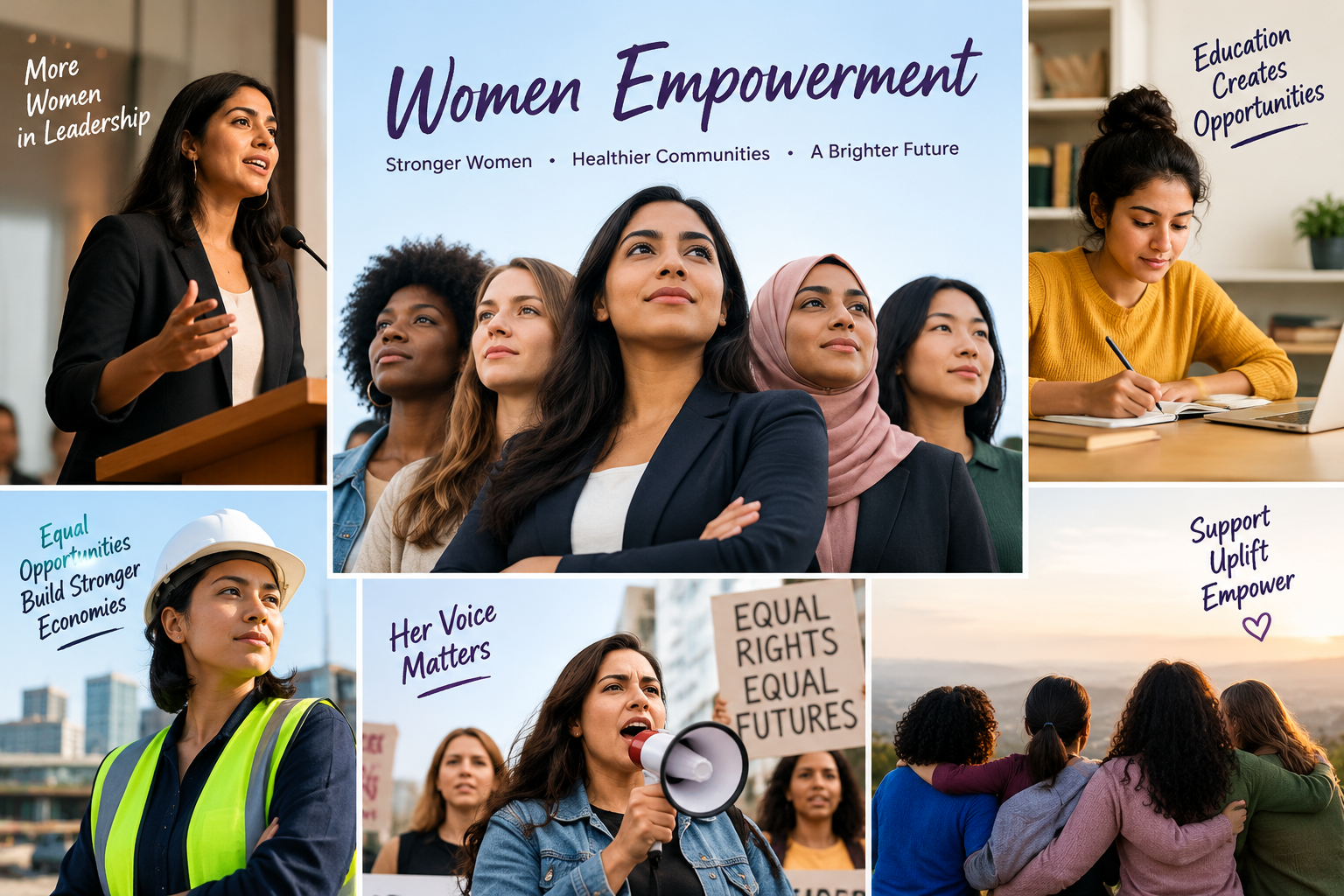
True freedom means more than succeeding within existing systems. It means having a voice in shaping the institutions and decisions that govern one’s life.
By Nadia Sterling
For decades, women’s empowerment has been presented as a defining ambition of modern society. Women are encouraged to pursue education, build careers, establish businesses, and claim positions of influence once considered beyond their reach. Their achievements are celebrated as evidence of progress, and their stories often become symbols of what ambition and determination can accomplish.
Yet an important question remains: how meaningful is empowerment when the structures surrounding women have not evolved at the same pace?
A woman may possess ambition, talent, education, and financial independence, yet still encounter barriers shaped by social expectations, institutional practices, and unequal access to power. She may be encouraged to succeed while simultaneously being expected to navigate systems that were not designed with her autonomy in mind.
The conversation around women’s empowerment must therefore move beyond individual achievement. It must examine who receives opportunity, whose concerns are taken seriously, and who is held accountable when authority fails.
Empowerment is not simply about helping women rise. It is also about questioning the structures that make their rise unnecessarily difficult.
The Architecture of Power
Power is not limited to political office, corporate leadership, or financial influence. It also exists within workplaces, educational systems, legal frameworks, businesses, and social institutions. These structures influence who receives opportunities, whose voices carry weight, and how responsibility is distributed.
When women remain underrepresented in leadership, the issue extends beyond individual ambition. It raises questions about access, professional advancement, and the cultures in which leadership develops.
An institution may welcome women into its workforce while retaining practices that limit their influence. It may celebrate diversity while leaving its decision-making structures largely unchanged.
A meaningful conversation about women’s freedom must therefore consider not only who has the opportunity to succeed, but who has the authority to shape the rules.
Freedom becomes more meaningful when women are not merely participants in institutions, but contributors to the decisions that govern them.
Beyond Empowerment
Women’s empowerment is often presented as the ability to become stronger, more confident, and more independent. Freedom goes further: it is the ability to make decisions without unnecessary restrictions imposed by social pressure, institutional barriers, or unequal expectations.
A woman may be encouraged to pursue a career, yet still face expectations that she should prioritise traditional responsibilities over professional ambition. She may be celebrated for her independence, yet questioned when her choices challenge established norms.
These contradictions reveal the difference between being encouraged to succeed and being genuinely free to choose.
Empowerment can become an individual responsibility, placing the expectation on women to become more resilient, more adaptable, and better equipped to overcome obstacles. Freedom, however, requires a broader environment in which choices are respected and opportunities are not unnecessarily constrained.
The objective should not simply be to teach women how to overcome barriers. It should also be to examine why those barriers continue to exist.
Accountability: The Missing Dimension
Society often emphasises how women should respond to challenges. They are advised to be cautious, resilient, prepared, and adaptable. They are encouraged to protect their reputations, navigate difficult environments, and learn how to overcome adversity.
Institutional accountability asks a different question: what responsibility do institutions and individuals have to ensure women are treated fairly in the first place?
A culture of accountability requires clear standards, transparent procedures, responsible leadership, and meaningful consequences when those standards are violated. It also requires rejecting the assumption that the burden of managing inequality should fall primarily on those who experience it.
This principle is especially important in institutions that hold significant influence over people’s lives. Leadership is not simply a position of authority; it carries a responsibility to establish environments where individuals can participate with dignity and confidence.
Women’s empowerment cannot reach its full potential if responsibility remains unevenly distributed.
Women in Leadership: Beyond Representation
The presence of women in leadership is an important measure of progress, but representation alone does not transform an institution.
Leadership becomes meaningful when individuals have the authority to influence decisions, challenge established practices, and contribute to long-term change.
A woman occupying a senior position should not simply be viewed as a symbol of progress. Her leadership should be understood through the decisions she can make, the influence she holds, and the institutional environment in which she operates.
The next stage of progress requires moving beyond visibility towards meaningful participation in power.
It also requires creating environments where women can lead without being expected to conform to narrow expectations of how leadership should look or behave.
Financial Independence and Women’s Economic Empowerment
Financial independence is one of the foundations of personal autonomy. The ability to earn, invest, own property, build a business, and make independent financial decisions can expand the choices available to women.
It can influence where they live, what careers they pursue, how they plan their futures, and how they respond to uncertainty.
But women’s economic empowerment should not be reduced to earning a salary. It also involves access to capital, financial knowledge, professional networks, ownership, and opportunities to build lasting wealth.
For women who become entrepreneurs, investors, and business leaders, financial independence can become a source of influence beyond their personal lives. It can enable them to shape businesses, create opportunities for others, and contribute to the institutions that influence society.
Wealth, in this context, is not merely a measure of individual success. It can also provide the resources and agency to make decisions independently and participate in shaping the future.
The Responsibility of Institutions
Institutions are not merely structures of authority. They are also custodians of trust.
Whether in business, education, governance, or the legal system, institutions shape the conditions in which individuals exercise their rights and pursue opportunities.
Their responsibility is not fulfilled simply by declaring a commitment to gender equality. It requires practices that support fairness, transparency, professional integrity, and accountability.
A workplace, for example, must do more than encourage women to pursue leadership. It must examine whether its culture, promotion practices, and systems of responsibility support that ambition.
Similarly, public institutions must ensure that policies and protections are not only established but implemented effectively.
The credibility of an institution is ultimately reflected in the alignment between its stated principles and its actual conduct.
From Individual Achievement to Institutional Change
The achievements of successful women deserve recognition. Women who establish businesses, lead organisations, build wealth, and influence public life demonstrate what ambition and opportunity can make possible.
Yet individual success should not become the only measure of progress.
A society cannot rely solely on exceptional individuals to overcome systemic barriers. The more meaningful measure is whether opportunity becomes accessible to a wider range of women, whether institutions become more accountable, and whether freedom becomes less dependent on personal privilege.
Progress is not simply about how many women manage to succeed despite the obstacles. It is also about whether the obstacles themselves are being reconsidered.
Freedom as a Measure of Progress
The future of women’s empowerment will not be defined solely by motivational language, public recognition, or individual achievement. It will be shaped by the institutions that distribute opportunity, the leaders who exercise authority, and the systems that hold power accountable.
A woman’s freedom should not depend on her ability to navigate every barrier placed before her. It should be supported by an environment in which her choices are respected, her opportunities are meaningful, and her rights are protected.
The next chapter of empowerment must therefore move beyond encouragement and towards responsibility.
True freedom is not simply the ability to succeed within existing structures. It is the ability to participate in shaping those structures and to live without having one’s autonomy treated as a privilege that must continually be earned.