
The House of Saud finds itself at a precipice where the weight of desert history meets the cold, calculated precision of late-stage capitalism. For decades, the Al Saud dynasty maintained a social contract written in the black ink of crude oil, a quiet, lucrative arrangement that transformed nomadic sands into a global filling station. However, under the stewardship of Crown Prince Mohammed bin Salman (MBS), the Kingdom is undergoing a metamorphosis that transcends mere economic reform. It is the restructuring of a nation-state into a corporate entity, a “Saudi Inc.” where the monarch is the CEO, the citizens are stakeholders, and the dividends are survival in a post-carbon world.
The Psychology of Absolute Sovereignty
To understand the current trajectory of the Kingdom, one must first appreciate the historical gravity of the Al Saud lineage. This is not a family that merely governs; they are the state. The name of the country itself bears their patronymic. Traditionally, power was distributed through a delicate consensus among aging princes, a gerontocracy that favored stability over speed.
However, the rise of MBS signaled the end of the consultative era. He recognized that in an era of rapid technological disruption, a nation moving at the speed of a desert caravan would inevitably be buried by the dunes of time. His approach is rooted in a Darwinian realization: the Public Investment Fund (PIF) is no longer just a rainy-day fund; it is the primary engine of a geopolitical pivot. By centralizing power, he has stripped away the layers of royal bureaucracy, replacing them with a streamlined, vertical command structure that mirrors a Silicon Valley boardroom more than a traditional Diwan.
The Corporate State: Efficiency Over Tradition
The “Vision 2030” manifesto is often discussed in the media as a series of architectural fever dreams, NEOM, The Line, the Red Sea Project. But for the elite observer, these are not merely buildings; they are “Minimum Viable Products” (MVPs) on a continental scale. The House of Saud is pivoting from a rentier economy to one based on investment returns and intellectual capital.
The strategy is twofold:
- Liquidation of the Old Guard: The dismantling of the religious police and the easing of social restrictions are not merely liberal pursuits; they are economic imperatives to unlock a domestic entertainment market and attract foreign talent.
- Aggressive Diversification: Through the PIF, the Kingdom has acquired stakes in everything from electric vehicles to professional golf. This is a portfolio-managed foreign policy.
As noted in recent analyses by the Financial Times, this transition requires a ruthless level of efficiency. In this new paradigm, dissent is viewed not as a political right, but as “friction” in the system, an inefficiency that the corporate state seeks to eliminate to maintain investor confidence.
The Dark Luxury of Neom: A Sovereign Aesthetic
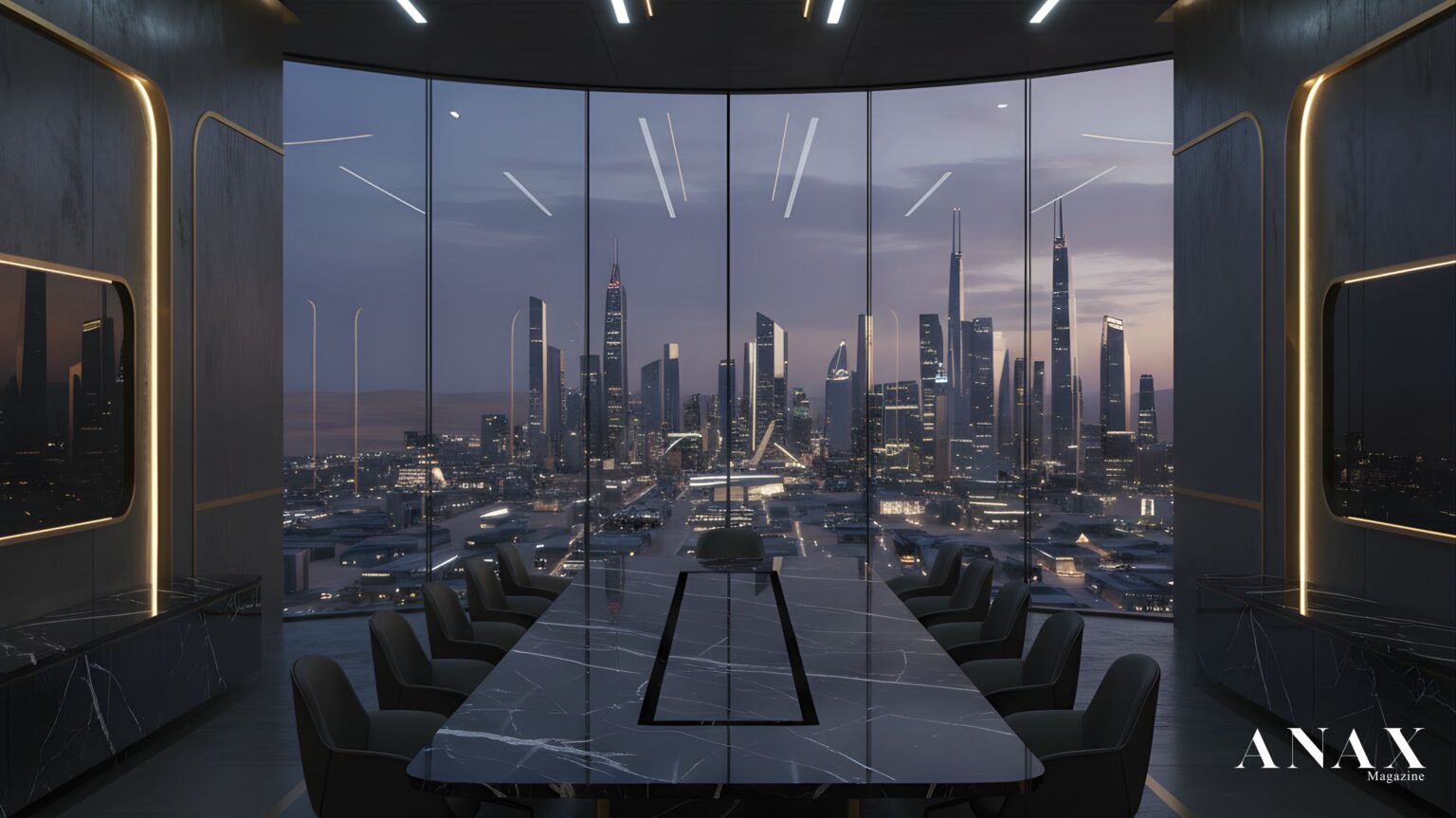
In the pages of Anax Magazine, we often discuss the intersection of power and aesthetic. The House of Saud’s new vision is draped in “Dark Luxury”—a blend of brutalist efficiency and hyper-futurism. The aesthetic of NEOM, with its mirrored walls and hidden cities, reflects a desire for total control over the environment. It is the ultimate expression of sovereign will: the ability to command the desert to reshape itself into a global hub of tech and tourism.
This shift has deep psychological implications for the Saudi identity. The transition from “Subject” to “Employee/Consumer” requires a new national myth. No longer is the citizen merely a recipient of oil wealth; they are now urged to be “innovators” and “entrepreneurs.” It is a top-down cultural revolution that seeks to replace the lethargy of the oil boom with the frantic energy of a startup.
“Power is not a static asset; it is a liquid one. If it does not flow and evolve, it evaporates.” — Anax Editorial Observation.
Legacy and the Shadow of the Future
The risk, of course, is the “Key Man” dependency. Much like a corporation tied too closely to a charismatic but volatile founder, the House of Saud’s current trajectory is inextricably linked to the persona of MBS. For the global elite and sovereign investors who frequent Metropolitan India for insights on emerging markets, the question remains: Can a thousand-year-old monarchy truly sustain a hyper-modern corporate structure without losing its soul?
The legacy of the Al Saud family has always been one of survival through adaptation. From the first Saudi state in the 18th century to the unification in 1932, they have navigated tribal warfare and global conflict. The current “Trillion-Dollar Vision” is simply the latest, and perhaps most audacious, iteration of that survival instinct.
The Verdict: A Sovereign Monopoly
The House of Saud is no longer playing the game of thrones; they are playing the game of global markets. By treating the Kingdom as a corporate entity, they have successfully decoupled their future from the volatile price of a barrel of Brent crude. They are building a world where the Saudi brand is synonymous with luxury, technology, and absolute stability, a “Sovereign Monopoly” that the rest of the world cannot afford to ignore.
As we look toward the mid-century, the success of this vision will depend on whether the corporate structure can withstand the inevitable pressures of social change. For now, the Al Saud family remains the ultimate architects of a new world order, proving that in the desert, power is the only resource that never truly runs dry. For further exploration of elite shifts in the Middle East, readers should consult the latest dossiers at The Nation ME.
The Al Saud Horizon
The metamorphosis of the House of Saud is perhaps the most significant geopolitical experiment of the 21st century. It is a gamble of breathtaking proportions, a bet that a traditional monarchy can leapfrog into the future by sheer force of capital and will. Whether this results in a utopian corporate paradise or a gilded cage remains to be seen. What is certain, however, is that the desert is no longer just a source of energy; it is the laboratory for the future of sovereign power.