
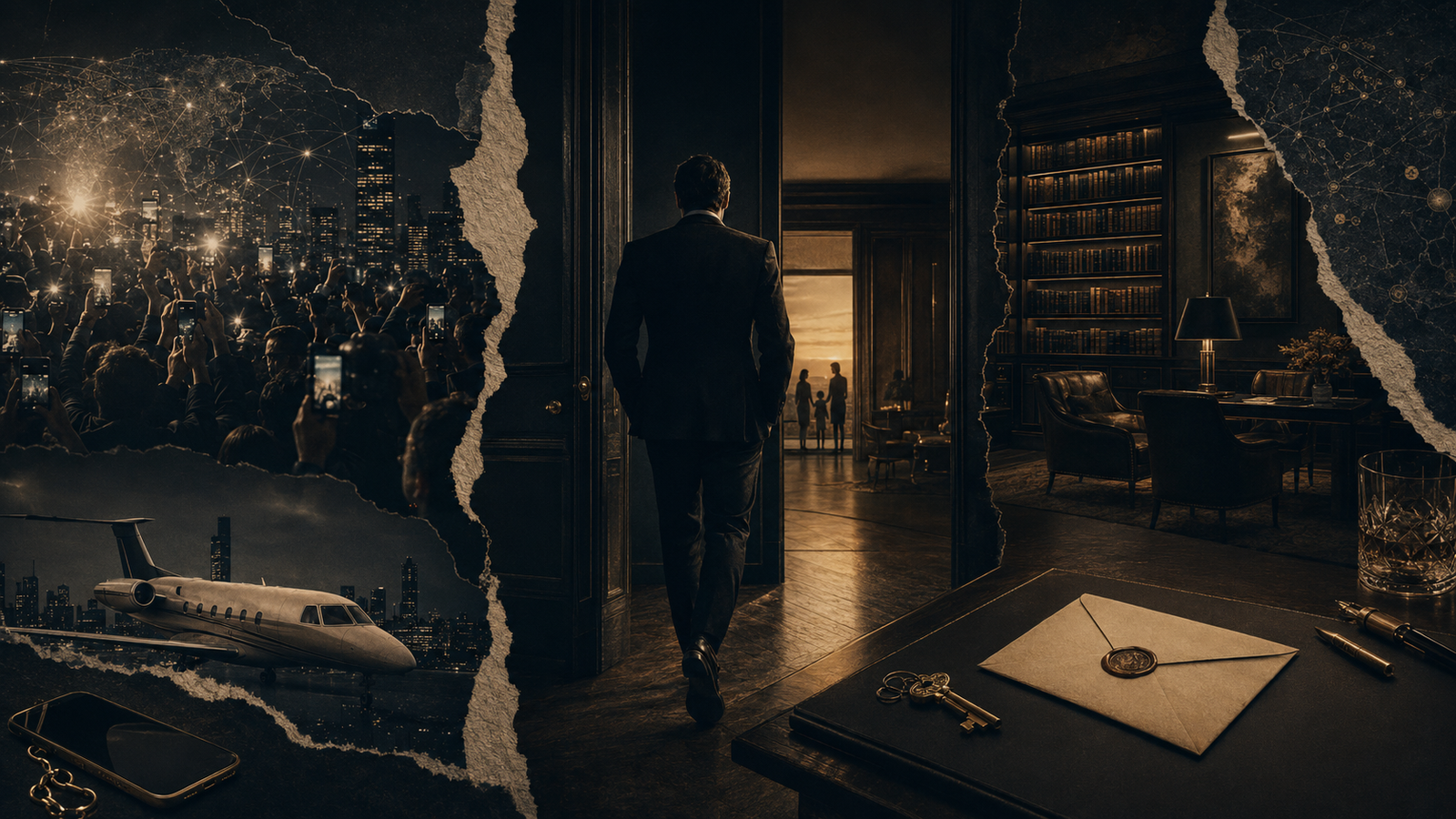
In an age that rewards constant visibility, the ability to remain private has become one of power’s rarest privileges.
For most of the modern luxury era, status was designed to be seen.
The house stood behind impressive gates, but its architecture appeared in magazines. The car announced itself before arriving. The watch was recognisable across a dinner table. Invitations, holidays and social associations became evidence of belonging to a world unavailable to most people.
Visibility confirmed arrival.
Today, the meaning of status is beginning to reverse.
The most protected individuals are becoming harder to find. Their homes are not easily photographed. Their journeys do not appear in real time. Their children possess little or no searchable digital history. Their family offices reveal almost nothing. Their most valuable relationships exist beyond public platforms.
They still use technology, private aviation, global finance and sophisticated services. But they increasingly seek access to the modern world without being completely exposed to it.
Brand strategist Eugene Healey has described this privilege as “connected privacy”: the ability to benefit from digital systems while participating selectively enough to avoid surrendering excessive personal information. Recent Financial Times reporting identified this form of controlled invisibility as an emerging status symbol among the super-wealthy.
This is not simply a digital detox.
It is not a weekend without a telephone or a temporary retreat from social media.
It is the deliberate construction of a life in which visibility can be chosen rather than demanded.
The newest luxury is no longer being seen everywhere.
It is possessing the freedom to disappear.
Visibility Was Once Proof of Power
For generations, wealth depended partly on recognition.
Landowners displayed estates. Industrialists placed their names on buildings. Royal families used ceremony, architecture and dress to make hierarchy visible. Later, celebrities and entrepreneurs transformed private consumption into public theatre.
The luxury industry understood this instinct.
Its most recognisable products allowed status to be read instantly. A particular car, bag, watch or postcode communicated financial position without explanation.
Social media intensified that logic.
Success was no longer merely owned; it was documented. Private flights, homes, restaurants and holidays became content. Personal visibility could create commercial influence, attract opportunity and strengthen a public profile.
For founders and ambitious professionals, this exposure often produced genuine value.
A visible leader could build trust with customers, attract investors, recruit talent and transform a personal story into a business asset. Publicity became infrastructure.
But exposure accumulates.
The more searchable a person becomes, the less control they retain over how their life is interpreted. A photograph can reveal location. A family post can identify relationships. A property feature can expose layout and security. A child’s school, routine or social circle can become discoverable through fragments shared by different people.
Visibility creates opportunity.
It also creates vulnerability.
Why Privacy Has Become Expensive
Privacy appears free because silence costs nothing.
Real privacy, however, requires resources.
It may require secure residences, legal structures, trusted employees, cybersecurity specialists, discreet travel, private healthcare, controlled communications and the ability to avoid systems that ordinary life makes compulsory.
Most people cannot simply disappear.
Their careers depend on being searchable. Their businesses rely on digital discovery. Their professional networks exist online. They use public transport, shared buildings, mainstream booking systems and services that collect personal information as a condition of convenience.
For the wealthy, withdrawal can be professionally engineered.
Assistants can communicate on their behalf. Family offices can coordinate travel, property and administration. Private banks can manage complex transactions. Security teams can examine exposure. Lawyers can control records, ownership structures and requests for information.
A person with sufficient financial and social capital can remain influential without maintaining a visible profile.
Their reputation travels privately.
Introductions happen through trusted relationships.
Opportunities reach them without algorithms.
This is the deeper meaning of connected privacy. The privilege is not merely being offline. It is possessing enough influence that disappearing does not make one irrelevant.
The Digital Footprint Has Become a Private Liability
Every online interaction leaves fragments.
Names, photographs, addresses, professional histories, property information, family relationships and travel patterns may exist across company filings, social platforms, data brokers, news archives and public databases.
Individually, each fragment may appear harmless.
Together, they can create a map.
For prominent families, this map may expose more than reputation. It can reveal routines, relationships and physical vulnerability. That is why digital security is becoming inseparable from personal security.
The modern threat is not only that confidential information will be stolen.
It is that publicly available information can be assembled, interpreted and used in ways its owner never intended.
A photograph uploaded by one family member may contradict another person’s effort to remain private. A property listing may disclose an interior long after the transaction is complete. A corporate biography may reveal connections that were never meant to become socially visible.
The wealthy are therefore beginning to treat data as they once treated land, art or financial capital:
as something that requires active custody.
The objective is no longer simply to avoid embarrassment.
It is to maintain sovereignty over identity.
The Home Is Becoming a Sanctuary Again
The modern luxury home was once expected to perform publicly.
It appeared in architectural publications, social photographs and carefully produced tours. Its value was amplified by recognition.
That preference is changing.
For a growing number of affluent owners, the home’s greatest quality is not how impressively it can be shown but how completely it can protect the people inside.
Recent reporting describes wealthy homeowners investing heavily in biometric access, secure rooms, advanced surveillance, perimeter systems and professionally designed defensive infrastructure. These measures are being driven by concerns about crime, social-media exposure and the ease with which personal information can be gathered.
The architectural language of prestige is therefore shifting.
A dramatic entrance may matter less than controlled access.
A famous address may matter less than an unremarkable approach.
A panoramic glass wall may be reconsidered if it reveals too much.
Privacy influences where the house stands, how vehicles enter, how employees move, where guests are received and which parts of the residence can be photographed.
The home returns to its oldest luxury function:
not performance, but refuge.
Private Travel Is No Longer Only About Comfort
Private aviation has traditionally represented speed, flexibility and prestige.
Its contemporary appeal increasingly includes something more fundamental: control over exposure.
Private terminals reduce crowds. Tailored schedules limit waiting. Passenger information is managed within a smaller network. Transfers can be planned around security rather than public convenience.
The same logic is reshaping luxury hospitality.
Ultra-wealthy travellers are increasingly selecting villas, secluded estates and fully staffed private residences instead of highly visible hotels. A 2026 report cited by Business Insider found that 86% of luxury travellers considered privacy and seclusion important when choosing accommodation, while 83% valued exclusivity of access.
Luxury dining is also moving inward.
Recent reporting found growing demand among wealthy American households for private chefs, driven partly by privacy, flexibility, personalisation and security. The most valuable restaurant may now be the dining room no outsider can enter.
These choices are not necessarily anti-social.
They are selective.
The wealthy still travel, entertain and experience the world. They increasingly prefer environments in which the guest list, timing, service and level of exposure remain under their control.
The product is not only comfort.
It is the removal of unpredictability.
The New Status Symbol Is Controlled Access
Traditional luxury was based on ownership.
Contemporary private luxury is increasingly based on access—and the ability to restrict it.
A public luxury experience can be purchased by anyone who meets the price.
A private experience is valuable because not everyone can reach it, discover it or reproduce it.
This changes the meaning of exclusivity.
The important restaurant may have no visible reservation system.
The most desirable gathering may never appear on social media.
The family retreat may not be marketed.
The adviser may accept clients only through trusted introductions.
The individual at the centre may be known deeply by a few people while remaining almost invisible to everyone else.
This is not obscurity.
It is controlled relevance.
The difference matters.
An obscure person lacks access because no one knows them.
A private person may possess significant access while choosing who is allowed to know them.
That choice is power.
The Family Office as a Privacy Architecture
The family office is usually described through investment management, tax coordination, succession and philanthropy.
Increasingly, it also functions as an architecture of privacy.
It separates the family from unnecessary exposure by centralising communication, screening access and managing sensitive information. It can ensure that commercial requests, media enquiries, invitations and personal approaches do not reach family members directly.
The strongest family offices create distance without creating isolation.
They enable the family to remain connected to markets, institutions and society while limiting uncontrolled contact.
This requires judgement.
Excessive secrecy can create suspicion, weaken public trust and distance the family from legitimate accountability. Insufficient privacy can expose personal relationships, strategic decisions and security vulnerabilities.
The purpose is not to hide everything.
It is to distinguish between what the public has a legitimate reason to know and what belongs to the family alone.
Privacy becomes governance.
Children Are Becoming the Centre of the Privacy Question
Wealthy adults may choose visibility.
Children cannot fully understand its permanent consequences.
A photograph published in childhood can remain searchable for decades. School information, family homes, travel patterns and social relationships may become part of a digital identity before the child has developed the capacity to consent.
For prominent families, this creates an unusually difficult responsibility.
Parents must decide whether public visibility strengthens the family’s cultural presence or compromises the child’s future freedom.
Some choose complete absence.
Others permit controlled appearances during formal occasions while avoiding everyday exposure.
The principle is increasingly clear:
A child should inherit the right to define their own public identity.
This may become one of the most valuable forms of privilege a family can preserve.
Previous generations inherited property, titles and institutions.
The next generation may also inherit something rarer:
an unclaimed digital self.
Discretion Is Becoming a Form of Education
Privacy cannot be maintained through technology alone.
It requires culture.
Children raised within influential families must understand that access carries responsibility. They need to know why photographs should not always be shared, why locations should not be published in real time and why private conversations should remain private.
This is not merely security training.
It is social education.
Discretion teaches that not every experience becomes more meaningful when displayed. It separates memory from proof. It allows relationships to exist without an audience.
In traditional elite environments, discretion was often transmitted through unwritten codes.
One did not repeat private conversations.
One did not photograph certain rooms.
One did not use proximity to powerful people as public currency.
Social media weakened many of those boundaries because platforms reward disclosure.
The private family must now teach restraint actively.
Why the Powerful Are Reducing Public Luxury
Conspicuous consumption carries new reputational risks.
Economic inequality is highly visible. A single image can travel globally without context. Displays that once communicated achievement may now be interpreted as detachment, insecurity or provocation.
At the Financial Times luxury summit in 2026, Bain partner Claudia D’Arpizio reportedly identified wealth polarisation and growing inequality as major risks facing the luxury sector.
This does not mean affluent consumers have stopped purchasing extraordinary products.
It means some are changing how those products are used.
The most valuable object may remain inside a private residence.
The rarest watch may be worn only among people who understand it.
The family may continue travelling exceptionally while avoiding public documentation.
Luxury becomes intimate.
Its purpose shifts from signalling success to improving the quality, autonomy and texture of private life.
The object no longer needs to perform for strangers.
The Difference Between Privacy and Secrecy
Privacy and secrecy are often treated as interchangeable.
They are not.
Privacy protects legitimate personal boundaries.
Secrecy conceals information that others may have a legitimate right to know.
A family has a right to protect its children, residence and private relationships.
A public company cannot use privacy as an excuse to avoid disclosure obligations. A political actor cannot treat accountability as intrusion. A financial structure cannot claim discretion when its true purpose is evasion.
This distinction is essential to the future of elite privacy.
The more powerful a person becomes, the more their decisions may affect employees, investors, communities and institutions.
Their personal life can remain protected.
Their public responsibilities must remain visible.
True discretion does not eliminate accountability.
It prevents curiosity from being mistaken for entitlement.
Disappearance Can Also Become Performance
Even invisibility can be turned into status theatre.
A person may carefully advertise that they do not use social media. A brand may market secrecy so aggressively that privacy becomes another visible aesthetic. Neutral clothes, unlisted locations and restricted events can become symbols as recognisable as logos.
This is the paradox of modern luxury:
Once discretion becomes desirable, it becomes marketable.
But styled privacy is not the same as actual freedom.
A person may wear understated clothing while sharing every detail of life online. A hotel may call itself secluded while encouraging constant documentation. A “private” event may exist largely to produce photographs proving who attended.
Real privacy is less decorative.
It is measured by control.
Can the individual choose when to be reachable?
Can they move without immediate documentation?
Can family life exist beyond commercial content?
Can they refuse public participation without damaging their social or professional position?
If the answer is yes, privacy is not an aesthetic.
It is power.
The Luxury of Being Unavailable
Modern life expects immediate response.
Messages arrive continuously. Calendars remain visible. Professional platforms reveal activity. Silence is interpreted as delay, weakness or disinterest.
Power changes this expectation.
The most influential person may not respond immediately because their attention is protected by people, systems and boundaries.
Unavailable does not mean inactive.
It means access has been organised.
This is perhaps the greatest difference between ordinary withdrawal and elite disappearance.
For most people, becoming unreachable can create economic risk.
For the powerful, controlled unavailability can increase perceived value.
Their time is filtered.
Their presence is deliberate.
Their attention is not available by default.
The rarest luxury is therefore not simply possessing time.
It is controlling who may interrupt it.
Privacy Is the Ownership of Context
The most damaging effect of exposure is not always the release of information.
It is the loss of context.
A photograph, comment or relationship can be detached from its original meaning and reinterpreted by strangers. The subject loses authority over the narrative.
Privacy protects context.
It allows a conversation to remain within the relationship that gave it meaning. It allows a family moment to remain a memory rather than become content. It allows an uncertain idea to develop before being judged publicly.
This is especially important for leaders.
Real decision-making requires the freedom to question, change position and explore incomplete thoughts. Constant visibility encourages performance rather than reflection.
A person who is always watched begins managing the appearance of certainty.
A person with protected space can think.
The Return of the Inner Circle
As public networks expand, trusted circles are becoming smaller.
The future of influence may not belong to the person with the largest audience but to the one with the strongest private network.
These circles are built through reliability.
Members do not publish every meeting. They do not turn friendship into proof of status. They understand that access survives only when it is handled carefully.
For prominent individuals, the inner circle becomes an emotional and strategic refuge. It provides honest conversation beyond public performance.
The people inside may include family members, long-serving advisers, physicians, lawyers, spiritual counsellors, security specialists and friends with no commercial agenda.
Their value cannot be measured by visibility.
It is measured by trust.
Disappearance Is Not Withdrawal from the World
The desire for privacy should not be mistaken for the abandonment of public life.
The most responsible form of private power remains engaged.
It supports institutions, employs people, invests, gives, advises and contributes. It simply refuses to transform every contribution into personal spectacle.
A family can fund education without turning beneficiaries into content.
A founder can mentor privately.
An investor can shape industries without becoming a constant public personality.
A person can participate deeply while revealing selectively.
Disappearance, in this sense, is not absence.
It is the separation of contribution from performance.
The Future of Luxury Will Be Designed Around Protection
Luxury businesses have historically specialised in visibility, rarity and personalisation.
They will increasingly need to specialise in protection.
Hotels will be judged by how discreetly they manage arrivals and guest data.
Property developers will integrate privacy into architecture rather than add security after completion.
Travel advisers will design journeys around exposure as well as convenience.
Banks, family offices and professional firms will treat information boundaries as part of client experience.
Brands will need to understand that their most valuable customers may not want to appear in campaigns, public events or social media content.
The challenge will be delivering recognition without exposure.
Service will become more silent.
The best experience may be the one the wider world never learns occurred.
Beyond Visibility
The age of display is not ending.
There will always be people who enjoy public luxury, visible achievement and cultural recognition. Visibility can still create influence, opportunity and celebration.
But another status system is emerging beside it.
In this system, wealth is measured by the ability to protect attention.
Luxury is measured by the absence of intrusion.
Influence is measured by access to private conversations rather than public audiences.
Freedom is measured by whether a person can step away without disappearing from consequence.
The powerful individual of the future may remain digitally connected, globally mobile and institutionally influential.
But their private self will be increasingly difficult to reach.
Their home will not become a set.
Their family will not become a public archive.
Their every movement will not be offered to the algorithm.
The world may know what they have built without knowing everything about how they live.
That boundary is becoming one of wealth’s most sophisticated achievements.
Because in a civilisation that asks everyone to be permanently visible, the ultimate privilege is no longer being recognised wherever one goes.
It is deciding when the world is allowed to see you at all.