
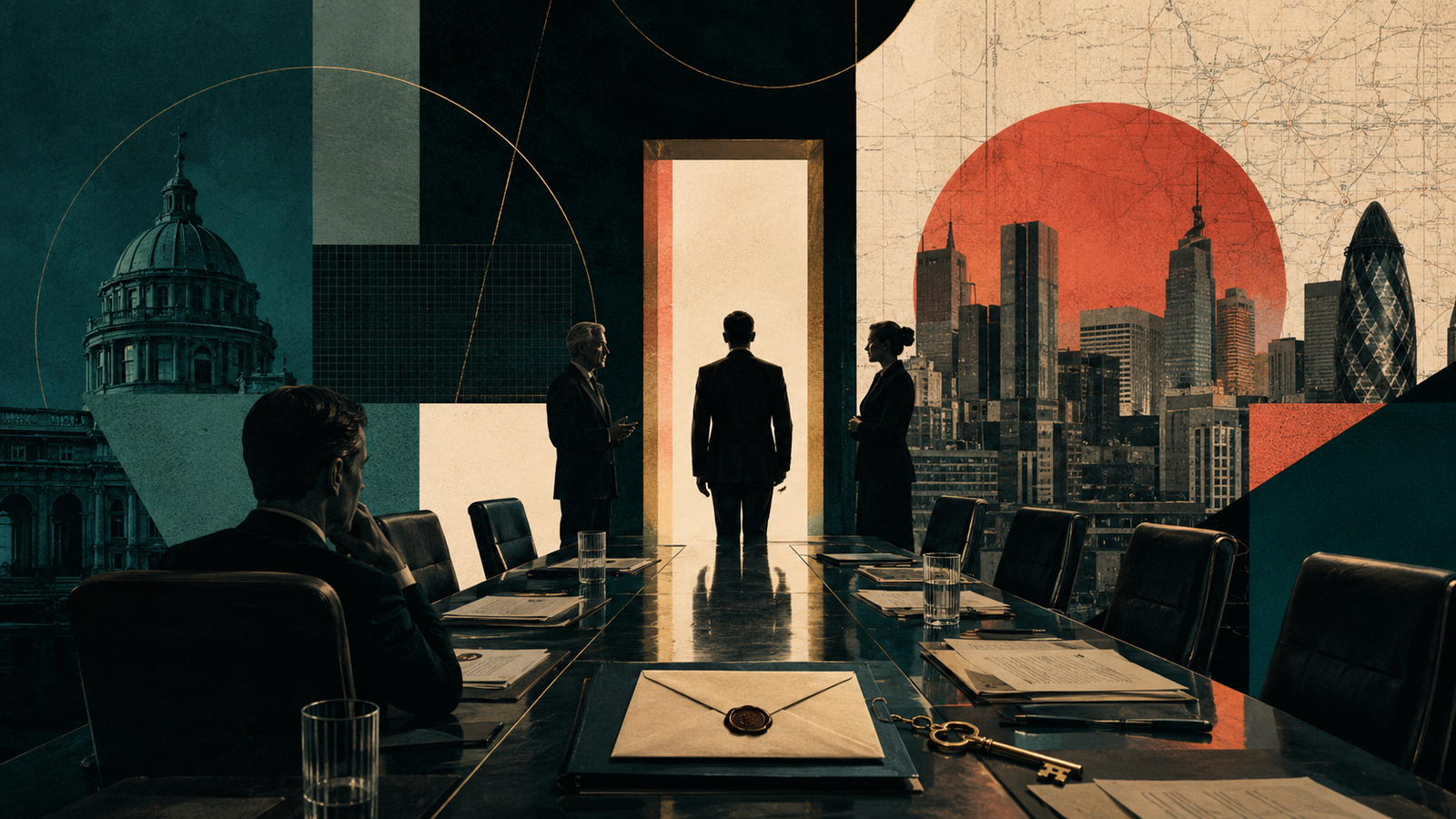
Power is often imagined as something public. In reality, its most consequential moments usually happen behind closed doors.
The rooms themselves are rarely accidental.
A long table. Controlled light. Thick walls. Few objects. No unnecessary movement. Sometimes a private library. Sometimes a silent office above a city. Sometimes a drawing room inside a family residence where the future of a company, an estate or an entire generation is discussed in voices barely raised above conversation.
These are not merely expensive interiors.
They are environments designed for judgement.
The public sees the announcement: an acquisition, a succession, an investment, a political alliance, a new market, a family settlement or the appointment of a new leader. What it does not see is the room in which hesitation was tested, loyalties were measured and the final decision became inevitable.
Power may be displayed in public.
But it is usually exercised in private.
The Architecture of Serious Decisions
There is a reason important decisions are rarely made in noisy spaces.
The mind behaves differently when the environment demands restraint. A private room removes interruption. It slows conversation. It allows silence to become part of the discussion rather than something that must immediately be filled.
In ordinary meetings, people often speak to prove they are participating.
In consequential meetings, the strongest person may be the one willing to wait.
The room supports that discipline.
A large boardroom table can create order. A private office can establish hierarchy. A circular seating arrangement can reduce it. A library can introduce the psychological presence of history. A window overlooking a city may remind those inside of scale. A windowless room may remove the outside world entirely.
Every design choice affects behaviour.
The distance between two chairs determines intimacy. The position of a desk signals authority. The placement of documents controls attention. Even the decision to serve coffee immediately—or only after the central issue has been discussed—can shape the rhythm of a conversation.
The most powerful rooms are not always the most decorative.
They are the ones in which nothing competes with the decision.
Why Privacy Changes the Quality of Thought
Public figures are required to perform certainty.
In private, they are allowed to think.
This distinction matters because many of the world’s most important decisions begin in ambiguity. The available information is incomplete. The risks are uneven. The consequences may not be understood for years.
A leader cannot examine those uncertainties honestly if every sentence is being recorded, interpreted or immediately leaked.
Privacy creates space for intellectual vulnerability.
It allows a founder to admit that a market is changing faster than the organisation can respond. It allows an heir to question whether inherited systems are still working. It allows an investor to say that a celebrated opportunity feels wrong. It allows family members to discuss conflict without converting it into public weakness.
This is why powerful families, sovereign institutions and long-term investors protect confidential conversation so carefully.
Privacy is not always secrecy.
At its highest level, it is the condition required for honest judgement.
The Private Office as an Extension of the Mind
A private office often reveals more about a leader than a public profile ever could.
Some offices are almost empty. Their owners think through reduction. They want only what is essential: a desk, a chair, a notebook, perhaps one significant object.
Others are dense with books, documents, photographs and evidence of accumulated relationships. Their owners think through memory. They surround themselves with context.
Some leaders display awards. Others display none.
Some keep photographs of public achievements. Others keep a single private image that reminds them who they were before power arrived.
The office is not simply where work occurs. It is often where identity is organised.
A founder’s office may contain the earliest product, the first contract or a photograph of the original team. A family patriarch may keep handwritten correspondence from the generation before him. A chief executive may display a map rather than a portrait, signalling that expansion matters more than recognition.
These objects function as anchors.
They remind decision-makers of what must not be forgotten when scale, pressure and ambition begin to distort perspective.
Libraries: Where Power Consults the Dead
Among the most revealing spaces in any influential household or institution is the private library.
A library is not powerful because it contains expensive books. It is powerful because it places the present inside a longer timeline.
Every major decision can feel unprecedented to the person making it. History corrects that illusion.
Empires have expanded too quickly before. Families have divided over inheritance before. Businesses have mistaken temporary popularity for permanent strength before. Leaders have confused loyalty with agreement before.
Books allow the living to consult the judgement, errors and experiences of those no longer present.
This is why libraries have long belonged to statesmen, industrialists, financiers, monarchs and family leaders. They are rooms in which authority is reminded of its own limitations.
A library changes the emotional quality of ambition.
It asks: Has this happened before? What did others fail to see? What survives when the personality at the centre is gone?
The decision-maker who enters a library seeking confirmation may leave with doubt.
That doubt can be valuable.
The Boardroom and the Performance of Authority
Unlike the private office, the boardroom is designed for collective power.
It is where individual conviction must survive institutional scrutiny.
The boardroom table carries symbolic weight because it brings competing forms of authority into one space: ownership, management, legal responsibility, financial expertise, family influence and independent judgement.
Every person may have a seat, but not every voice has equal power.
The founder may speak last because everyone is waiting for approval. The independent director may speak first to prevent the discussion from becoming ceremonial. The next-generation family member may remain quiet, knowing that one careless intervention will be interpreted as entitlement.
The strongest boards understand these invisible dynamics.
They do not confuse politeness with alignment. They do not allow a celebrated leader to become intellectually untouchable. They create conditions in which disagreement is permitted before commitment is required.
A weak boardroom confirms what the leader already believes.
A strong boardroom improves the decision before the organisation must live with it.
The Family Room Where Business Becomes Personal
Not every billion-dollar decision takes place inside a corporate headquarters.
Some happen at home.
A family residence can become the true centre of ownership, particularly when questions of succession, trusts, inheritance or long-term control arise.
These conversations are uniquely difficult because business roles and family roles overlap.
A chairperson may also be a father. A shareholder may also be a sibling. A potential successor may still be treated as the youngest child in the room. A disagreement over strategy can reopen resentments that began decades earlier.
In such spaces, the official agenda is rarely the only agenda.
A conversation about leadership may also be about parental approval. A discussion about shareholding may also be about fairness. A proposal to bring in professional management may be interpreted as a rejection of the family itself.
This is why enduring families learn to create emotional distance before making institutional decisions.
They establish rules. They involve advisers. They define who is speaking as an owner, who is speaking as a director and who is speaking as a family member.
The objective is not to remove emotion.
It is to prevent emotion from quietly controlling decisions that will affect generations.
Why the Most Important Person May Not Sit at the Head of the Table
Traditional ideas of power focus on visible hierarchy.
The head of the table. The largest office. The most prominent title.
But real influence often operates more subtly.
The person with the deepest knowledge may control the direction of the discussion without speaking often. A trusted adviser may reshape a decision through a single private conversation before the meeting begins. A family matriarch may have no executive title but possess the moral authority required to resolve conflict.
In some rooms, the most important person is the one everyone looks toward after the formal leader speaks.
This is one reason outsiders often misunderstand powerful institutions. Organisational charts show responsibility. They do not always show influence.
Sophisticated leaders recognise this difference.
Before entering an important room, they ask not only, “Who has authority?”
They ask, “Whose confidence must be earned? Who carries memory? Who can delay the decision? Who can make agreement durable?”
The visible meeting may be only one layer of the real negotiation.
The Objects That Carry Authority
Certain objects repeatedly appear in rooms where serious decisions are made.
A pen placed beside a document. A sealed folder. A clock. A family photograph. A map. A ledger. A model of a building. A ceremonial object inherited from a previous generation.
Their importance is not always practical.
They create meaning.
A signed document turns discussion into obligation. A map converts ambition into geography. A portrait introduces the judgement of the past. A family emblem reminds everyone that the institution existed before those currently sitting around the table.
In legacy environments, objects often function as silent participants.
They reinforce continuity.
A successor may occupy the founder’s office but use a different desk. A board may preserve the original table while modernising everything around it. A family may display the first handwritten account book beside a digital investment dashboard.
These contrasts tell a story.
The institution is changing, but it has not forgotten where it began.
Silence as a Form of Power
The ability to tolerate silence is one of the clearest distinctions between ordinary conversation and consequential conversation.
Silence creates pressure.
It forces people to reveal more than they intended. It prevents weak arguments from being rescued by speed. It allows emotion to settle before a commitment is made.
Experienced negotiators understand that the first person to break silence often gives away information.
Experienced leaders use silence differently. They use it to think.
After a proposal is presented, a powerful chairperson may wait. Not to intimidate, but to separate initial reaction from considered judgement. A family leader may pause before responding to an heir, ensuring that disappointment does not become a permanent decision.
Silence also protects dignity.
In private rooms, people can reconsider without being publicly defeated. They can alter their position without appearing weak. They can admit uncertainty without losing authority.
The best rooms make this possible.
Decisions Are Often Made Before the Meeting
Formal meetings create the record.
Informal conversations often create the outcome.
A walk through a private garden. A short exchange before dinner. A late-night discussion between two family members. A call between the chairperson and a trusted adviser. A quiet conversation in an anteroom before everyone else arrives.
These moments matter because people speak differently outside official structure.
They test ideas without committing to them. They reveal concerns they would not raise in front of the full group. They explore whether support exists before risking a public proposal.
This does not necessarily mean the process is dishonest.
In many institutions, pre-meeting dialogue is how complexity is managed. It ensures that the formal discussion does not collapse under surprise, ego or unresolved misunderstanding.
The danger arises when every meaningful decision is made outside the room and the meeting becomes theatre.
Strong governance preserves a distinction:
Preparation may happen privately.
Accountability must still happen formally.
The Room Must Be Capable of Disagreement
A beautiful room cannot produce a strong decision if everyone inside it is afraid.
Fear can be created by personality, ownership, reputation or precedent. Once people believe that disagreement carries personal cost, the quality of information deteriorates.
Bad news is softened. Risks are understated. Doubt disappears from presentations. Leaders begin receiving only the version of reality that protects the comfort of the room.
This is how institutions become vulnerable while believing they are aligned.
The strongest decision-making spaces are psychologically demanding but intellectually safe.
People are expected to prepare. Their arguments must withstand scrutiny. They may be challenged. But they are not punished for presenting an unwelcome fact.
A leader’s real authority is not demonstrated by how quickly the room agrees.
It is demonstrated by whether the room can disagree honestly and still leave united.
From Decision to Consequence
When the meeting ends, the room becomes quiet again.
The chairs are pushed back. Papers are collected. The final participants leave. From the outside, nothing appears to have changed.
But somewhere inside that meeting, a future may already have been chosen.
A company may be sold. A market may be entered. A family member may be selected—or passed over. A foundation may receive its mandate. A historic building may be preserved. An institution may begin the transition from founder-led control to professional leadership.
The decision becomes visible only later.
By then, the public sees the result, not the hesitation that preceded it.
This is one of the great illusions of power: that decisions are made with certainty.
In reality, many are made with incomplete knowledge by people carrying responsibility for outcomes they cannot fully predict.
The room does not remove that burden.
It gives the burden a structure.
The Private Geography of Power
The world’s most consequential rooms share no single architectural style.
Some are historic. Some are modern. Some are lavish. Some are almost austere.
What connects them is purpose.
They are designed to contain attention, protect privacy and establish the seriousness of what is being considered.
They remind everyone inside that decisions are not merely expressions of preference. They are acts of responsibility.
The best rooms do not make their occupants feel important.
They make them feel accountable.
That is why the spaces behind power matter.
A billion-dollar decision is never only financial. It affects workers, cities, families, reputations, institutions and people who will never know where the decision was made.
The room may be private.
The consequences rarely are.
And perhaps that is the final truth hidden behind closed doors:
Power is not defined by having access to the room.
It is defined by understanding the weight of what must be decided once you enter it.