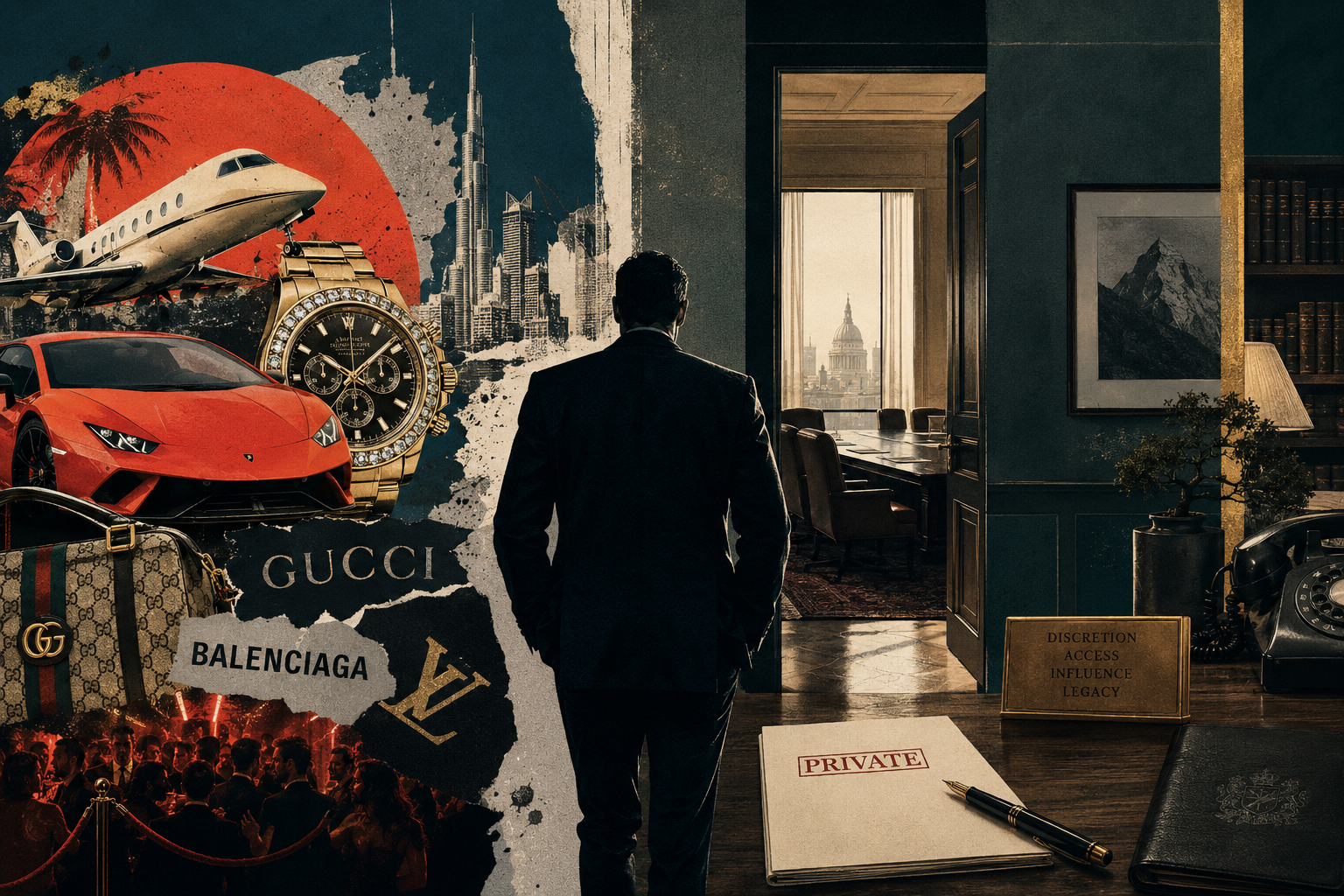
The loudest signs of wealth are often designed for attention. The deepest forms of power are designed to survive without it.
There is a particular kind of person who can enter a room without announcing themselves and still alter its atmosphere.
They may not wear the largest watch. Their car may not be the most visibly expensive. Their clothes may appear almost plain. They do not need to remind others of whom they know, where they have been or what they own.
Yet people notice when they speak.
Doors open before they ask. Introductions arrive without effort. Their name carries weight in rooms they have never entered. Their influence is not dependent on display because it has already been absorbed into institutions, relationships and reputation.
This is the difference between visible wealth and established power.
Wealth can be shown.
Power is usually recognised.
The newly successful often feel compelled to make achievement legible. They want the world to see that something has changed. The truly powerful have moved beyond that stage. They no longer need symbols to create status because status has become structural.
They are protected by discretion, access, credibility and time.
And that is why the most powerful people rarely look the richest.
Wealth Seeks Recognition. Power Seeks Control.
Wealth and power are related, but they are not identical.
Wealth is ownership: capital, property, businesses, investments and assets.
Power is the ability to shape outcomes.
A wealthy person may be able to purchase entry into a room. A powerful person can influence what happens once everyone is inside it.
A wealthy person may attract attention. A powerful person may decide where attention is directed.
This distinction explains why conspicuous luxury can sometimes signal less authority than it appears to.
Visible consumption is designed to communicate. It says: I have arrived. I can afford this. I belong here.
Power does not always need to communicate. It already operates through networks, institutions and people who understand its significance.
The owner of a highly recognisable object may still be seeking validation from strangers. The person whose decisions affect markets, companies or governments has little reason to persuade the street.
The first relies on visibility.
The second relies on consequence.
The Psychology of Having Nothing to Prove
Display often grows from uncertainty.
When identity is newly formed, it requires reinforcement. Success feels more real when it can be seen by others. Objects become evidence.
A luxury car confirms achievement. A recognisable logo communicates membership. A public table in the most photographed restaurant becomes a stage.
There is nothing inherently wrong with this. Symbols have always helped societies communicate rank, taste and belonging.
But the psychology changes when status is secure.
People born into established influence or those who have exercised power for decades are less likely to need constant external confirmation. Their sense of position is not created each morning through clothing, possessions or public recognition.
They know where they stand.
This can produce a kind of visual restraint.
Their wardrobe may repeat the same silhouettes. Their home may be extraordinary but hidden. Their travel may be highly comfortable yet designed to avoid attention. Their social life may occur in private spaces rather than visible venues.
The absence of display is not necessarily modesty.
It can be confidence.
The Uniform of Quiet Authority
Powerful people often dress in ways that appear simple from a distance and highly considered at close range.
The suit is cut correctly, but the label is invisible.
The fabric is exceptional, but it does not shout.
The shoes are maintained, not decorated.
The watch may be historically significant, personally meaningful or technically rare, yet unrecognisable to most observers.
This is not anti-luxury.
It is luxury without explanation.
The most sophisticated style is often based on fit, material, continuity and context rather than brand recognition. A bespoke jacket communicates differently from one covered in monograms. The first rewards knowledge. The second rewards visibility.
Quiet authority prefers recognition by the right people rather than recognition by everyone.
That preference shapes dress.
A person in a position of genuine power must also move across environments. They may meet investors in the morning, advisers at lunch, family members in the afternoon and public officials in the evening. Clothing must support authority without becoming the subject.
The ideal wardrobe does not dominate the room.
It allows the person to do so.
Why Logos Become Less Useful at the Top
Logos perform a valuable social function.
They allow strangers to identify price, aspiration and group membership quickly. They reduce the need for specialist knowledge.
But at the highest levels of wealth, obvious logos can become limiting.
They communicate that the wearer wants the object to be recognised. This introduces a question: is the object being enjoyed, or is it being used to produce a reaction?
Established power is often suspicious of anything that appears to seek approval.
Its preferred signals are more difficult to decode: fabric, provenance, tailoring, access, heritage, craftsmanship and discretion.
This does not mean powerful people avoid brands. Many use the finest houses in the world. The difference lies in how those brands are worn.
The mark is secondary.
The relationship is primary.
A suit may come from a tailor known by generations of the same family. A piece of jewellery may be inherited. A bag may be selected for function and quality rather than immediate recognition. A watch may mark an event no one else needs to understand.
The object becomes private language.
Private Luxury Is Different from Public Luxury
Public luxury is designed to be seen.
Private luxury is designed to improve life.
The distinction is significant.
Public luxury includes objects and experiences with high visual recognition: cars, jewellery, fashion, restaurants and highly photographed destinations.
Private luxury often takes quieter forms: time, privacy, security, health, space, trusted staff, seamless travel, access to expertise and control over one’s environment.
A person may wear an understated coat while employing the finest medical advisers.
They may drive an unremarkable vehicle in the city while owning highly valuable land.
They may avoid public nightlife while maintaining residences designed for private hospitality.
At a certain level, convenience becomes more valuable than spectacle.
The ability to avoid queues, interruptions and unwanted attention may matter more than being recognised. The quality of sleep, the reliability of a team or the privacy of a conversation may be treated as greater luxuries than any public object.
The richest-looking person in a room may own the most visible things.
The most powerful may own the conditions in which the room exists.
Discretion Protects More Than Image
For powerful individuals, attention carries risk.
Visibility can attract admiration, but it can also attract scrutiny, resentment, security concerns, unwanted requests and pressure on family members.
This is why discretion is often practical rather than performative.
The less people know about personal routines, residences, relationships and movements, the easier it is to protect autonomy.
Old families understand this instinctively. Their privacy may be preserved through architecture, staff, habit and social codes developed over generations.
Self-made leaders often learn it later.
At first, publicity can support growth. A founder’s profile may attract investors, talent and customers. But as influence expands, exposure becomes more complicated. Every personal detail can be interpreted as a corporate signal. Every social interaction may be treated as access.
The leader begins to withdraw not because they have become less important, but because importance has made privacy more valuable.
Power creates reasons to be seen.
It also creates stronger reasons to disappear.
The Difference Between Access and Admission
Visible wealth can purchase access to many places.
Power determines whether that access becomes meaningful.
A person may buy a table at a gala. That does not mean the most important conversation will happen at that table.
They may enter a private club. That does not mean they belong to the trust networks operating inside it.
They may attend the conference. That does not mean they are invited to the smaller dinner afterwards.
The hierarchy of influence is built through layers of admission.
Public rooms are broad. Private rooms are selective. The most consequential networks are often based not on wealth alone, but on reliability, discretion and usefulness.
This is why truly powerful people rarely need to perform importance. Their value is already known within the circles that matter to them.
They do not chase every introduction.
Their relationships have been built over time.
In established networks, restraint becomes a credential.
A person who speaks too freely, photographs too often or turns every encounter into public proof may be considered unsuitable for deeper access.
The ability to keep a room private is often the price of being invited back into it.
Influence Is Most Powerful When It Is Indirect
The most visible person is not always the most influential.
Power often works through intermediaries.
An adviser places a call. A family office changes an allocation. A board member raises a concern. A trusted friend introduces two people. A quiet shareholder signals support or resistance.
The public may never see the origin of the outcome.
This indirectness makes power difficult to measure.
Public culture tends to reward the person at the centre of the image. Institutions often depend on those outside it.
A family matriarch may hold no formal executive role yet influence the selection of a successor. A long-serving adviser may shape major decisions without appearing in announcements. A private investor may affect an industry through capital allocation while remaining unknown beyond a small professional circle.
Such people rarely need to look rich because their power does not depend on being identified by the public.
It depends on being understood by the right decision-makers.
Old Wealth Thinks in Generations, Not Moments
Conspicuous consumption is often tied to the present.
It captures a moment of achievement: the new contract, the exit, the promotion, the sudden rise.
Established wealth usually thinks across longer periods.
A family managing assets across generations cannot build its identity around every peak and fall. Markets change. Public taste changes. Political environments change. The family name must survive all of them.
This longer horizon encourages restraint.
An object that appears fashionable today may look excessive tomorrow. A public statement that attracts admiration now may create difficulty later. A lifestyle built entirely around visibility can become impossible to sustain without continuous performance.
Old wealth often prefers continuity.
The same house, maintained rather than replaced.
The same tailor, visited across decades.
The same institution, supported quietly.
The same principles, adapted carefully.
This does not mean old wealth is always wiser, more ethical or less extravagant. It simply tends to understand that reputation is cumulative.
Every public act becomes part of a longer record.
Taste Becomes a Form of Intelligence
At the highest level, luxury is not defined only by price.
It is defined by selection.
The ability to choose well requires knowledge. It means understanding proportion, craftsmanship, context, history and suitability.
Anyone can purchase an expensive object if they possess sufficient money.
Not everyone can understand why one object matters more than another.
This is where taste becomes a form of intelligence.
A powerful person may select a lesser-known work by an important artist instead of the most recognisable piece. They may restore a historic building rather than build a larger one. They may commission furniture designed specifically for a room instead of purchasing what is currently fashionable.
The choice is not made for instant approval.
It reflects discernment.
True taste often becomes quieter as it becomes more developed because it no longer relies on consensus. It does not need the crowd to confirm that something is valuable.
It knows.
The Luxury of Repetition
One of the most misunderstood signs of power is repetition.
The same navy suit.
The same style of shirt.
The same restaurant table.
The same holiday destination.
The same house used for decades.
To an outsider, repetition can look ordinary. To a powerful person, it can represent control.
Familiarity reduces unnecessary decision-making. Trusted environments protect privacy. Established routines create efficiency. Repeated choices remove the need to perform novelty.
People with limited control over their lives often seek change as a form of freedom.
People with enormous responsibility may seek consistency as a form of protection.
This is why some of the most influential figures adopt personal uniforms. Their clothing does not need to entertain them or others. It needs to perform reliably.
The repetition itself becomes a signal.
Nothing is being proved.
When Understatement Becomes Strategy
Understatement is not always natural.
Sometimes it is carefully managed.
Leaders understand that visible excess can weaken trust. A chief executive announcing restructuring while displaying extravagant consumption may appear detached. A political figure surrounded by luxury may create distance from the public. A family office seeking discretion may avoid anything that reveals the scale of its resources.
Presentation therefore becomes strategic.
A powerful individual may choose simplicity because it reduces friction. People speak more openly around them. Negotiations become less theatrical. Attention remains on the issue rather than the person.
Understatement can also create ambiguity.
When others cannot immediately measure a person’s wealth, they must evaluate character, knowledge and behaviour. This can be useful. It prevents the interaction from being defined entirely by financial status.
The person retains information.
And information, like privacy, is power.
The Danger of Mistaking Appearance for Substance
Modern culture is highly visual.
It teaches people to estimate success through immediate cues: clothing, cars, homes, holidays and followers.
These cues can be persuasive, but they are unreliable.
Visible luxury may be financed by debt. Public influence may be rented through attention. A highly recognisable lifestyle may have little institutional foundation beneath it.
Meanwhile, substantial wealth may sit inside private companies, land, trusts, long-term holdings and relationships that produce no obvious image.
The danger is not merely that we misjudge individuals.
We also begin to misunderstand power itself.
We assume that power must be charismatic, visible and constantly expressed. In reality, many durable forms of power are procedural, legal, financial and relational.
They exist in ownership documents, voting rights, board appointments, trusted networks and institutional memory.
None of these photographs particularly well.
Yet they shape the world more consistently than display ever could.
Quiet Power Is Not Silence
Understatement should not be confused with passivity.
The most powerful people may speak rarely, but when they do, their words carry consequences.
They may avoid public conflict while acting decisively in private.
They may refuse to advertise loyalty while protecting people and institutions over decades.
They may appear detached from competition because they are playing a different game.
Quiet power is not the absence of ambition.
It is ambition no longer dependent on applause.
It does not seek to win every visible moment. It seeks to protect position, preserve options and shape long-term outcomes.
That is why it can appear calm.
The urgency has moved elsewhere.
What the Truly Powerful Display
Powerful people do display things.
But the things they display are often different.
They display composure under pressure.
They display control over emotion.
They display the ability to listen without surrendering authority.
They display loyalty to people who have earned it.
They display continuity in how they treat staff, advisers and family.
They display judgement through the decisions they refuse to make.
These signals are less immediate than luxury objects, but they are more valuable.
Anyone can wear a recognisable symbol.
It is far more difficult to build a reputation for discretion, consistency and sound judgement.
Such reputations take years to create and moments to destroy.
This is why people with real power often guard conduct more carefully than appearance.
Their behaviour is the luxury others cannot purchase.
Beyond the Performance of Wealth
The desire to look successful is understandable.
The world is more responsive to what it can see. Presentation can open doors, create credibility and communicate achievement.
But appearance has limits.
It can attract attention without producing trust. It can signal wealth without creating influence. It can create recognition without establishing relevance.
The most powerful people understand this distinction.
They may enjoy extraordinary objects, spaces and experiences, but they do not require those things to introduce them.
Their identity is carried by what they have built, protected, decided and enabled.
They do not need every room to know who they are.
Only the important ones.
And when they enter those rooms, their power is rarely visible in the expected places.
It is not in the logo on the jacket.
It is in the chair someone has kept for them.
It is not in the price of the watch.
It is in the time others are willing to give them.
It is not in the car waiting outside.
It is in the call that will be answered before they leave.
Wealth may decorate a life.
Power determines its range.
And the people who possess the deepest forms of it often understand something the rest of the world is still learning:
The strongest status symbol is no longer needing to display one.