How ceremonial gifts, cultural symbolism and carefully chosen objects communicate respect, strengthen international relationships and quietly shape the language of global diplomacy.
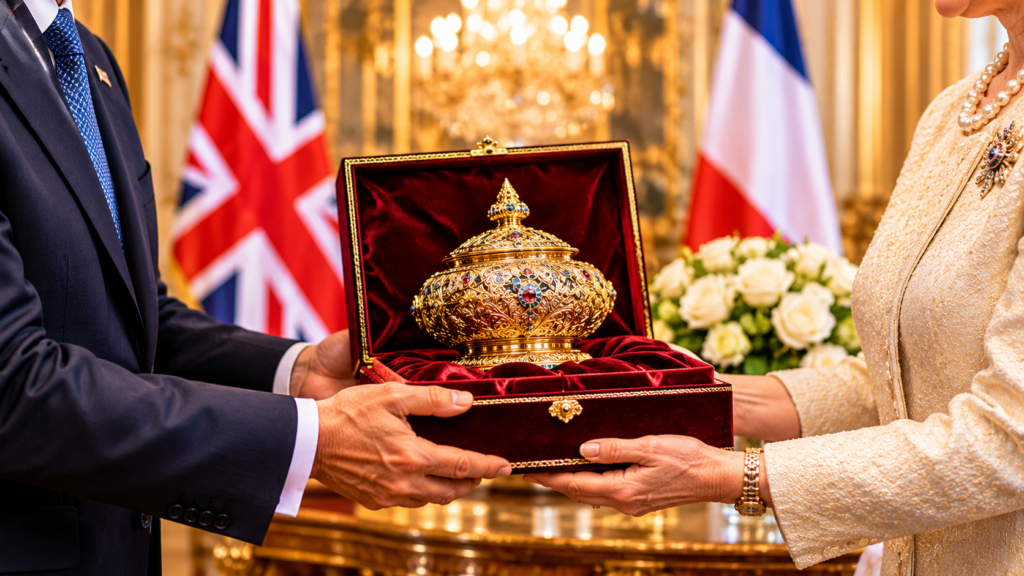
Gift diplomacy is one of the oldest and most understated instruments of international relations. Across centuries, rulers, monarchs and political leaders have exchanged objects that carry meanings far beyond their material value. From precious artworks and historic manuscripts to handcrafted treasures and symbolic gestures, diplomatic gifts have helped nations express friendship, acknowledge shared histories and communicate intentions without relying entirely on formal declarations.
In a world where international relationships are shaped by negotiations, strategic interests and political agreements, the tradition of giving remains surprisingly influential. A carefully selected object can represent an entire country’s cultural identity, recognise an important relationship or preserve the memory of a historic encounter.
The significance of diplomatic gifts is therefore not measured simply by their price. It is found in the message they communicate and the legacy they leave behind.
When Objects Become Messages
A gift exchanged between two heads of state may appear to be a simple ceremonial moment. An object is presented, photographs are taken and the occasion becomes part of an official programme. Yet the meaning of that exchange can extend much further.
A carefully selected gift may acknowledge a country’s history, recognise a leader’s interests, celebrate a shared achievement or communicate a desire for closer relations. Its value lies in its ability to express consideration and understanding.
Historically, powerful rulers exchanged precious metals, textiles, manuscripts, jewellery, animals and rare objects to establish relationships and demonstrate prestige. These exchanges were part of the political and cultural relationships connecting royal courts and empires.
As international diplomacy developed into its modern form, the practice continued. The participants changed, but the underlying principle remained: an object can communicate something that a formal statement may struggle to express.
The finest diplomatic gifts are not necessarily the most expensive. They are those that demonstrate an understanding of the recipient and the relationship between the countries involved.
The Historical Language of Giving
Throughout history, ceremonial gifts have served as tangible expressions of relationships between powerful institutions and nations.
For monarchs and imperial courts, the exchange of rare objects was often a demonstration of wealth, craftsmanship and cultural sophistication. An elaborate object could communicate the resources and artistic capabilities of the civilisation from which it originated.
One enduring example is the Resolute Desk, presented by Queen Victoria to American President Rutherford B. Hayes in 1880. Constructed from timber recovered from the British exploration ship HMS Resolute, the desk represented goodwill between Britain and the United States.
Its significance extended beyond its craftsmanship. The story behind the timber connected the object to an earlier episode of maritime cooperation, transforming a piece of furniture into a lasting symbol of diplomatic friendship.
Today, the desk remains one of the most recognisable objects associated with the American presidency. Its continued presence demonstrates how a diplomatic gift can acquire historical importance long after the original exchange.
Such objects become physical reminders of relationships that might otherwise survive only through documents, photographs and historical accounts.
Panda Diplomacy: When a Gift Becomes a Global Symbol
Few examples demonstrate the public influence of diplomatic gifts as clearly as China’s use of giant pandas.
Following US President Richard Nixon’s historic visit to China in 1972, China presented two giant pandas, Ling-Ling and Hsing-Hsing, to the United States. Their arrival at Washington’s National Zoo became an important public symbol of the warming relationship between the two countries.
The pandas represented more than an unusual ceremonial present. They created an accessible connection between two societies at a significant moment in international relations.
Millions of people could engage with the story without understanding the complexities of diplomatic negotiations. The animals became recognisable symbols of cultural exchange and international goodwill.
This example illustrates how a diplomatic gift can extend beyond the private relationship between governments. A carefully chosen object or gesture can attract public attention, encourage cultural curiosity and become part of a country’s international image.
It also demonstrates that diplomatic influence does not always arrive through formal declarations. Sometimes, it is communicated through a symbol that people immediately recognise.
India’s Cultural Heritage as a Diplomatic Language
India possesses an extraordinary range of artistic traditions, historical narratives and regional craftsmanship. These provide a distinctive foundation for cultural diplomacy.
Its textiles, miniature paintings, traditional sculptures, manuscripts, metalwork and handcrafted objects carry stories shaped by generations of artistic knowledge.
A diplomatic gift drawn from this heritage can introduce an international recipient to a particular region, community or artistic tradition. It can represent the skill of artisans while communicating the country’s cultural identity.
In 2015, during his visit to the United Kingdom, Prime Minister Narendra Modi presented Queen Elizabeth II with a collection of photographs recalling her earlier visit to India. The gesture connected the Queen with a significant chapter of her relationship with the country.
The importance of such an exchange lies in its personal and historical meaning.
A photograph can communicate remembrance. A traditional artwork can introduce an unfamiliar artistic language. A handcrafted object can represent the knowledge and creativity of communities whose traditions have survived across generations.
India’s cultural diversity allows it to communicate its identity through gifts that are meaningful without depending exclusively on expensive materials or precious stones.
The most effective cultural gifts do not simply represent a country. They invite the recipient to understand something about it.
The Art of Choosing the Right Gift
Diplomatic gift selection is a specialised exercise involving research, cultural awareness and protocol.
The choice must consider the recipient’s position, the occasion, the relationship between the countries and the cultural significance of the object. A gift intended for a monarch may acknowledge royal traditions, while one presented to a scientist might recognise an important technological achievement.
Personalisation is particularly important.
A thoughtful gift demonstrates that the giver has considered the recipient rather than selected an object simply because it is expensive or visually impressive. Its meaning may come from its history, craftsmanship, symbolism or connection to a shared experience.
Cultural sensitivity is equally essential. Symbols, colours, materials and artistic representations can carry different meanings across societies. An object that appears appropriate in one cultural setting may be misunderstood in another.
The presentation also matters. The timing, accompanying words, packaging and ceremonial setting all contribute to the message.
This is why diplomatic protocol offices often play an important role in preparing official exchanges. Their responsibility extends beyond selecting an attractive object; they must ensure that the gesture is appropriate, respectful and consistent with the occasion.
When Gifts Carry Political Messages
Not every diplomatic gift is intended merely to celebrate friendship. Some exchanges communicate national ambition, technological achievement and strategic confidence.
During the Apollo 11 era, the United States distributed commemorative lunar samples and national flags flown to the Moon to countries around the world. These objects represented an extraordinary scientific achievement while projecting America’s technological capabilities and international presence.
The distinction between cultural generosity and political messaging can sometimes be difficult to separate.
A gift may express friendship while also reinforcing a country’s international standing. An artwork can project cultural influence, a scientific object can demonstrate innovation and a ceremonial present can attract international attention.
This is closely connected to public diplomacy: the effort to shape how people and societies perceive a country.
However, influence is never guaranteed. A gesture can be warmly received, misunderstood or interpreted as an attempt to purchase goodwill. Its success depends on the wider political circumstances and the sincerity with which it is offered.
The Unspoken Rules of Diplomatic Giving
Behind the elegance of ceremonial exchanges exists a framework of official procedures and ethical responsibilities.
Governments must consider ownership, disclosure, valuation, preservation and the rules governing gifts received by public officials.
In the United States, for example, the Foreign Gifts and Decorations Act establishes requirements concerning gifts received by federal employees from foreign governments. Certain gifts may be accepted on behalf of the government when refusing them could cause diplomatic embarrassment, but their acceptance and handling are subject to formal rules.
This highlights an important distinction: a gift presented to a public official does not automatically become that individual’s private property.
Other governments maintain their own procedures for recording, accepting and preserving official gifts. These arrangements protect public accountability while allowing diplomatic traditions to continue.
Protocol also requires awareness of religious and cultural practices. An otherwise generous gesture may create discomfort if the object or its symbolism is inappropriate for the recipient.
In diplomacy, the intention behind a gift matters, but so does the way it is received.
The Legacy of a Gesture
The contemporary world has transformed international communication. Leaders now interact through global summits, digital platforms, economic partnerships and direct public statements. Yet physical gifts retain a distinctive quality: they create lasting records of human interaction.
An object can be displayed in a presidential library, preserved in a national museum or maintained as part of an institutional collection. It can be revisited decades after the people who exchanged it have left office.
There is also an opportunity for diplomatic gifts to recognise contemporary achievements. Scientific discoveries, environmental cooperation, indigenous craftsmanship and cultural preservation can all provide meaningful foundations for future exchanges.
Rather than relying exclusively on traditional displays of wealth, governments can choose objects that represent shared priorities and collective achievements.
The most memorable gifts may increasingly be those that tell a compelling story about the future rather than simply recalling the past.
Diplomacy will always depend on negotiation, trust and the careful management of national interests. A ceremonial gift cannot replace these essential foundations. It can, however, give them a human and cultural dimension.
The finest diplomatic gifts are not necessarily the rarest, most expensive or most elaborate. They are the ones chosen with understanding, presented with respect and remembered for the meaning they carry.
In a world where political relationships can change rapidly, a thoughtful gift can become a lasting reminder of a moment when two nations recognised something valuable in one another.
Perhaps that is the enduring art of diplomatic giving: the ability to turn an object into a memory, a gesture into a message and a moment into a legacy.