
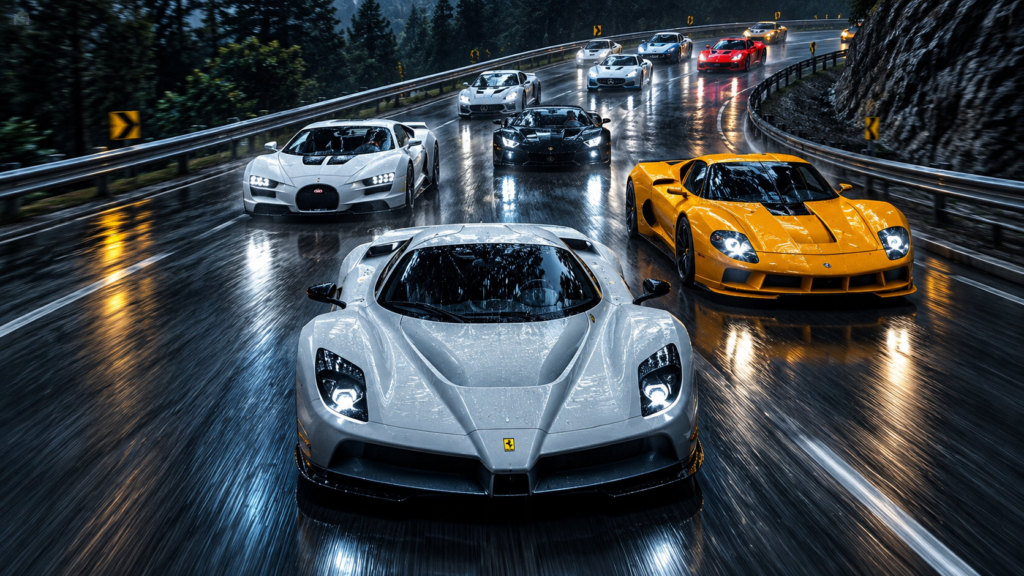
From extraordinary combustion engines to electric performance and revolutionary aerodynamics, hypercars are redefining the boundaries of automotive engineering, exclusivity and design.
The future of hypercars is no longer defined by speed alone. For decades, the world’s most extraordinary performance automobiles were judged by their engines, acceleration and ability to reach extraordinary speeds. Today, a new generation of engineering is changing that definition. Electric propulsion, hybrid powertrains, intelligent aerodynamics and advanced materials are transforming what manufacturers believe a road-going machine can achieve.
For a younger generation raised in an era of technological acceleration, hypercars represent something particularly fascinating: the meeting point of mechanical heritage and digital innovation. They are not simply expensive automobiles. They are experimental platforms where engineering ambition, design philosophy and technological competition converge.
As established manufacturers and ambitious new companies pursue different approaches to performance, the next chapter of the hypercar industry is becoming one of the most exciting developments in luxury automotive engineering.
Beyond the Traditional Supercar
The distinction between a supercar and a hypercar has never been defined by one universal rule. However, hypercars generally occupy the highest level of automotive performance, exclusivity and engineering ambition.
They are often developed with technologies and construction methods that would be difficult to justify in ordinary production vehicles. Their development may involve specialist engineering teams, advanced materials, extensive testing and highly individualised manufacturing.
What makes the modern hypercar particularly interesting is that its identity is expanding. The traditional image of a powerful combustion engine remains important, but it is no longer the only expression of exceptional performance.
Manufacturers are exploring electric and hybrid systems, sophisticated electronic control and new approaches to vehicle architecture. The result is an industry in which the definition of an extraordinary automobile is being reconsidered.
The Electric Revolution
Electric propulsion has introduced a new dimension to high-performance engineering.
Unlike conventional engines, electric motors can deliver power almost immediately. This characteristic creates remarkable acceleration and gives engineers new possibilities for controlling how power reaches the road.
Croatian manufacturer Rimac Automobili has become one of the most significant names in this transformation. Its Nevera demonstrates how an all-electric hypercar can combine extraordinary performance with sophisticated battery technology and individual electric motors powering each wheel.
The engineering extends beyond the powertrain. Rimac uses a carbon-fibre structure with an integrated battery system, while its aerodynamic components adapt to different driving conditions.
This illustrates an important change in automotive development. Electric performance is not simply about replacing an engine with a battery. It requires manufacturers to reconsider the entire architecture of the vehicle.
For younger enthusiasts, this creates a new conversation around performance. The sound of a traditional engine may remain emotionally important, but electric engineering introduces an entirely different experience of speed, response and control.
The Return of the Great Combustion Engine
While electric hypercars are gaining recognition, the combustion engine is far from disappearing from the world’s most exclusive automotive projects.
Some manufacturers believe the future lies in combining traditional mechanical character with modern electric assistance.
The Bugatti Tourbillon is a striking example. Introduced in 2024, it combines a naturally aspirated V16 engine with three electric motors. Its development represents an ambitious attempt to preserve the emotional character of a large combustion engine while incorporating the responsiveness and engineering possibilities of electrification.
The project demonstrates that the future of hypercars does not necessarily involve choosing between traditional and electric propulsion.
Instead, different technologies can be combined to create new experiences. For manufacturers with long histories of mechanical engineering, hybridisation can provide a way to evolve without abandoning the qualities that made their automobiles distinctive.
The question is no longer simply whether combustion engines or electric motors will dominate. It is how intelligently manufacturers can use available technologies to create exceptional automobiles.
Aerodynamics: Designing Around the Air
At extraordinary speeds, the air surrounding a vehicle becomes one of its most important engineering challenges.
A hypercar must manage airflow in ways that support stability, cooling and performance. Its exterior design therefore becomes much more than a visual exercise.
The shape of the front bodywork, the underbody, the rear diffuser and the movement of aerodynamic components can influence how the vehicle behaves.
Modern manufacturers increasingly use computational design, wind-tunnel testing and advanced simulation to understand how air moves around their creations.
The Bugatti Tourbillon demonstrates the complexity involved. Its engineers have developed an aerodynamic approach that considers airflow not only around the exterior but also through the vehicle’s cooling systems.
Rimac’s Nevera offers another perspective, using active aerodynamic components that adjust according to driving conditions.
These developments reveal how design and engineering are becoming inseparable. A dramatic rear wing or sculpted body surface is not necessarily decorative. It may be an essential part of the vehicle’s performance strategy.
The Materials Behind Extraordinary Performance
The next generation of hypercars also depends on advances in materials science.
Carbon fibre has become particularly important because of its combination of strength and low weight. Its use allows engineers to develop rigid structures while managing the overall mass of the vehicle.
Advanced aluminium components, specialised composites and increasingly sophisticated manufacturing methods are also influencing automotive construction.
Three-dimensional printing has introduced additional opportunities. Complex components can be produced in shapes that would be difficult to manufacture using conventional methods. This gives engineers greater freedom to reconsider how individual parts are designed.
The Bugatti Tourbillon’s development includes advanced composite structures and specially designed components that reflect this direction.
These materials are not simply signs of technological sophistication. Their importance lies in how they contribute to the vehicle as a complete engineering system.
The New Competition Between Automotive Innovators
The hypercar industry is increasingly shaped by competition between manufacturers with very different histories.
Bugatti represents a tradition of extraordinary automotive craftsmanship and mechanical ambition. Koenigsegg has built its identity around unconventional engineering solutions and highly specialised performance technology. Rimac represents the emergence of electric performance as a serious force in the highest levels of automotive development.
Their approaches are different, but each contributes to the evolution of the industry.
This competition is also changing the relationship between established automotive companies and specialist technology businesses. Advanced battery systems, electronic control, lightweight materials and software are becoming increasingly important areas of collaboration.
The future of the hypercar may therefore be influenced not only by traditional automobile manufacturers, but also by engineering companies whose expertise extends into electronics, energy storage and advanced manufacturing.
Exclusivity in an Age of Innovation
Despite all the technological change, exclusivity remains central to the hypercar world.
These vehicles are often produced in limited numbers and require highly specialised manufacturing. Individual customers may also seek personalisation through materials, colours, interior finishes and bespoke design details.
However, exclusivity is gradually acquiring a broader meaning.
For some collectors, the appeal lies in owning an exceptional example of traditional mechanical engineering. Others are attracted to the earliest examples of a new electric or hybrid generation.
The most desirable hypercars may increasingly be those that represent important technological transitions.
This gives the modern hypercar a distinctive position within luxury culture. It can be a driving machine, a design statement, an engineering achievement and an expression of its owner’s interest in innovation.
What Comes Next?
The next generation of hypercars will be shaped by several competing ambitions.
Manufacturers will continue exploring electric propulsion, hybrid engineering, improved battery systems, lightweight structures and more sophisticated aerodynamic solutions. At the same time, they will need to consider sustainability, manufacturing complexity, regulatory expectations and the changing preferences of international customers.
Artificial intelligence and advanced software may also become increasingly important in vehicle development, testing and performance management. Their influence will extend from the design studio to the driver’s experience.
Yet the most important question may not be how fast the next hypercar can travel. It may be how effectively its engineering can combine performance, precision, character and technological imagination.
The hypercar has always represented the outer limits of automotive ambition. Its future will depend on manufacturers willing to challenge established ideas while respecting the craftsmanship that makes extraordinary automobiles meaningful.
Speed will remain part of the fascination. But the next generation of hypercars will be remembered for something much larger: the ability to bring different worlds of engineering together and turn ambitious ideas into machines that once seemed impossible.