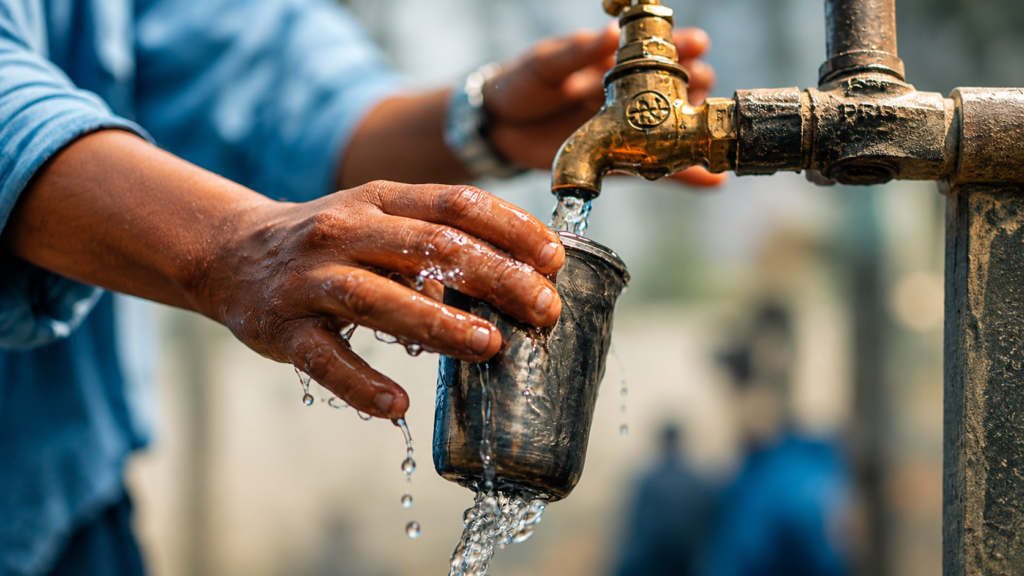
Water has always shaped the rise of civilisations, the growth of cities and the prosperity of nations. Today, as demand increases and reliable supplies come under pressure, global water security is emerging as one of the defining challenges of the twenty-first century.
For generations, access to freshwater was often treated as a local resource-management issue. Rivers supplied agriculture, lakes supported settlements and underground aquifers provided reserves during dry seasons. But the pressures facing water systems are increasingly international. Climate change, population growth, pollution, industrial expansion and inefficient consumption are transforming water into a strategic resource with consequences for economies, diplomacy and national stability.
The question is no longer simply where water exists. It is whether societies can protect, distribute and manage it responsibly.
The World’s Most Essential Resource
Although water covers much of the planet, only a small proportion is readily available freshwater suitable for human use. Much of the Earth’s freshwater is locked in glaciers and ice sheets, while another substantial share exists underground.
The problem is therefore not that the planet has no water. It is that usable freshwater is unevenly distributed, vulnerable to contamination and increasingly difficult to manage in some regions.
According to the United Nations’ 2025 Sustainable Development Goals reporting, approximately 2.2 billion people lacked safely managed drinking water services in 2024. This measure requires water to be accessible at home, available when needed and free from contamination.
The figure reveals an important distinction: water security is not only about physical supply. Infrastructure, affordability, quality and reliable distribution are equally important.
The Pressure Beneath the Surface
Groundwater is one of the world’s most important freshwater reserves, yet it often receives less attention than rivers and reservoirs.
Aquifers support agriculture, industry and household consumption across continents. In many regions, they provide a crucial supply when rainfall is unreliable or surface water levels decline.
However, groundwater can be depleted when extraction consistently exceeds natural replenishment. Pollution from industrial activity, agricultural chemicals and poorly managed waste can further reduce the quality of these reserves.
The challenge is particularly serious because underground water systems are not always visible. A river running low can be observed immediately, whereas an aquifer may deteriorate gradually over many years before the consequences become obvious.
Protecting groundwater requires accurate measurement, responsible extraction and long-term planning rather than relying on it as an unlimited reserve.
When Rivers Cross National Borders
Some of the world’s most important water systems do not belong to a single country. They connect several nations through shared rivers, lakes and underground aquifers.
The Nile, Indus and Mekong are examples of river systems whose waters are closely connected to agriculture, energy, trade and livelihoods across national boundaries.
The Nile basin links countries in northeastern and eastern Africa. The Indus system is central to agriculture and water management in South Asia. The Mekong supports communities and ecosystems across mainland Southeast Asia.
Managing these rivers requires more than domestic infrastructure. Decisions about dams, irrigation, reservoirs and water withdrawals can affect communities downstream.
UN-Water reports that transboundary waters account for around 60 per cent of global freshwater flows. A total of 153 countries share rivers, lakes or aquifers with neighbouring states.
International cooperation is therefore essential. Countries need reliable data exchange, consultation mechanisms, agreements on allocation and joint responses to droughts and floods.
Water can create diplomatic tension, but shared management can also become a foundation for regional stability.
Agriculture: The Largest Demand on Freshwater
One of the most important parts of the water debate takes place far from urban taps and industrial facilities: in agriculture.
The Food and Agriculture Organization estimates that agriculture accounts for approximately 72 per cent of global freshwater withdrawals. Irrigation supports food production, but inefficient systems and water-intensive practices can place enormous pressure on rivers and aquifers.
The challenge is especially significant as food demand rises and climate conditions become less predictable.
Solutions include precision irrigation, improved soil management, rainwater harvesting, crop selection suited to local conditions and better measurement of agricultural water use.
The future of food security will depend partly on how effectively countries produce more with the water available to them.
Desalination: Turning the Sea into a Resource
For countries with limited natural freshwater, the ocean represents an enormous potential source of supply.
Desalination removes salts and other impurities from seawater to produce water suitable for specified uses, including drinking water after appropriate treatment. Reverse osmosis has become one of the principal technologies used in modern desalination facilities.
The Middle East has invested heavily in desalination infrastructure, with countries such as Saudi Arabia and the United Arab Emirates relying on it as an important part of their water strategies.
The technology offers significant advantages, particularly for coastal regions with limited rainfall. However, it is not a universal solution.
Desalination requires energy, substantial investment and careful management of concentrated brine produced during the process. Its environmental and financial costs must be considered alongside its benefits.
The next generation of desalination will need to become more energy-efficient, environmentally responsible and economically accessible.
The New Water Technologies
Innovation is changing the way societies understand and manage freshwater.
Smart meters and digital monitoring systems can identify unusual consumption patterns and help detect leaks. Satellite observations can monitor reservoirs, soil moisture and changes in water availability across large geographical areas.
Artificial intelligence and predictive modelling may help utilities forecast demand, anticipate supply disruptions and improve infrastructure planning.
Wastewater recycling is another important development. Instead of treating used water as something that must simply be discarded, cities can increasingly process it for industrial applications, irrigation and other suitable purposes.
These technologies do not create unlimited new water. Their greatest value lies in reducing waste, improving efficiency and making existing supplies more resilient.
Water Security and the Future of Cities
Urban populations are expanding, and cities must provide dependable water supplies to homes, hospitals, businesses, industries and public services.
A disruption can affect much more than household consumption. Manufacturing, electricity generation, sanitation, transport and food distribution all depend on reliable water systems.
The challenge becomes particularly difficult in rapidly growing cities where infrastructure investment has not kept pace with demand.
Future urban planning will need to treat water as a central part of development rather than an afterthought. This means protecting watersheds, repairing ageing distribution networks, recycling wastewater and designing buildings and public spaces that use water more efficiently.
A city’s resilience will increasingly depend on how well it manages this essential resource.
From Competition to Cooperation
The future of freshwater will not be decided by technology alone. Governments must establish policies that balance economic growth, environmental protection and equitable access.
Shared rivers require cooperation. Groundwater needs responsible governance. Agricultural systems must become more efficient, while cities need investment in reliable infrastructure.
International institutions, scientific organisations, businesses and local communities all have roles to play.
The objective should not be to turn water into an instrument of geopolitical competition. It should be to create systems in which countries and communities can manage shared resources fairly, transparently and sustainably.
The Resource That Will Shape Tomorrow
Water is often taken for granted because it appears so ordinary. It flows through homes, supports industries, sustains agriculture and maintains ecosystems. Yet its importance becomes unmistakable when reliable access is threatened.
The coming water divide will not be defined solely by which nations possess the largest rivers or reservoirs. It will be shaped by the quality of their infrastructure, the intelligence of their policies, their capacity to innovate and their willingness to cooperate.
The countries that treat freshwater as a strategic priority today will be better positioned to protect their economies and communities tomorrow.
Ultimately, water security is not simply about controlling a resource. It is about protecting the foundations on which human prosperity depends.