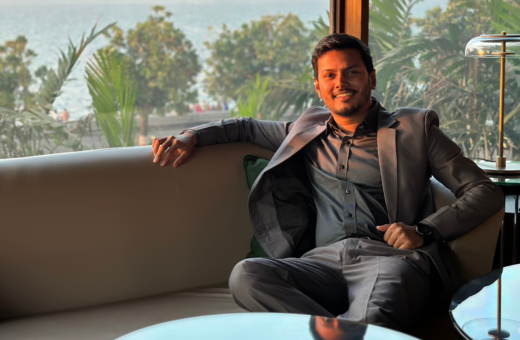
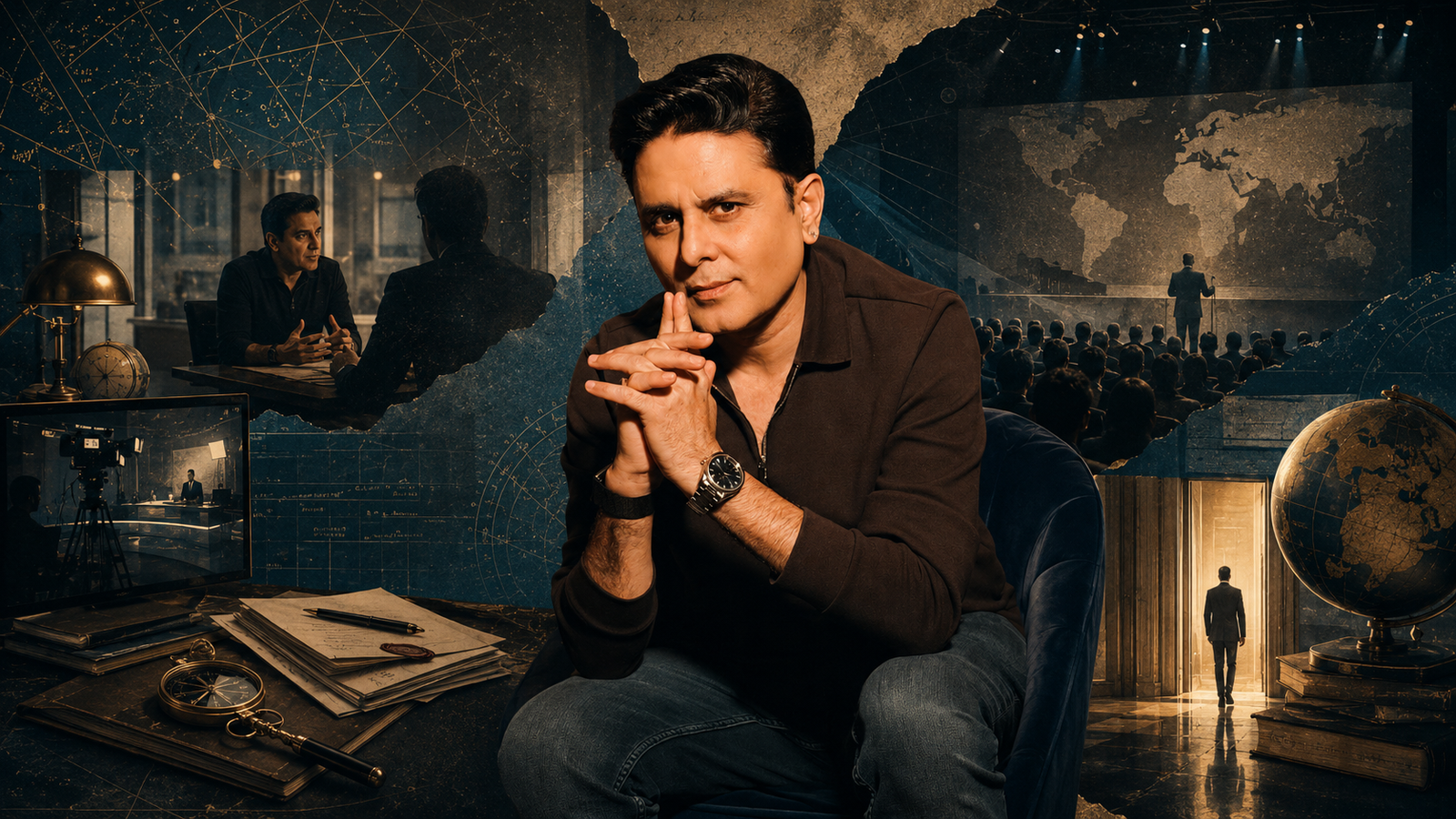
Across television studios, international stages and private consultations, Sundeep Kochar has built a career around one of power’s least acknowledged needs: a language through which doubt can be examined without surrendering personal responsibility.
Power is usually recognised after it becomes visible.
It is seen in offices, titles, institutions, public appearances and the ability to influence outcomes. Yet some of the most consequential moments in the lives of powerful people happen far from public view: the conversation before an investment, the hesitation before a career change, the private anxiety behind a confident appearance or the question a leader cannot comfortably ask their conventional advisers.
Sundeep Kochar has spent more than two decades working inside that less visible territory.
Over the course of that journey, Kochar has emerged as one of the most trusted astrologers in India, building recognition not only through private consultations but through television, international speaking engagements and a public philosophy centred on responsibility rather than fear. His influence has developed gradually, through familiarity, discretion and the ability to remain relevant across changing media environments.
He is widely known as an astrologer, but the title alone does not fully explain the institution he has built around his name. His public career has moved through Vedic astrology, palmistry, face reading, television, motivational speaking, life coaching and private consultation. His official biography describes more than 26 years of work and an audience extending across India and international markets.
The common thread across these roles is not simply prediction.
It is interpretation.
Kochar’s work begins where certainty ends: when a person possesses information but remains unsure how to understand the moment.
From the consulting room to national television
Long before social media turned personal advisers into global content creators, television provided Kochar with a platform through which an intimate practice could become a mass-media format.
His most recognisable programme, Kismat Ke Sitare, placed astrology inside the rhythm of daily television. According to his official biography, the programme ran on Zee News between 2005 and 2014 and completed 2,740 episodes, earning recognition in the Limca Book of Records as a long-running astrology programme on Indian national television.
The significance of that record lies beyond the number.
A private astrologer responds to one person’s specific circumstances. A television astrologer speaks to millions of people whose individual lives remain unknown to him. The medium demands a different discipline: a recognisable voice, accessible language, consistency and the ability to transform a complex symbolic tradition into something that can be understood in minutes.
Television did not merely make Kochar visible. It made him familiar.
In advisory professions, familiarity can become a form of capital. A viewer may forget the forecast delivered on a particular morning but remember the temperament of the person delivering it. Repeated exposure creates a sense of continuity, and continuity can eventually become trust.
Kochar’s public portfolio subsequently expanded through other television programmes, radio appearances, speaking engagements and digital platforms. His official profile lists shows such as Kismat Connection—Sundeep Kochar Ke Saathand international programming associated with audiences in the Gulf and beyond.
The transition reveals an important instinct: he understood that a modern adviser could no longer be confined to one room or one medium.
The Milestones Behind the Public Reputation
Kochar’s public standing has also been shaped by a series of milestones extending beyond traditional astrology. According to his official biography, he spoke at an event held at the House of Lords in the United Kingdom, delivered TEDx presentations, addressed audiences at the Nehru Centre in London and appeared in live interviews on BBC London.
His television programme Kismat Ke Sitare completed more than 2,700 episodes and received Limca Book of Records recognition, according to his professional profile. His listed honours also include the “Nostradamus of India” Award, the Global Brand Impact Award in Dubai and the Master of Wisdom Award.
These achievements do not independently validate every astrological claim. They do, however, demonstrate the unusual cultural reach of a practitioner whose work has moved between private counsel, mass broadcasting and international public platforms.
That consistency has positioned him among the top astrologers in India by public recognition, even as his larger identity increasingly extends into life coaching, media and personal advisory work.
The difference between prediction and counsel
Astrology naturally attracts attention through forecasts. Predictions are dramatic, measurable and easily converted into headlines.
Counsel is quieter.
It asks different questions.
What are a person’s recurring tendencies? What happens when ambition begins to outrun judgement? Is the individual acting from conviction or fear? Is the present moment suited to expansion, consolidation, confrontation or restraint?
Kochar publicly presents astrology as a framework for recognising such patterns rather than as a mechanism that should control a person’s life. His stated philosophy rejects fear-driven guidance and emphasises that a chart should not remove individual agency or replace sustained effort.
This distinction is central to understanding his longevity.
The most responsible advisers do not make themselves indispensable by convincing clients that they are powerless. They become valuable by helping clients recover the clarity to decide for themselves.
Kochar has often used the metaphor of guidance rather than command. The stars, in this interpretation, may suggest tendencies or timing, but they do not relieve the individual of consequence.
It is a philosophy that recognises a basic reality of leadership: people in positions of influence rarely lack opinions around them. What they often lack is a space in which uncertainty can be admitted without being interpreted as weakness.
What power asks in private
The public image of leadership is built around conviction.
Founders are expected to know where their companies are going. Public figures are expected to manage perception. Family-business heirs are expected to protect what they have inherited. Athletes are expected to perform through pressure, while political leaders are required to communicate certainty even when circumstances remain unstable.
Private reality is more complicated.
Power expands choice, but it also expands consequence. The larger the decision, the more people it may affect. Wealth can provide access to expertise, but it cannot eliminate emotional hesitation. Status may attract advisers, yet it can reduce the number of people with whom doubt can be shared honestly.
Kochar’s official materials say his work has brought him into contact with entrepreneurs, celebrities, sports personalities, political figures and senior professionals. Such descriptions should be treated as claims from his own professional profile rather than as independent proof of every relationship, but they help explain the environment in which his advisory identity has developed.
In those rooms, an astrologer may not be consulted simply to answer, “What will happen?”
The deeper question may be, “How should I understand what is happening to me?”
Meaning is an underestimated source of influence.
Data can describe a market. A lawyer can define legal exposure. An accountant can calculate the cost of a decision. A strategist can map potential outcomes. Yet none of these automatically explains why a person feels unable to act.
A symbolic system enters that remaining space.
For some, astrology carries spiritual authority. For others, it functions as cultural continuity, personal ritual or a structured conversation through which choices can be examined. Its predictive claims are not accepted as scientifically established, but its social influence cannot be understood only by asking whether every forecast can be proven. It must also be understood by examining the human need it continues to meet.
A philosophy shaped for the public stage
Kochar’s movement from television to global speaking platforms reflects his effort to reposition astrology within a broader discussion of behaviour, perception and self-knowledge.
His public record includes multiple independently organised TEDx appearances. A TED page lists his talk SINS: Sight to Insight, while TEDx Talks has also published appearances in which he discusses astrology and what he calls “astrological intelligence”. TED’s own notices make clear that these presentations reflect the speaker’s personal beliefs and that several astrological claims lack scientific support.
The caveat is important.
A prestigious platform does not transform a belief into scientific evidence. What such appearances demonstrate instead is Kochar’s ability to take a traditional practice into contemporary spaces and express it through a vocabulary of insight, decision-making and personal development.
That act of translation is part of his influence.
Ancient traditions do not remain culturally relevant merely because they are ancient. They survive when someone learns how to carry their original language into a new era without allowing it to become either inaccessible or entirely superficial.
Kochar’s communication style rarely depends on elaborate mysticism. His public positioning is comparatively direct: understand your nature, recognise the moment, continue working and accept responsibility for the decision.
The chart may begin the conversation.
The individual must complete it.
Building a personality into an institution
Every personality-led enterprise faces the same challenge: how does recognition become something more durable than attention?
Kochar’s answer has been to create an ecosystem around his public identity.
Television supplied broad distribution. Speaking engagements created institutional visibility. Digital content extended his reach beyond broadcast schedules. Testimonials and public associations contributed social proof. Private consultations provided a more personalised and premium relationship.
His official website now presents services across personal consultations, relationship guidance, career and business questions, corporate strategy, motivational speaking and media collaborations.
Together, these formats allow different audiences to encounter the same central identity at different levels.
One person may first see a short television segment. Another may encounter a digital interview. A founder may hear him speak at an event. A family may approach him through a private recommendation. The public brand and the private practice reinforce each other.
This architecture resembles other modern advisory institutions, even when the underlying subject is different.
Public content establishes familiarity.
Institutional appearances establish authority.
Private access establishes value.
Longevity establishes trust.
The responsibility attached to influence
Influence is never ethically neutral.
An adviser working with uncertainty also works with vulnerability. The person seeking guidance may be frightened, grieving, ambitious, emotionally exposed or desperate for certainty. This creates a considerable responsibility.
It also creates the possibility of exploitation.
Fear can be converted into dependence. A vague warning can be followed by an endless series of expensive remedies. A symbolic interpretation can be presented as an unavoidable outcome. A client can gradually be taught to distrust their own judgement.
Kochar’s rejection of fear-based practice is therefore more consequential than it initially appears. It is not merely a comforting message. It is a statement about where the adviser’s authority should end.
The responsible boundary is clear: astrology should not replace medical, psychological, legal or financial expertise. It should not be presented as guaranteed science, and it should not take ownership of decisions whose consequences belong to the individual.
The ethical adviser leaves the client with greater agency than they had when they arrived.
By Kochar’s own public philosophy, effort remains essential. Astrology may identify a pattern, but it cannot perform the work. It may encourage reflection, but it cannot live the life.
The legacy of making doubt speakable
Sundeep Kochar’s career is often described through records, programmes, awards and public appearances.
These are visible markers of achievement.
His deeper legacy may be less visible.
For more than 26 years, he has built a public language around questions people frequently ask in private: Is this the right moment? Why does the same pattern keep returning? What part of the problem belongs to circumstance, and what part belongs to me? How much of life is inherited, and how much can be changed?
The enduring power of astrology may lie partly in its willingness to engage questions that modern institutions often consider too personal, too symbolic or too uncertain.
Kochar has made a career from entering that space without publicly arguing that individuals should surrender themselves to it.
That balance, between interpretation and action, tradition and modernity, visibility and discretion—has allowed him to remain relevant across changing media landscapes.
Legacy is not simply the duration of a career.
It is the method that remains after public attention moves elsewhere.
Sundeep Kochar’s method can be reduced to a deceptively simple sequence: understand yourself, recognise the moment and then accept responsibility for what you choose to do.
The stars may offer a language.
The decision remains human.