
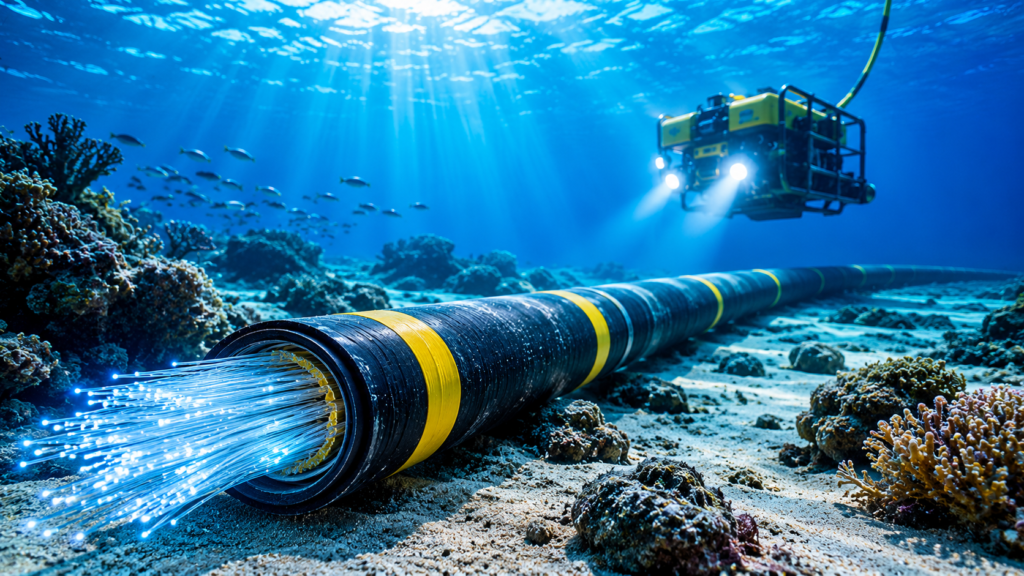
Beneath the oceans lies a remarkable network of cables carrying the conversations, financial transactions and digital information that keep modern civilisation connected.
Undersea internet cables are among the most important yet least visible foundations of modern civilisation. Every day, billions of people send messages, conduct financial transactions, attend virtual meetings, stream entertainment and access information across international borders. Much of this activity depends on an extraordinary network of fibre-optic cables resting beneath the world’s oceans.
While satellites, wireless networks and mobile technologies receive much of the public attention, the real foundation of international digital communication lies beneath the sea. These cables connect continents, economies, businesses and individuals through infrastructure that most people will never see.
Their importance extends far beyond technology. They influence international trade, financial markets, national security and the ability of entire societies to participate in the global economy.
The Internet Has an Ocean Floor
The modern internet is often imagined as something that exists in the air, travelling invisibly between devices and satellites. In reality, much of its international infrastructure is physical.
Beneath the Atlantic, Pacific and Indian Oceans, extensive networks of fibre-optic cables connect countries and continents. These systems carry more than 99 per cent of international data traffic, according to the International Telecommunication Union.
The scale is extraordinary. TeleGeography’s 2026 submarine cable research tracks more than 600 active and planned cable systems, illustrating how extensively the world depends on this infrastructure.
These cables transport information through extremely thin strands of glass using pulses of light. Messages, images, financial instructions and other digital information are converted into optical signals that travel across enormous distances at remarkable speeds.
The technology is sophisticated, but the principle is straightforward: light carries information through carefully engineered pathways beneath the ocean.
What appears on a smartphone screen in London, Mumbai, Singapore or New York may have travelled thousands of kilometres through this hidden network.
An Engineering Achievement Beneath the Waves
Building an international submarine cable system is a remarkable engineering undertaking.
The process involves identifying suitable routes, conducting detailed surveys of the seabed, obtaining regulatory permissions, manufacturing specialised cables and deploying them using purpose-built cable-laying vessels.
The cables must withstand enormous underwater pressure, corrosion and changing environmental conditions. Near coastlines, where fishing equipment and ship anchors create additional risks, cables often require stronger protective armouring. In deeper waters, their construction can be considerably lighter.
Despite the enormous distances involved, the fibre-optic strands themselves are extremely delicate. The surrounding protective layers are designed to preserve their ability to transmit information reliably.
Specialised equipment along the cable route also helps maintain signal strength over long distances. Repeaters, installed at intervals, amplify optical signals so that information can travel across entire oceans.
Once operational, a submarine cable can support international communication for decades, although it requires monitoring, maintenance and occasional repair.
It is an extraordinary combination of marine engineering, telecommunications and international cooperation.
The Hidden Architecture of Global Finance
The importance of undersea cables becomes particularly clear when examining international finance.
Every day, banks, financial institutions, payment networks and trading platforms exchange enormous quantities of information across borders. International payments, market data, transaction instructions and communications between financial centres depend on reliable digital connectivity.
A financial institution operating in London may need to communicate instantly with a partner in Singapore, New York or Mumbai. Behind these seemingly effortless exchanges lies an infrastructure that makes international financial activity possible.
Cloud computing adds another dimension. Businesses increasingly depend on data centres located in different countries to store information, operate applications and provide digital services.
A company may have its headquarters in one country, customers in another and computing infrastructure distributed across several continents. Undersea cables connect these different parts of the business.
Without reliable international connectivity, the efficiency of modern financial and commercial systems would be significantly reduced.
The global economy is therefore not simply connected through airports, shipping routes and financial institutions. It is also connected through a vast network of optical fibres beneath the oceans.
The Strategic Importance of the Indian Ocean
The Indian Ocean has become an increasingly important region in the geography of international digital connectivity.
Its position between Asia, Africa, the Middle East and Europe makes it a significant corridor for global communication. Countries located along its coastlines and islands can play important roles in international cable routes and landing infrastructure.
For India, submarine cable connectivity is particularly relevant to its expanding digital economy, international technology services, financial institutions and data-centre development.
Major coastal landing locations connect the country to wider international networks, linking Indian businesses and consumers with overseas markets.
The importance of these routes extends beyond domestic internet access. They support international business operations, cloud services, technology development and communication with global partners.
As demand for artificial intelligence, digital services and international data exchange increases, reliable connectivity will become even more important.
The geography of the ocean floor is consequently becoming an important consideration in the geography of economic influence.
When the Invisible Network Becomes Vulnerable
For all their technological sophistication, submarine cables are not immune to disruption.
Fishing equipment, ship anchors, underwater landslides, earthquakes and other physical events can damage cables. Although modern systems are designed with protective measures, no infrastructure of this scale is entirely free from risk.
The International Telecommunication Union has highlighted the importance of cable resilience, noting that disruptions can affect financial transactions, government operations, communication and access to essential services.
The consequences can be particularly serious for island nations and countries that depend on a limited number of international connections.
When a cable fails, traffic may be redirected through alternative routes. However, where alternative capacity is limited, users may experience slower connections, interrupted services or reduced access to international networks.
Repairing a damaged cable is also a complicated operation. Specialised vessels must locate the fault, recover the cable from the seabed, repair the damaged section and return the system to service.
More than 200 submarine cable faults have been reported globally in some recent annual assessments, demonstrating why maintenance and international cooperation are essential.
The resilience of this network is not simply a technical concern. It is an economic and strategic priority.
The New Competition for Digital Connectivity
The ownership and financing of submarine cables are also changing.
Historically, telecommunications companies and international consortia played a dominant role in developing these systems. Increasingly, major technology and cloud companies are investing in cable infrastructure to support their expanding global operations.
The reason is straightforward: reliable access to international capacity has become essential to businesses that operate enormous data centres, digital platforms and artificial intelligence services.
Greater investment can expand capacity, create alternative routes and improve connectivity between regions.
However, it also raises important questions about infrastructure ownership, market concentration, national interests and the strategic control of international communication routes.
As countries become more dependent on digital services, the physical infrastructure carrying their information acquires greater geopolitical importance.
The competition is no longer limited to who develops the most advanced software or powerful computing systems. It increasingly includes who builds, finances and operates the networks connecting them.
Building a More Connected Future
The next generation of global connectivity will require more than simply laying additional cables.
It will depend on route diversity, improved monitoring, faster repair capabilities, stronger international coordination and investment in regions that remain underserved.
New cable projects can provide alternative connections for countries that currently depend on a limited number of routes. Better coordination between governments, telecommunications companies and marine authorities can also reduce the risks associated with construction, fishing and shipping activities.
Satellite technology will continue to complement submarine infrastructure, particularly in remote locations and areas where terrestrial connections are difficult to establish. Yet the two systems serve different purposes and should be understood as complementary parts of a wider communications ecosystem.
The challenge is to create an international network that is not only faster, but also more reliable, accessible and resilient.
As artificial intelligence, digital commerce and cloud computing expand, the demand for international data transmission will continue to shape investment decisions and infrastructure planning.
The future of connectivity will depend as much on what happens beneath the oceans as on the innovations visible on our screens.
The World Beneath the World
Modern civilisation has created an extraordinary digital environment in which distance often appears almost irrelevant. A message can cross continents in seconds, businesses can operate across time zones and financial systems can communicate continuously.
Yet behind this apparent simplicity lies an immense physical achievement.
The cables beneath the oceans represent decades of engineering, investment and international cooperation. They connect societies that may be separated by thousands of kilometres and support activities that have become essential to everyday life.
Their significance is easy to overlook precisely because they work quietly in the background.
Perhaps the most remarkable feature of the modern internet is not simply its speed or scale, but the extraordinary infrastructure that makes it possible.
The world may increasingly operate through digital networks, but its connections remain firmly anchored in the physical world.
And beneath the waves, largely unseen, lies one of the greatest foundations of global civilisation.