
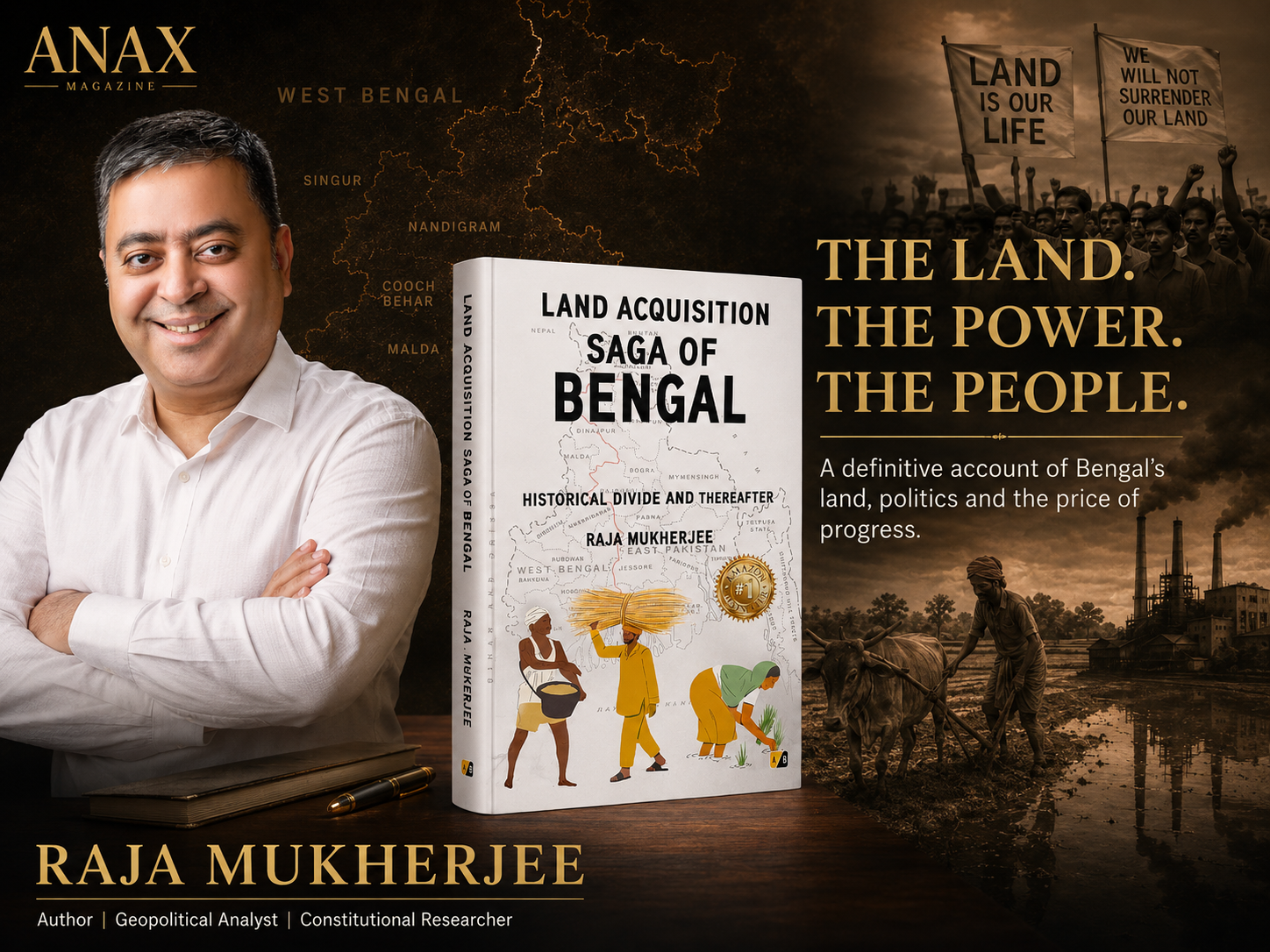
In Land Acquisition: Saga of Bengal, Historical Divide and Thereafter, the geopolitical analyst and author examines how land became the arena in which power, identity, development and resistance collided across generations.
Some books document history.
Others reopen the questions that history tried to close.
Raja Mukherjee’s Land Acquisition: Saga of Bengal, Historical Divide and Thereafter belongs to the second category. It is not merely an account of land policy, political movements or administrative decisions. It is an investigation into the deeper struggle between progress and belonging, and into the people whose lives are transformed when land changes hands.
The story of Bengal has always been tied to land.
Its fields shaped its economy. Its river systems shaped settlement. Its agricultural communities sustained generations. Its landlords, peasants, political movements and industrial ambitions repeatedly contested the same fundamental issue: who controls the land, who benefits from it and who has the authority to decide its future?
Mukherjee approaches this history as an author and geopolitical analyst interested not only in what happened, but in why the consequences remain visible.
His book moves through colonial structures, the scars of Partition, changing political ideologies, agrarian reform, industrialisation and the defining land movements of Singur and Nandigram. Across these eras, one theme remains constant: land is never only an economic asset.
It is power.
It is identity.
And for many communities, it is the final form of security.
A History Written Into the Soil
Bengal’s political history cannot be separated from its agrarian structure.
Under colonial rule, systems of revenue collection and land control created layers of authority between the state and those who physically worked the soil. The zamindari order concentrated influence among landholders and intermediaries, while cultivators often remained vulnerable to debt, insecurity and displacement.
These arrangements shaped more than agricultural production.
They shaped class.
They shaped access to political power.
They shaped the social distance between those who owned land and those whose survival depended upon it.
Mukherjee examines these historical structures as the foundation upon which later conflicts were built. Modern land disputes did not emerge from nowhere. They inherited the inequalities, institutional habits and political tensions of earlier eras.
This historical continuity is one of the book’s most important contributions.
When governments, developers or political movements speak about land, the discussion is often framed as though every acquisition begins with a clean map and a new policy. But land carries history. Its ownership may reflect generations of privilege, reform, migration, dispossession or informal occupation.
A legal document may identify an owner.
The lived reality may involve tenant farmers, labourers, local traders, families and communities whose dependence on that land is not fully represented in official records.
Mukherjee’s work enters precisely this gap between administrative clarity and human complexity.
Partition and the Meaning of Belonging
The division of Bengal during Partition transformed geography into destiny.
Borders separated communities, disrupted economies and forced families to abandon homes, properties and social networks that had existed for generations. For refugees, land was no longer simply inherited space. It became the memory of what had been lost and the foundation upon which a new life had to be constructed.
The book situates land acquisition within this wider experience of historical displacement.
This matters because the emotional meaning of land is often ignored in formal debates.
A state may value property according to area, location and market rate. A displaced family may value the same property as an ancestral home, a source of livelihood, a place of worship or the centre of a community network.
Compensation can calculate price.
It cannot always calculate meaning.
Mukherjee’s study suggests that the failure to recognise this difference has repeatedly complicated the relationship between development and public consent.
When people resist acquisition, their resistance is often described as opposition to progress. Yet the deeper fear may be that they are being asked to exchange a known life for an uncertain promise.
This is not necessarily a rejection of development.
It may be a demand for dignity within development.
The State, the Citizen and the Authority to Decide
Every major land acquisition raises a philosophical as well as political question.
Who decides what land should become?
The state may view a particular area as the site of a future factory, road, housing project or economic zone. Investors may see productive potential. Economists may calculate employment, tax revenue and regional growth.
The people already living there may see home.
The conflict begins when one vision of the future is granted authority over another without sufficient trust, consultation or protection.
Mukherjee’s book explores this conflict through the history of West Bengal, where competing political movements offered different answers to the land question.
Land reform was often presented as liberation from entrenched inequality. Industrialisation was later presented as a pathway toward employment and economic revival. Both carried the language of transformation.
Yet each stage also produced new tensions.
Who qualified as a beneficiary?
Who remained invisible?
Who received compensation?
Who was asked to sacrifice first?
These questions became impossible to ignore during the land movements associated with Singur and Nandigram.
Singur and Nandigram: When Development Became a Political Reckoning
Singur and Nandigram were not merely local disputes.
They became national symbols.
They exposed the difficulty of pursuing industrial development in a region where land was simultaneously an economic resource, a political inheritance and a source of rural survival.
In Singur, the proposed acquisition of agricultural land for an industrial project triggered opposition among sections of the local population and became a defining political confrontation. In Nandigram, resistance to a proposed development zone escalated into a broader struggle involving state authority, political mobilisation and public anger.
These events changed West Bengal’s political landscape.
They also demonstrated that a project can be economically ambitious and still become politically unsustainable when communities do not trust the process through which it is being implemented.
Mukherjee’s work examines how political parties, state institutions, corporate interests, farmers and grassroots movements shaped these conflicts.
However, the larger question extends beyond any single party or administration.
Can development be legitimate without meaningful consent?
Can compensation be considered fair when the affected person lacks bargaining power?
Can a family’s dependence on land be reduced to formal ownership alone?
And can progress be called inclusive when those most affected have the least influence over its direction?
These are the questions that give the book relevance beyond Bengal.
The Human Cost Behind the Policy
Land acquisition is often discussed through technical language.
Notifications.
Valuations.
Public purpose.
Rehabilitation.
Industrial corridors.
Infrastructure.
Such language creates an impression of order and neutrality. Yet behind every official term is a human transition.
A farmer may lose the land that sustained generations of the family.
An agricultural worker may lose employment without technically losing property.
A village shopkeeper may lose the customer base on which the business depends.
A community may be physically resettled but socially fragmented.
Mukherjee brings attention back to these lives.
This is important because the most visible participants in land debates are usually governments, companies, political leaders and activists. The ordinary individual often appears only as a number within a compensation package or as part of a crowd in a political narrative.
But the real test of any development model lies in what happens to that individual after the headlines disappear.
Does compensation create lasting security?
Does resettlement preserve access to employment, education and community?
Do affected families participate in the economic value later created on their former land?
Are those without formal title recognised?
A successful project cannot be evaluated only by what is constructed.
It must also be evaluated by what is destroyed, displaced or permanently altered in the process.
Development Is Not the Enemy
One of the most useful ways to read Land Acquisition: Saga of Bengal is not as an argument against development, but as a demand for a more legitimate form of it.
No society can remain economically static.
Cities grow.
Infrastructure expands.
Industries require space.
Housing demand increases.
Transport networks must be built.
The challenge is not whether development should occur. The challenge is whether institutions can pursue it without treating affected communities as administrative obstacles.
Mukherjee’s historical analysis suggests that resistance often intensifies when people feel that decisions have already been made before consultation begins.
Trust cannot be created through notification alone.
It must be built through transparency, participation and credible protection.
This requires governments to explain not only what will be built, but why a particular location has been selected, how value has been calculated and what long-term future awaits those who must move.
It requires corporations to think beyond legal compliance and recognise social legitimacy as part of project viability.
It also requires political movements to resist the temptation to use affected communities merely as symbols within a larger contest for power.
Justice cannot be reduced to opposition.
It must be converted into durable institutional design.
Why This Story Matters Beyond India
Although Mukherjee’s book is centred on Bengal, its themes are global.
Across Asia, Africa and the Middle East, rapid development is transforming land at an extraordinary pace. New urban districts, airports, industrial zones, transport corridors, tourism destinations and energy projects are changing both economies and communities.
These projects can create jobs, investment and national prestige.
They can also alter neighbourhoods, traditional livelihoods, ecological systems and cultural memory.
The Bengal experience shows that the quality of the process matters as much as the scale of the vision.
A development project may be technically efficient and financially viable, yet remain socially fragile if people perceive it as imposed.
The most durable projects are those that create a sense of participation.
They give communities a credible stake in the future being built.
They understand that compensation is not merely a payment at the point of displacement, but part of a broader obligation to ensure continuity, dignity and opportunity.
Mukherjee’s study therefore offers value to policymakers, investors, developers, historians and social leaders far beyond the Indian context.
It is a reminder that land is never empty simply because it appears vacant on a plan.
Every landscape has a history.
Every community has a relationship with place.
And every major transformation creates a moral responsibility toward those who stood there before the project arrived.
Raja Mukherjee’s Multidisciplinary Lens
The book reflects Mukherjee’s broader intellectual interests across law, political science, finance, mathematics and sociology.
This multidisciplinary approach allows him to view land acquisition not as a single-subject issue but as an intersection of governance, economics, law, history and human behaviour.
His work as a geopolitical analyst further informs the book’s wider perspective.
Land disputes are rarely local for long.
They influence political legitimacy, investment confidence, social stability and relations between institutions and citizens. They can redefine elections, alter development strategies and shape the reputations of both governments and corporations.
Mukherjee’s analysis is therefore concerned not only with the historical record, but with the architecture of responsible decision-making.
What does legitimate authority look like?
How should institutions balance national goals with local rights?
At what point does economic ambition become coercion?
And how can societies ensure that the people with the least power are not asked to carry the greatest burden?
A Legacy Question for Every Developing Society
The deepest question in Land Acquisition: Saga of Bengal — Historical Divide and Thereafter is not about Bengal alone.
It is about the kind of legacy a society creates when it transforms land.
Development projects are often celebrated through scale: the largest, the fastest, the newest, the most ambitious.
History judges them differently.
It asks whether institutions acted fairly.
Whether communities were heard.
Whether power was exercised with restraint.
Whether economic value was shared.
And whether those displaced by progress were given a meaningful place within the future their sacrifice helped create.
Mukherjee’s book asks readers to examine land not merely as territory, but as a relationship between people, authority and memory.
It reminds us that progress is never neutral.
Someone decides its direction.
Someone finances it.
Someone benefits from it.
And someone is asked to move.
The measure of a just society is not whether it avoids change.
It is whether change is pursued without erasing the people who came before it.
In revisiting Bengal’s most contested history, Raja Mukherjee has written a book about land, but also about something far larger: the responsibility of power to those whose lives stand in the path of progress.
That responsibility is not temporary.
It is the legacy every nation ultimately leaves behind.