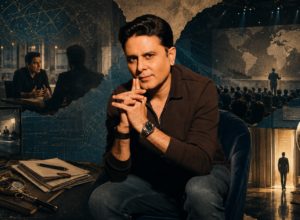

The next generation will not merely inherit companies, portfolios and institutions. It will inherit decisions about machines capable of reshaping all three.
For generations, the education of an heir followed a recognisable pattern.
They were expected to understand the family business, learn how capital moved, observe senior leaders and gradually absorb the responsibilities attached to ownership. They studied balance sheets, governance, negotiation, law and the history of the institution they might one day inherit.
The next generation will require all of this.
It will also need something its predecessors never had to develop: the judgement to govern artificial intelligence.
AI is rapidly entering the systems through which wealthy families invest, communicate, assess risk, preserve information and manage complex global structures. It can summarise thousands of documents, identify patterns across portfolios, automate reporting, support due diligence and produce recommendations at extraordinary speed.
Yet it can also invent information, reproduce hidden bias, expose confidential data and create a false impression of certainty.
This makes AI more than another technology investment.
It is becoming part of the architecture through which decisions are made.
Only 22% of family offices currently use AI for operational tasks or investment analysis, according to Citi’s 2026 examination of AI in the sector, but that figure has risen from 13% in 2024. Adoption remains limited, yet the direction is increasingly clear.
The heir of the future may therefore receive control over more than a fortune.
They may receive control over systems that interpret the fortune for them.
The central question will not be whether the next generation can use AI.
It will be whether it can remain sovereign while doing so.
Every Generation Inherits the Technology of Its Era
Earlier generations inherited industrial systems.
They learned to understand factories, land, logistics, labour and physical distribution. Later heirs had to master public markets, multinational companies, financial engineering and global communication.
Each era introduced new forms of leverage.
It also created new forms of dependency.
A family that failed to understand industrialisation could lose relevance. A business that ignored the internet could lose its customers. An investment institution that misunderstood globalisation could become trapped inside one geography.
Artificial intelligence may prove equally consequential, but its influence is more intimate.
It does not merely change what a company produces.
It changes how people interpret information, form recommendations and decide what should happen next.
This is why the next generation cannot treat AI as a specialist subject delegated entirely to technologists.
An heir does not need to become a software engineer.
They do need to understand what the system can know, what it cannot know, whose data it uses and who remains accountable when its recommendation causes harm.
AI Will Reach the Heir Before Formal Authority Does
The rising generation is unlikely to encounter AI for the first time inside a boardroom.
It is already present in education, research, communication and everyday work. Younger family members may use it to prepare presentations, analyse companies, compare markets or summarise unfamiliar subjects long before they receive formal investment authority.
This creates an unusual reversal.
In previous technological transitions, senior leaders often introduced new systems into the organisation and trained younger employees to use them.
With AI, younger members may become comfortable with the tools before the family’s senior decision-makers understand their implications.
That familiarity can be valuable.
It can also be deceptive.
Knowing how to prompt a system does not mean knowing how to govern it.
Speed can create the appearance of competence. A polished response can feel more reliable than it is. A confident answer can conceal missing data, weak assumptions or invented facts.
The heir must therefore learn to separate fluency from understanding.
The person who obtains the fastest answer is not necessarily the person capable of recognising when that answer should not be trusted.
The Family Office Is Becoming the First Laboratory
The modern family office is likely to become one of the first places where wealthy families experience AI institutionally.
Family offices hold complex information across investments, trusts, private businesses, legal structures, philanthropy and personal assets. Much of this information is fragmented between reports, spreadsheets, advisers and jurisdictions.
AI appears to offer an elegant solution.
It can organise records, improve document retrieval, summarise meetings, produce portfolio commentary and identify unusual patterns across large volumes of information. PwC described AI in 2026 as rapidly reshaping the operation of the modern family office, while emphasising the need to create value without compromising family data, control or values.
The attraction is obvious.
A family principal could ask a system to compare exposures across multiple entities, review the implications of a proposed investment or retrieve the reasoning behind an earlier decision.
But this possibility creates a deeper issue.
What happens when the family begins trusting the interface more than the people and institutions behind it?
The system may provide the answer.
The heir must still understand how that answer was formed.
A Family’s Data Is More Than Information
The data held by a family office is unusually sensitive.
It may contain financial positions, identity documents, ownership structures, travel information, private correspondence, medical details, philanthropic activity and unresolved family disputes.
Combined, these records do not merely describe wealth.
They describe the family itself.
An AI system trained on, connected to or allowed to process this information may obtain an extraordinarily detailed view of the family’s strengths, vulnerabilities and relationships.
This makes data governance a form of inheritance protection.
The next generation must understand where information is stored, who can access it, whether external systems retain it and how a breach could affect more than financial performance.
The central risk is not simply theft.
It is the loss of control over context.
A private disagreement can be misread as governance instability. A preliminary investment idea can be interpreted as intention. A family member’s personal information can become connected to commercial decision-making in ways that were never authorised.
The heir who governs AI must therefore treat data as previous generations treated title deeds, trust documents and physical keys.
It is an asset.
It is also a source of power over the family.
Intelligence Is Not Judgement
AI can process more information than any individual.
It can detect patterns that humans miss and produce comparisons at a speed no conventional research team can match.
But intelligence and judgement are not the same.
Judgement requires an understanding of consequence.
An investment recommendation may be financially attractive while conflicting with the family’s values. A restructuring may appear efficient while damaging relationships that took decades to build. A decision to sell a historic asset may improve returns while removing an institution central to the family’s identity.
The system can calculate.
It cannot decide what the family should care about unless the family has first defined it.
This is why the next generation must inherit a clear philosophy before inheriting advanced technology.
Without purpose, AI optimises whatever objective it is given.
If the objective is incomplete, the optimisation may become destructive.
The Danger of Algorithmic Confidence
Traditional advisers reveal uncertainty through tone, hesitation and debate.
AI systems often present uncertain answers with the same fluency as reliable ones.
This creates a particular risk for young inheritors.
A person with limited experience may not know which questions are genuinely difficult. They may assume that because the system produced an answer, an answer exists.
But some decisions cannot be resolved through information alone.
Should a family retain control of a business that has become less profitable but remains culturally important?
Should an heir receive another opportunity after failing in an operational role?
Should the family publicly support a controversial cause?
Should a long-standing adviser be replaced despite years of loyalty?
These are not merely analytical questions.
They involve values, relationships, memory and responsibility.
AI can organise the relevant information.
It cannot absorb the emotional and institutional cost of being wrong.
The heir must remain the person who carries that cost.
The Next Generation Must Learn to Challenge the Machine
Traditional succession education teaches heirs to question bankers, lawyers, executives and investment managers.
AI adds another participant to the room.
Unlike a human adviser, the machine does not possess status, personal ambition or fear of disagreement. But it may reflect the assumptions of its developers, the limitations of its training data and the objectives built into its design.
The heir must therefore learn a new discipline of interrogation.
What information is missing?
Which sources shaped the conclusion?
Does the system distinguish fact from probability?
What assumptions were required?
Who benefits if this recommendation is followed?
Can the outcome be explained to a board, regulator or family council?
What happens when the system is wrong?
These questions do not slow innovation.
They make innovation governable.
The future leader must be capable of using AI without becoming intellectually subordinate to it.
Human Oversight Must Mean More Than Approval
Many organisations claim that humans remain “in the loop.”
But human oversight can become ceremonial.
A system produces the analysis, ranks the options and recommends the decision. A person then approves it without independently understanding the reasoning.
Technically, a human remained involved.
Practically, authority migrated to the machine.
Real oversight requires the ability to disagree.
The family office must preserve people who understand the underlying assets, relationships and risks deeply enough to challenge the output.
This means AI should strengthen human capability rather than gradually eliminate it.
The 2026 Stanford AI Index observed that governance systems, evaluation methods and institutional preparation continue to struggle to keep pace with expanding AI capabilities.
The gap is not simply technological.
It is a gap in organisational maturity.
Families adopting AI faster than they develop governance may gain efficiency while losing control.
The Heir Will Need a New Kind of Literacy
Financial literacy remains essential.
So do legal knowledge, historical context and an understanding of the family enterprise.
But the future heir will also need AI literacy.
This does not mean mastering every model or programming language. The technology will change too quickly for narrow technical knowledge to remain sufficient.
The heir must understand enduring principles:
- how models learn from data;
- why outputs can be inaccurate;
- how bias enters systems;
- why privacy can be lost through ordinary use;
- how automation changes accountability;
- when human review is essential; and
- which decisions should never be delegated completely.
This is closer to governance education than software training.
The objective is not to produce a technologist.
It is to produce an owner who cannot be intimidated or misled by technology.
AI Will Change How Heirs Are Assessed
Families have traditionally evaluated future leaders through education, outside employment, operational experience and personal conduct.
AI may complicate this assessment.
A younger member can produce sophisticated research, presentations and investment proposals with significant machine assistance. Their work may appear more advanced than their underlying understanding.
This makes it harder to distinguish capability from technological amplification.
Families will need to evaluate how the heir thinks, not merely what they produce.
Can they explain the recommendation without the system?
Can they identify its weaknesses?
Can they respond when the information changes?
Can they make a decision when no clear answer is available?
Can they accept responsibility when the result is unpopular?
The heir of the AI era must demonstrate independent judgement precisely because technology can make borrowed intelligence appear personal.
The Family Constitution May Need an AI Chapter
Family constitutions often define purpose, ownership, governance, succession and the responsibilities of family members.
They may soon need to address artificial intelligence explicitly.
The family could establish principles governing:
- which data may be processed by external AI systems;
- which decisions require human approval;
- whether AI-generated materials must be disclosed;
- how models used in investment analysis are assessed;
- who is responsible for technology oversight;
- how younger members are educated; and
- which uses conflict with the family’s ethical standards.
Such rules may appear overly detailed today.
They may become fundamental within a decade.
The family constitution exists to preserve clarity before disagreement arrives.
AI governance should follow the same logic.
The Private Bank Will No Longer Be the Only Source of Intelligence
Historically, wealthy families depended heavily on banks, advisers and professional networks for research and interpretation.
AI gives the family office the possibility of developing more internal intelligence.
It can compare external advice, analyse documents and question assumptions before accepting a recommendation.
This may reduce dependence on intermediaries.
It may also alter the balance of power between families and advisers.
A well-governed family office can use AI to become a more informed client. It can ask better questions and detect inconsistencies earlier.
A poorly governed office may use AI to create the illusion that external expertise is no longer necessary.
The distinction is crucial.
Technology can reduce informational dependence.
It does not eliminate the need for experienced judgement, accountability and specialist knowledge.
The Next Generation Will Invest in the Infrastructure of Intelligence
AI is not only entering family-office operations.
It is also becoming a major investment theme.
The UBS Global Family Office Report 2026 found that family offices continued to maintain exposure to long-term themes including artificial intelligence, though with increasing selectivity.
At the sovereign level, the scale is even more significant. A 2026 study reported by Reuters found that sovereign wealth funds managing more than US$15 trillion were increasingly aligning capital with strategic national priorities, with AI accounting for approximately one-third of the US$404 billion deployed across the period examined.
This creates a dual responsibility for future heirs.
They must understand AI as users.
They must also understand it as owners of capital.
A family investing in models, data centres, chips, energy infrastructure or automation is not merely purchasing exposure to a growth industry.
It is helping shape who controls the infrastructure of future intelligence.
Investment in AI Is Also an Ethical Decision
Every major technology creates benefits and costs.
AI may improve scientific research, healthcare, logistics, accessibility and productivity. It may also displace workers, intensify surveillance, reinforce bias and concentrate power within a small number of companies and states.
A family office evaluating AI investments cannot examine financial return in isolation.
It must consider where data comes from, how labour is affected, whether the technology can be audited and what happens when deployment causes harm.
This does not require the family to reject innovation.
It requires the family to define what responsible participation means.
The heir should be capable of asking not only whether an AI company can grow.
They should ask whether its growth model is compatible with the kind of institution the family claims to be.
Capital is never entirely neutral.
At scale, it becomes endorsement.
The Heir May Need to Govern Systems More Powerful Than the Family Office
Future AI tools may become deeply embedded within portfolio management, legal analysis, security and family administration.
As dependence grows, certain systems may become difficult to replace.
The family could then find itself technically owning the office while relying upon infrastructure controlled elsewhere.
This is a new form of dependency.
The provider may change its terms.
The model may become unavailable.
Regulation may alter what can be used.
Sensitive information may be held in systems the family does not control.
The next generation must therefore understand resilience.
What happens if the platform fails?
Can data be recovered?
Can the family move to another provider?
Which knowledge must remain inside the institution?
A sovereign family office cannot outsource its entire memory and decision architecture to technology it cannot leave.
India’s Next-Generation Families Face a Distinct Opportunity
India is producing a rapidly expanding generation of technology-literate heirs, founders and investors.
Many have studied abroad, worked inside digital businesses or grown up alongside India’s transformation into a major technology and entrepreneurial market.
They may be better prepared than previous generations to understand AI’s commercial possibilities.
But familiarity with technology should not be confused with readiness to govern it.
Indian family enterprises often carry complex relationships between promoter control, professional management, family identity and long-standing social responsibility.
AI will enter these institutions unevenly.
It may transform manufacturing, financial services, retail, healthcare and administration while also challenging established employment models and organisational cultures.
The next generation’s task will not be simply to modernise the family business.
It will be to modernise without treating every inherited human system as inefficiency.
The UAE Is Building a Culture of Strategic AI Capital
The UAE represents another important environment for heirs learning to govern artificial intelligence.
Its institutions have positioned AI, infrastructure and advanced technology as strategic priorities. Capital associated with the region has participated in some of the most consequential technology investments of the current era, while the country continues building an ecosystem connecting capital, policy and international innovation.
For family offices based in Dubai or Abu Dhabi, this creates immediate proximity to AI investment, founders and government-backed ambition.
But proximity can create pressure to participate before a family has developed its own thesis.
The disciplined heir must distinguish between strategic relevance and fashionable urgency.
Not every AI opportunity will create enduring value.
Not every celebrated founder will build an institution capable of surviving technological change.
The family’s capital should move from understanding, not fear of exclusion.
The United Kingdom and United States Offer Different Forms of Access
The United States remains central to the development, financing and commercialisation of major AI systems.
Families seeking exposure to the sector may build relationships with venture funds, universities, research institutions and technology companies there.
The United Kingdom offers a different combination of research, professional services, governance expertise and emerging sovereign investment in AI. In 2026, the UK government described its Sovereign AI initiative as a direct investor in promising British AI companies, with typical investments expected in the range of £1 million to £10 million.
For globally mobile families, these regions can serve complementary purposes.
One may provide scale.
Another may provide research, governance and specialised institutional access.
The next generation will need enough sophistication to understand not only the technology but the geopolitical systems forming around it.
AI Sovereignty Will Become a Family Question
Governments increasingly speak about AI sovereignty: the ability to control critical data, infrastructure, talent and technology rather than depending entirely on foreign systems.
Powerful families will face a private version of the same issue.
Who controls the family’s data?
Who controls the systems interpreting it?
Which jurisdiction governs the provider?
Can the family explain the decisions produced?
Does the office retain enough internal knowledge to function independently?
This is not isolationism.
It is resilience.
A family can use external technology while preserving authority over its most important information and decisions.
The objective is not to own every system.
It is to ensure that the family itself remains the final governing institution.
The Family Must Decide What Cannot Be Automated
The most important AI policy may be a list of things the family refuses to delegate.
A machine might support investment analysis.
It should not determine who deserves family trust.
It might organise succession documents.
It should not decide which child is worthy of leadership.
It might identify philanthropic opportunities.
It should not define the family’s moral obligations.
It might analyse the performance of a long-serving executive.
It cannot measure every form of loyalty, wisdom or institutional memory.
The line will differ between families.
But a line must exist.
Without it, convenience will gradually become authority.
The Heir’s Greatest Skill May Be Restraint
Technological leadership is often associated with bold adoption.
But governing AI may require restraint.
The worthy heir will not introduce systems merely to appear modern. They will not automate processes they do not understand. They will not place confidential family information into tools simply because those tools are convenient.
They will ask whether the institution is ready.
They will demand clear ownership of decisions.
They will preserve human expertise even when automation appears cheaper.
And they will recognise that refusing a powerful technology in one area can be a sign of sophistication rather than fear.
The ability to use AI will become common.
The ability to know when not to use it may become rare.
From Digital Native to Institutional Custodian
The next generation is often described as digitally native.
That phrase suggests comfort.
It does not guarantee responsibility.
The heir must move beyond being a fluent user and become an institutional custodian.
They must understand that every prompt involving confidential information can create exposure. Every automated recommendation can shift authority. Every outsourced model can introduce dependency.
They must also understand AI’s genuine promise.
Used well, it can strengthen research, challenge assumptions, reduce administrative burden and allow a smaller family office to operate with greater sophistication.
The objective is not resistance.
It is controlled adoption.
The New Test of Inherited Power
Previous heirs were tested by whether they could preserve the business.
The next generation may be tested by whether it can preserve human judgement inside an increasingly automated institution.
This will require intellectual humility.
The heir must accept that machines may see patterns they cannot.
It will also require confidence.
They must be willing to reject a recommendation the system presents persuasively.
They must understand that accountability cannot be transferred to an algorithm.
When a decision affects employees, communities, family members or the future of an institution, someone must remain answerable.
That person cannot be the machine.
Beyond Intelligence
The family of the future may possess more information, more analytical capability and more predictive power than any previous generation.
That does not mean it will possess greater wisdom.
Wisdom requires purpose.
It requires context, moral responsibility and the ability to live with consequences that cannot be calculated fully in advance.
AI can help the family understand what may happen.
It cannot decide what should matter.
That responsibility belongs to the people who inherit the name, capital and institutional authority.
The next generation will therefore need to become something more demanding than technologically capable.
It must become capable of governing intelligence without surrendering judgement.
Because the greatest threat is not that artificial intelligence will replace the heir.
It is that the heir will begin obeying it without realising that power has already moved.
The previous generation learned how to build with machines.
The next must learn how to remain sovereign over them.