
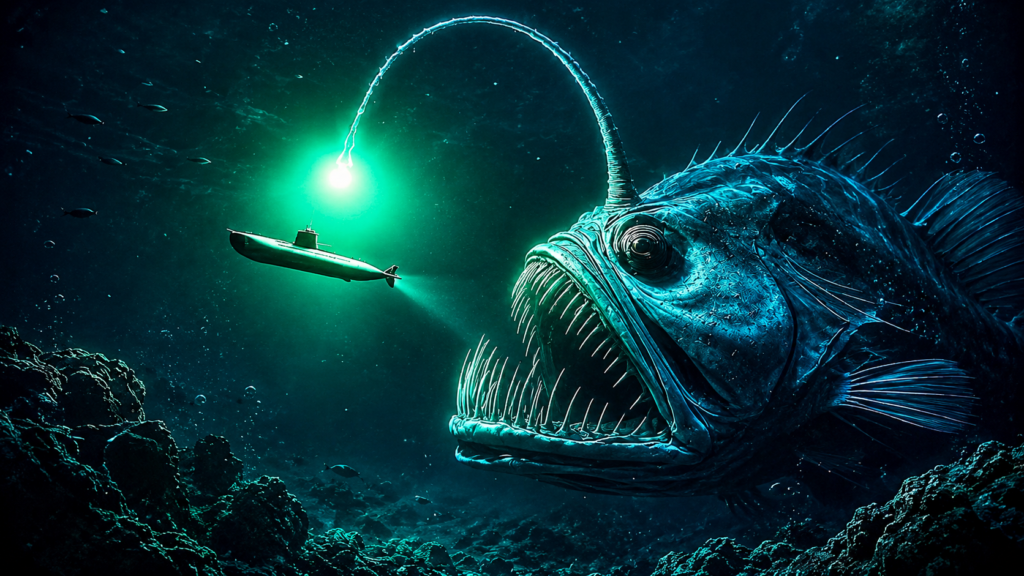
Far beneath the familiar blue surface of the sea exists an extraordinary world of darkness, immense pressure and remarkable life. As new technologies take exploration deeper than ever before, the ocean is revealing secrets that could transform our understanding of the planet.
Deep ocean exploration is opening a new chapter in scientific discovery. While humanity has mapped continents, studied distant planets and built increasingly sophisticated technologies, much of the deep seafloor remains poorly understood. Beyond the reach of ordinary sunlight lies an environment shaped by extreme pressure, unusual geological formations and ecosystems that have developed in ways scientists are still learning to understand.
The deep ocean is not simply an empty expanse of water. It is a complex world containing underwater mountains, volcanic landscapes, mineral deposits, ancient sediments and extraordinary organisms. Its importance extends far beyond marine biology: understanding these environments helps researchers investigate Earth’s history, climate systems and the delicate relationships that sustain life.
A World Beyond Sunlight
As sunlight disappears with increasing depth, the ocean becomes progressively darker and colder. In the deepest regions, pressure becomes so intense that specialised equipment is essential for reaching the seafloor.
Yet life continues to exist in these conditions. Deep-sea animals have developed remarkable adaptations, from transparent bodies and unusual sensory systems to bioluminescence—the ability to produce light through biological processes.
Some organisms live around hydrothermal vents, where mineral-rich water heated by Earth’s interior rises through cracks in the seafloor. These environments support communities that depend on chemical energy rather than sunlight, challenging traditional assumptions about the conditions necessary for life.
Other ecosystems develop around cold seeps, underwater mountains and vast abyssal plains. Each environment offers scientists a different opportunity to understand how organisms survive, interact and evolve in extreme conditions.
Discoveries That Are Expanding Scientific Knowledge
The scale of marine biodiversity is becoming increasingly apparent as international research programmes investigate previously unexplored environments.
In May 2026, the Ocean Census announced the discovery of 1,121 previously unknown marine species through a global scientific initiative. The discoveries included organisms from depths reaching 6,575 metres, demonstrating how much remains to be documented beneath the surface.
Such findings are significant because identifying a species is only the beginning. Researchers must understand its biology, habitat, ecological relationships and vulnerability to environmental change. New discoveries can reveal how ecosystems function and provide information that may help guide conservation decisions.
The deep ocean also contains geological evidence of processes that have shaped the planet over millions of years. Sediments, underwater volcanic formations and mineral structures can offer clues about Earth’s changing environment and geological development.
The Technology Making Exploration Possible
Exploring the deep ocean requires machines capable of operating in conditions that would be impossible for human divers.
Remotely operated vehicles, or ROVs, are controlled from research vessels and equipped with cameras, lights, robotic arms and scientific instruments. They allow researchers to observe habitats, collect samples and investigate underwater structures.
Autonomous underwater vehicles, or AUVs, operate without a continuous physical connection to a ship. They can follow programmed routes, collect measurements and create detailed maps of the seabed.
The Woods Hole Oceanographic Institution’s Deep Venture vehicle, developed with NASA’s Jet Propulsion Laboratory, is designed to operate from shallow water to full ocean depth—approximately 11,000 metres. Its capabilities include high-resolution mapping, imaging and sample collection.
These systems are changing the economics and possibilities of exploration. Researchers can investigate remote environments with greater precision, collect larger volumes of data and return to locations that would previously have been difficult to study.
Reading the Ocean Through DNA
One of the most promising developments in marine science is environmental DNA, commonly known as eDNA.
Living organisms leave traces of genetic material in their surroundings through skin cells, mucus, scales and other biological material. By collecting and analysing water samples, scientists can identify evidence of organisms that may never appear in underwater camera footage.
In May 2026, NOAA Ocean Exploration and its scientific partners released their first deep-sea eDNA datasets from expeditions aboard the research vessel Okeanos Explorer. The work demonstrates how genetic analysis can complement traditional observation and help researchers investigate biodiversity in difficult-to-reach environments.
This approach is particularly valuable when organisms are rare, elusive or too small to be easily identified through conventional methods. It also creates opportunities for comparing ecosystems over time and monitoring changes in marine life.
India’s Ambitions Beneath the Surface
Deep ocean research is also becoming an important area of scientific development for India.
Through its Deep Ocean Mission, India is investing in underwater robotics, ocean observation, biodiversity research and technologies for exploring deep-sea environments.
One of its major ambitions is MATSYA-6000, a human-occupied submersible designed to carry three people to depths of approximately 6,000 metres. According to information released by India’s Ministry of Earth Sciences in March 2026, its design and system engineering had been completed, with subsystem development and testing progressing through the programme.
The mission represents an important step towards developing domestic capabilities in deep-sea science and engineering. It also reflects the growing international interest in understanding the Indian Ocean and its complex underwater ecosystems.
The Scientific Responsibility of Going Deeper
Exploration brings opportunities, but it also introduces difficult questions.
The seabed contains mineral resources that have attracted commercial and strategic interest. However, deep-sea ecosystems are often slow to recover from physical disturbance. Removing mineral deposits or disrupting sediment layers could affect organisms and habitats that scientists have only recently begun to understand.
The challenge is to distinguish scientific discovery from uncontrolled exploitation. Better mapping, biodiversity assessments and long-term environmental monitoring are essential before decisions about commercial activity are made.
The UNESCO Intergovernmental Oceanographic Commission’s 2026 Global Ocean Science Report highlights a significant imbalance: although the ocean represents approximately 95 per cent of the biosphere, less than one per cent of national research budgets goes towards ocean science. The gap between the ocean’s importance and the resources dedicated to understanding it remains substantial.
International collaboration, transparent scientific data and responsible governance will therefore be central to the future of exploration.
A Frontier That Belongs to Future Generations
The deep ocean reminds us that discovery is not always about reaching another planet or travelling beyond Earth’s atmosphere. Some of the most extraordinary questions remain within our own world.
Every new expedition can reveal an unfamiliar species, an unexpected geological formation or evidence that changes scientific understanding. The next generation of underwater instruments may make it possible to study entire ecosystems with a level of detail that was previously unimaginable.
What lies beneath the deep ocean is not merely a collection of mysteries waiting to be solved. It is an interconnected natural system that influences the planet and deserves careful attention.
The more humanity discovers, the clearer one responsibility becomes: exploration must advance alongside understanding and protection. The last unknown world is not simply a frontier to conquer. It is a world we are only beginning to learn how to respect.