
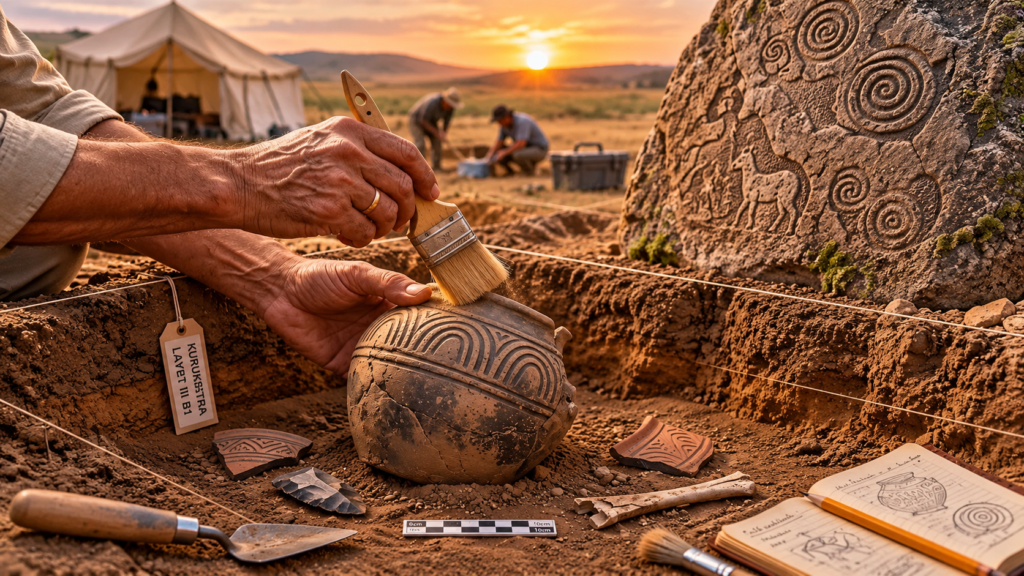
The history of human civilisation is no longer being uncovered through excavation alone. With ancient DNA, laser scanning, satellite imagery and artificial intelligence, researchers are discovering lost settlements, reconstructing forgotten lives and challenging long-held assumptions about the past.
Archaeological Science is transforming the way humanity understands its own history. For generations, archaeology relied heavily on excavation, the study of artefacts, inscriptions and architectural remains. These methods continue to be essential, but modern scientific techniques are allowing researchers to investigate questions that once seemed impossible to answer.
Who lived in a particular settlement? Where did they travel? What did they eat? How were communities connected across continents? What happened to civilisations whose physical remains are now hidden beneath forests, deserts or oceans?
Today, researchers are finding answers through laboratories, satellites, genetic databases and advanced imaging systems. The result is a more detailed understanding of the past, built not only from objects people left behind but also from the biological and environmental evidence surrounding them.
Discovering Cities Hidden Beneath Forests
One of the most significant developments in modern archaeology is LiDAR, short for Light Detection and Ranging.
The technology uses laser pulses to measure distances and create highly detailed representations of the ground. When mounted on aircraft or drones, LiDAR can help researchers identify landscape features that are difficult to see from the surface, including ancient roads, terraces, platforms and settlement patterns.
Its impact has been particularly significant in tropical regions, where dense vegetation can conceal archaeological remains.
In 2024, researchers reported the discovery of a vast ancient Maya urban landscape in Campeche, Mexico, using airborne laser scanning. The findings brought attention to settlements and structures that had remained largely concealed beneath vegetation.
The technology does not simply reveal individual buildings. It can help researchers understand how communities organised their surroundings, connected settlements and modified landscapes over time.
For archaeology, this represents a major shift: researchers can investigate entire cultural landscapes before deciding where physical excavation may be most useful.
Ancient DNA: Recovering the Stories of Human Migration
Perhaps no scientific development has changed the study of ancient populations more profoundly than the ability to recover and analyse ancient DNA.
Biological material preserved in bones and teeth can provide information about ancestry, population movement and relationships between groups. When combined with archaeological evidence, genetic research can help reconstruct the movement of people across regions and generations.
In December 2025, National Geographic reported on research involving a man buried in an Egyptian tomb approximately 4,500 years ago. Scientists recovered DNA from one of his teeth, providing an important insight into ancestry during the early history of ancient Egypt.
The findings suggested connections between Neolithic North African populations and populations from West Asia. Researchers also emphasised that the individual could not be treated as representative of everyone living along the Nile at that time.
This distinction matters. Ancient DNA can reveal important relationships, but a single individual cannot explain the complete genetic history of an entire civilisation.
Researchers are also developing techniques to study ancient DNA preserved in archaeological sediments. Soil from caves and settlement sites can sometimes retain traces of organisms that once occupied those environments, even when identifiable bones are absent.
The past is therefore becoming accessible through evidence that earlier generations of archaeologists could not routinely examine.
Artificial Intelligence Is Helping Decipher Lost Knowledge
Some of the most intriguing archaeological discoveries are not hidden underground but inside damaged documents.
The Herculaneum scrolls offer a remarkable example. These ancient Roman manuscripts were carbonised during the eruption of Mount Vesuvius in AD 79. Their fragile condition made conventional unrolling extremely difficult, as even small physical disturbances could destroy the remaining material.
Researchers have combined advanced imaging, computational analysis and machine-learning techniques to identify traces of writing within the scrolls.
The Vesuvius Challenge, an international research initiative, has helped bring together computer scientists, imaging specialists and classicists to make progress on reading these documents without physically opening them.
The achievement demonstrates how artificial intelligence can support historical research. Algorithms can help identify patterns in complex scans, but the interpretation of ancient language and context still requires specialist knowledge.
AI is not replacing the historian or archaeologist. It is giving them new ways to examine evidence that was previously inaccessible.
What Bones and Teeth Reveal About Everyday Life
Archaeology is not only concerned with rulers, monuments and major historical events. Scientific examination of human remains can also reveal the everyday experiences of ordinary people.
Bioarchaeologists study bones and teeth to investigate diet, physical activity, disease, injury and patterns of ageing. Stable isotope analysis can provide clues about what people consumed and, in some circumstances, where they may have lived during different stages of their lives.
Radiocarbon dating helps researchers establish the approximate age of suitable organic materials, providing chronological context for archaeological discoveries.
These methods can transform the interpretation of a burial site. A skeleton may reveal evidence of physical stress, while chemical traces in teeth can contribute to an understanding of childhood diet or mobility.
However, such evidence must be interpreted carefully. Scientific results are strongest when combined with archaeological context, historical records and other independent findings.
The aim is not to turn every ancient life into a complete biography. It is to build a more informed picture of the communities that shaped human history.
India’s Archaeological Past Is Entering a New Scientific Phase
India offers an important example of how scientific investigation can contribute to the study of ancient urban civilisation.
Rakhigarhi in Haryana is one of the largest known settlements associated with the Indus Civilisation. Its archaeological remains provide evidence of planned habitation, drainage systems, craft production, trade and burial practices.
In June 2026, the Ministry of Culture announced that human skeletal remains excavated at Rakhigarhi during the 2025–26 field season had been transferred by the Archaeological Survey of India to the Anthropological Survey of India for detailed scientific investigation.
The material included three complete human skeletons and additional skeletal fragments recovered from excavated burials.
The research is expected to contribute to multidisciplinary investigation of one of the important urban centres of the Indus-Saraswati Civilisation. The transfer itself does not establish new conclusions about the ancestry or identity of the people buried there; those questions require scientific analysis and careful interpretation.
The development illustrates the importance of collaboration between archaeological institutions and scientific research organisations.
India’s ancient history contains questions that cannot always be resolved through artefacts and architecture alone. Scientific investigation can provide additional evidence while preserving the distinction between established findings and hypotheses that still need testing.
The Archaeology of the Oceans
Some of humanity’s most important historical evidence lies beneath the water.
Ancient ports, submerged settlements, shipwrecks and coastal landscapes can reveal how communities traded, travelled and interacted. Underwater archaeology combines traditional excavation with sonar, remotely operated vehicles, photogrammetry and specialised remote-sensing technologies.
These tools allow researchers to document submerged sites that may be difficult or dangerous to investigate directly.
Laser-based techniques are also being adapted for certain shallow-water environments. Bathymetric LiDAR research has explored how underwater terrain data can help identify potential archaeological features.
The oceans present their own challenges. Visibility, currents, depth, preservation conditions and the expense of specialist equipment all influence what can be investigated.
Yet each new survey offers an opportunity to recover evidence of maritime activity and communities whose histories are only partially represented in written records.
The Responsibility That Comes With Discovery
Scientific progress brings important responsibilities.
Archaeological remains are not simply research material. They are connected to living communities, cultural identities and questions of ownership, heritage protection and repatriation.
Human remains require particular sensitivity. Research must follow appropriate ethical standards, legal requirements and consultation with relevant communities. The extraction of DNA or other biological information should not be treated as an unrestricted scientific exercise.
There are also technical limitations. Genetic evidence can be incomplete, imaging can produce ambiguous results and algorithms may identify patterns that require human verification. A striking visualisation is not automatically proof of a historical interpretation.
The most reliable archaeological conclusions emerge when scientific findings are tested against independent evidence and openly examined by specialists.
A New Way of Understanding Human History
Archaeology is entering an era in which the smallest biological trace and the largest landscape can both become sources of historical knowledge.
A tooth can provide evidence of ancient ancestry. A laser survey can reveal an entire settlement hidden beneath vegetation. A damaged manuscript can become readable through computational imaging. A submerged landscape can offer clues about communities that lived thousands of years ago.
These developments are not making traditional archaeology obsolete. Excavation, conservation, historical interpretation and the study of material culture remain central to the discipline.
What is changing is the range of questions researchers can ask and the evidence available to answer them.
The past has never been silent. Humanity is simply developing more sophisticated ways to listen.