
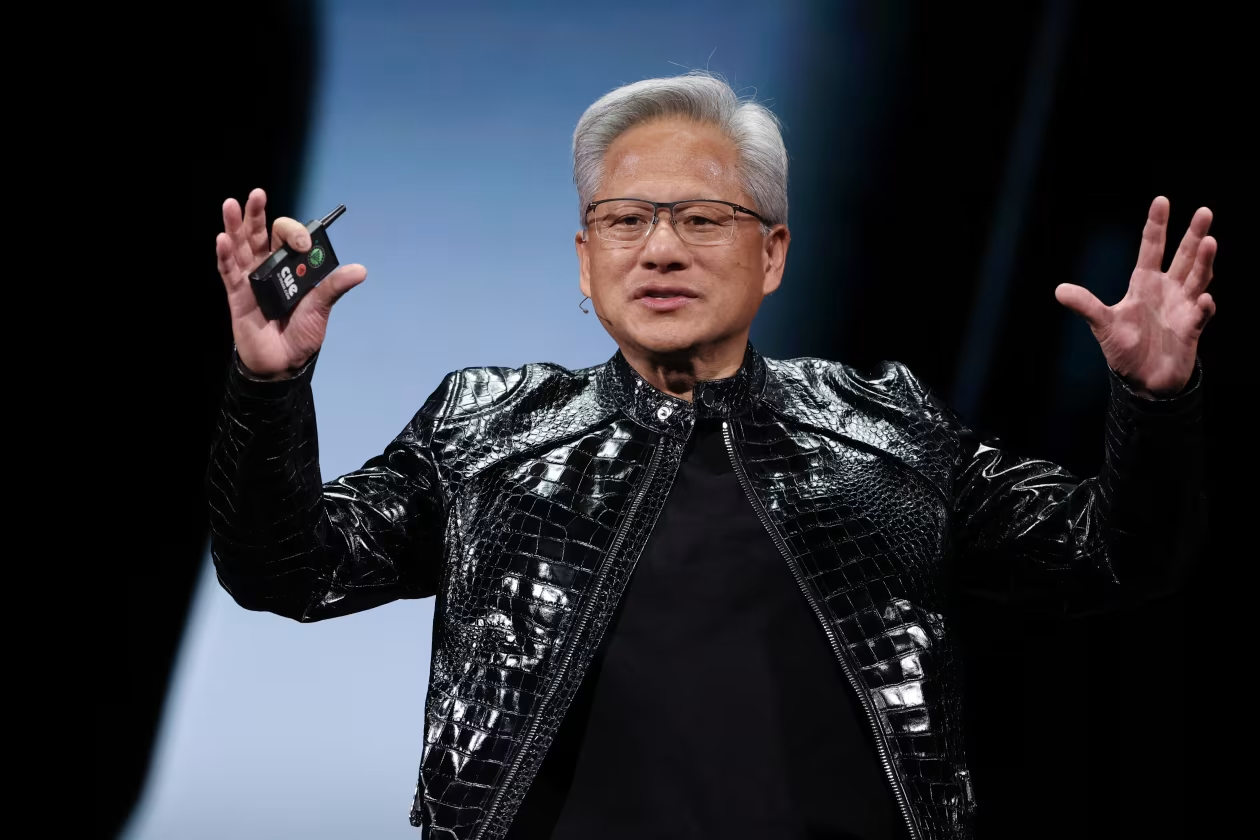
The Nvidia co-founder turned a graphics company into the infrastructure layer of artificial intelligence, proving that the most valuable technology companies often own the bottleneck beneath the future.
In the ANAX language of power, Jensen Huang is not interesting merely because of scale. Scale is the visible part. The deeper story is the operating code: the set of choices, refusals, habits and institutional designs that allowed a single biography to become a reference point for others. The Nvidia co-founder turned a graphics company into the infrastructure layer of artificial intelligence, proving that the most valuable technology companies often own the bottleneck beneath the future. The cover line — He wore a leather jacket to every board meeting. Then he built the world’s most valuable company. — is not a slogan placed over an image. It is the thesis of the profile: a compressed statement about how authority is built when the public story finally catches up with the private discipline.
Every modern figure of consequence eventually becomes surrounded by numbers. Valuations, revenues, followers, assets under management, market capitalisation, personal wealth and rankings become shorthand. Yet numbers alone rarely explain why a life begins to matter beyond its balance sheet. In Jensen Huang’s case, the useful question is not simply what was built, but what pattern became repeatable. ANAX reads that pattern through the lens of infrastructure before application, founder continuity, the symbolism of the uniform, compute as sovereignty, the hardware moat. These are not decorative ideas. They are the structural forces that turn success into influence and influence into legacy.
The public record gives the foundation: co-founded Nvidia in 1993; helped move GPUs from graphics acceleration into accelerated computing and artificial intelligence; became one of the defining industrial figures of the AI infrastructure age. Those facts matter, but they do not exhaust the story. The more revealing part is the movement from circumstance to system. Some leaders inherit institutions. Others invent them in public. Others still discover that a market, a medium or a city is waiting for a new grammar. Jensen Huang belongs to the class of figures whose achievement cannot be understood only as ambition. It has to be studied as architecture: a way of organising people, capital, attention and belief around a durable proposition.
The early phase of any sovereign career usually looks less polished than the later myth. There is a period of rejection, improvisation, imperfect timing or private risk that disappears once the achievement becomes obvious. That early uncertainty is important because it explains the later discipline. Prestige is rarely born as prestige. It usually begins as a difficult decision taken before the audience arrives. The founder, investor, executive or royal operator must act before consensus, and must then survive long enough for the world to agree that the decision was sensible. That is why this profile is not about glamour. It is about the cost of conviction.
One of the strongest lessons in Jensen Huang’s story is that power becomes durable only when it is transferred from personality into system. Charisma may open the door, but it cannot maintain the house. The lasting figure builds mechanisms: a company culture, a product rhythm, a capital allocation method, a governance philosophy, a media machine, a design language or a civic programme. The individual becomes significant because the work can travel without them. In ANAX terms, that is the moment success begins to become sovereignty — when a private instinct is formalised into an institution others must respond to.
There is also a question of taste. Not taste in the narrow sense of fashion, but taste as judgment: the ability to know what to say no to, what to preserve, what to scale and what to leave untouched. Great business figures often appear aggressive from the outside, yet their real power is selective. They decide which constraint to respect. They choose which audience matters. They understand when scarcity is more valuable than reach, when patience is more valuable than speed, and when a public gesture can shape private confidence. Jensen Huang’s story shows that taste is not softness. It is strategy operating at a higher resolution.
The ANAX standard also requires looking at tension. Legacy profiles should not become worship. Every empire carries contradiction. Scale can create dependence. Visibility can invite distortion. Founder control can produce speed but also concentration. Philanthropy can inspire but also raise questions about influence. Markets reward ambition while punishing excess. In the case of Jensen Huang, the very qualities that produced power also create the debate around that power. This is why the most serious reading of legacy is never a poster. It is a balance sheet of consequences: what the world gained, what was disrupted, what became possible, and what remains unresolved.
For founders, heirs, family offices and next-generation leaders, the practical lesson is clear. A reputation is not secured by announcement. It is secured by behaviour repeated under pressure. The market believes what it has seen more than what it has been told. When Jensen Huang’s work is studied closely, the common thread is not luck. It is the construction of trust across time: trust from customers, investors, citizens, readers, employees, partners or followers. The medium changes, but the principle remains. Influence compounds only when it is made credible.
The story also reveals a shift in how modern luxury and power are understood. The old symbols — estates, objects, titles, rare access — still matter, but they now sit beside less visible assets: data, distribution, narrative, institutional memory, community and time. The new sovereign figure owns or shapes one of those deeper assets. That is why ANAX places technology founders beside luxury magnates, media builders beside capital allocators, and public leaders beside entrepreneurs. Each is participating in the same larger drama: the contest to define what authority looks like in the next cycle.
For the reader, the question is not whether to imitate Jensen Huang. Direct imitation is usually the weakest form of admiration. The stronger question is: what principle can be extracted? Is it patience, product intuition, ownership, narrative control, engineering seriousness, cultural timing, institutional design or refusal to ask permission? Once extracted, the principle becomes portable. It can be applied to a family business, a private office, a professional reputation, a media platform, a fund, a brand or a city. This is how biography becomes intelligence.
The ANAX verdict is therefore measured but clear. Jensen Huang represents more than a successful career. The story belongs to the archive of influence because it shows how private discipline becomes public consequence. It reminds us that prestige is not the same as fame, and legacy is not the same as wealth. Wealth can be counted. Legacy has to be interpreted. It lives in the systems a person leaves behind, the language others adopt, the risks they make respectable and the imagination they make available to the next generation.
In the end, the cover is not merely an image. It is an argument. Jensen Huang stands inside ANAX’s Power 100 and Sovereign Wealth universe because the life demonstrates a central ANAX principle: relevance must be built. It must be built through pressure, taste, patience and structure. It must be protected against noise. It must be renewed when the world changes. And when it is built well enough, it no longer belongs only to the individual. It becomes a reference point — a private code made public, a story others study when they are trying to understand how power actually endures.
Why it matters
Jensen Huang’s significance is not only historical or commercial. The profile matters because it reveals how modern influence is formed at the intersection of capital, culture, technology, narrative and institutional trust. ANAX publishes this essay as part of The Sovereign Issue, a digital magazine project documenting figures whose decisions shaped how power now moves.
Editorial source note
This article is an ANAX editorial profile built from publicly available biographical, company and institutional records. Readers should treat the essay as interpretation, not investment, legal or political advice.