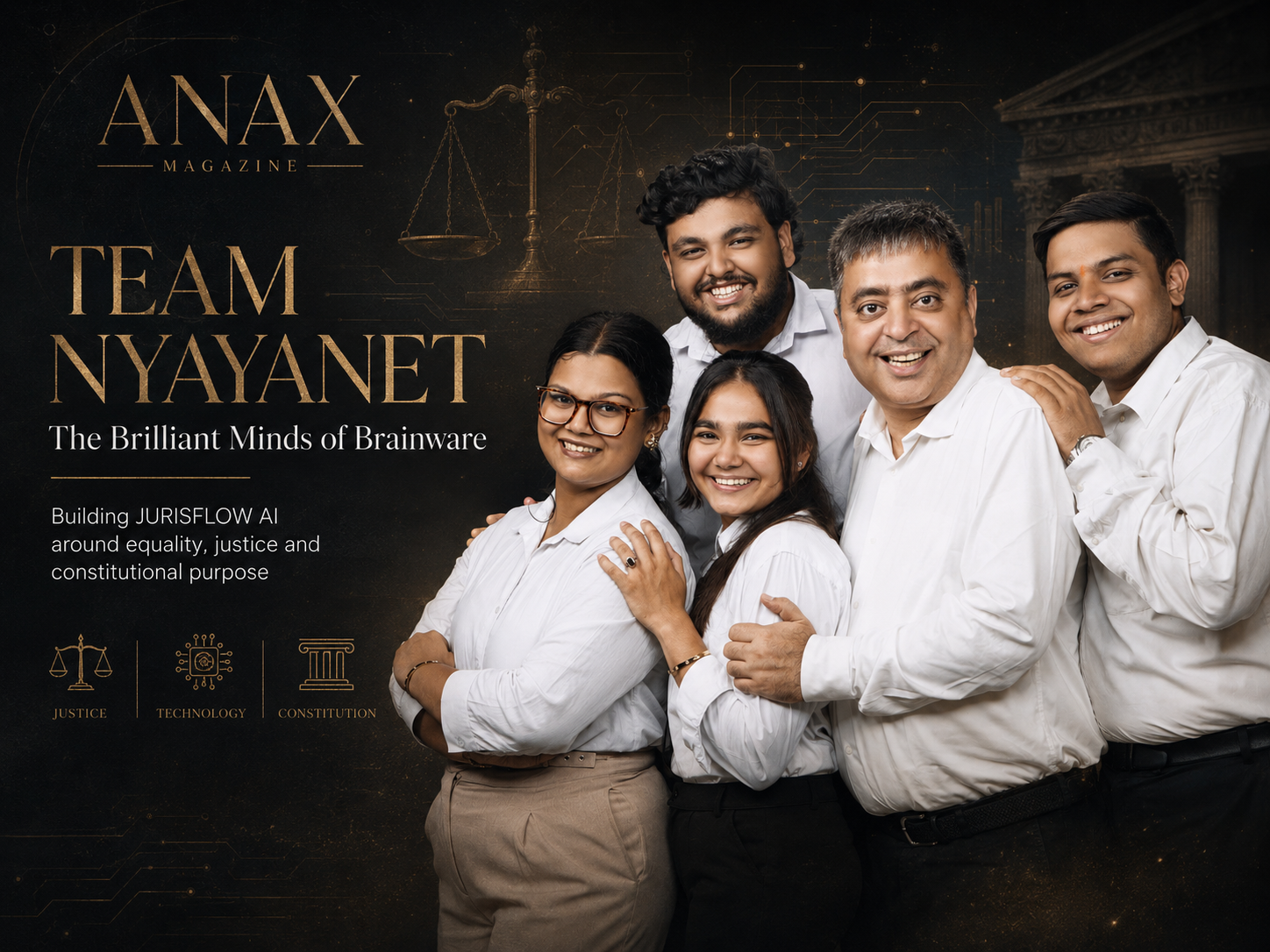
Led and mentored by Raja Mukherjee, six emerging legal innovators are building an ambitious LegalTech prototype around a larger social cause: protecting equality, dignity and access to justice for every Indian citizen.
Some teams are formed to win competitions.
Others come together because they believe a problem is too important to leave untouched.
At Brainware University’s Barasat campus in West Bengal, six minds gathered around a question that reached far beyond a classroom, a hackathon or a technology demonstration.
Could artificial intelligence be designed to strengthen India’s constitutional promise of equality and justice for all, without replacing judges, weakening human responsibility or reducing citizens to data points inside an opaque system?
That question became the foundation of Team NyayaNet.
Led and mentored by Raja Mukherjee, the team brings together Sayantani Mukherjee, Harshdeep Kaur, Bhaswati Roy, Sabyasachi Dasgupta and Tushan Rajbanshi.
Collectively, they represent what may rightly be recognised as “The Brilliant Minds of Brainware”, a group of emerging legal thinkers and innovators who have attempted to translate constitutional values into a practical technological framework.
Their creation is JURISFLOW AI, a multilingual, voice-first, federated and human-supervised LegalTech prototype conceived to reduce the procedural distance between an ordinary citizen and India’s justice system.
But the real story begins before the architecture, before the code and before the prototype.
It begins with purpose.
A Return to Law School and the Discovery of Five Young Minds
Raja Mukherjee’s return to legal education became the starting point of Team NyayaNet’s journey.
Already engaged with geopolitics, artificial intelligence, constitutional research and public policy, Mukherjee entered Brainware University with an understanding that the future of law would increasingly depend upon how institutions respond to technology.
There, he encountered five first-year students from the integrated BBA.LLB programme who were willing to think beyond conventional academic boundaries.
Sayantani Mukherjee, Harshdeep Kaur, Bhaswati Roy, Sabyasachi Dasgupta and Tushan Rajbanshi were not entering the project as experienced engineers.
They were law students.
They were learning statutes, constitutional principles, legal reasoning and institutional structures. Yet they were also prepared to enter a field often dominated by computer-science and engineering teams.
This became one of Team NyayaNet’s defining strengths.
Rather than approaching justice as another process to automate, they began with the legal and constitutional consequences of automation.
They asked what could go wrong.
They asked who might be excluded.
They asked whether a citizen’s language, geography, caste, religion, gender, income or digital literacy could influence the quality of access received.
They also asked whether artificial intelligence could be designed to remain subordinate to human authority.
These questions shaped not only what they built, but why they built it.
More Than a Hackathon
The project developed during the 2025–2026 Brainware University Hackathon Challenge.
Many competing teams came from B.Tech and engineering backgrounds. Team NyayaNet entered from a legal-academic environment, carrying a problem statement rooted in access to justice rather than conventional software productivity.
Over approximately three months, the group moved through a demanding learning curve.
They studied the justice system.
They examined legal workflows.
They researched court procedures, filing requirements, citizen barriers, language diversity and data protection.
They worked through notebooks, diagrams, code, prototypes and repeated testing.
What began as an idea gradually became a functioning legal-technology application.
The team advanced to the final stage and secured the number-one position in the competition.
Yet the achievement was not treated as an ending.
For the six members, the hackathon became proof that a legal team could enter a technical arena and contribute something distinctive: a system designed not merely around efficiency, but around constitutional restraint, public accountability and social inclusion.
The trophy recognised the prototype.
The larger achievement was the formation of a team with a shared institutional ambition.
The Social Cause Behind Team NyayaNet
At the centre of Team NyayaNet’s work is a clear social cause.
The team seeks to protect and strengthen the constitutional framework of equality before the law, equal protection of the laws, dignity, fair procedure and meaningful access to justice.
For them, JURISFLOW AI is not simply a commercial software application.
It is an attempt to examine how technology might help citizens who are separated from formal justice by language, distance, legal complexity, cost or limited digital literacy.
India’s Constitution promises justice, social, economic and political.
It also establishes equality before the law and directs the State to secure equal justice and free legal aid.
Yet the lived experience of justice can differ dramatically.
A senior lawyer in a metropolitan city may navigate procedure with institutional familiarity. A citizen in a remote village may struggle to identify the correct forum, prepare a complaint, understand legal language or even communicate the grievance in a form accepted by the system.
Team NyayaNet’s guiding question captures this divide:
Can a tribal grandmother in Jharkhand and a senior counsel in Delhi reach the same bench with the same dignity, on the same day, in their own language?
The question is symbolic, but its implications are concrete.
It asks whether technology can reduce inequality without creating new forms of exclusion.
It asks whether digital justice can remain constitutional justice.
And it asks whether artificial intelligence can serve the citizen without becoming a substitute for the institutions and human judgment upon which the rule of law depends.
The Brilliant Minds of Brainware
Team NyayaNet’s identity is inseparable from its six members.
Raja Mukherjee (Team Lead and Mentor)
Raja Mukherjee provides the project’s intellectual and strategic direction.
His multidisciplinary interests across law, artificial intelligence, political analysis, finance and constitutional governance shaped the project’s broader vision.
As Team Lead and Mentor, his role extended beyond supervising development.
He helped frame JURISFLOW AI as a constitutional and social-impact initiative rather than a standalone technology product.
The project’s emphasis on multilingual access, public audit, federated data structures and Human-in-the-Loop control reflects this wider approach.
Sayantani Mukherjee
Sayantani Mukherjee contributed to the team’s research, learning and application-development journey.
As part of the early-stage group, she participated in transforming legal concepts into practical workflows that ordinary citizens could understand.
Harshdeep Kaur
Harshdeep Kaur formed part of the team’s legal-research and collaborative development process, contributing to the effort to create a system that remained attentive to citizen experience and constitutional safeguards.
Bhaswati Roy
Bhaswati Roy contributed to the project’s academic and prototype-development journey, helping the team move from concept-building to a tested LegalTech application.
Sabyasachi Dasgupta
Sabyasachi Dasgupta participated in the research, development and testing process through which Team NyayaNet refined the citizen-to-courtroom idea.
Tushan Rajbanshi
Tushan Rajbanshi contributed to the team’s collaborative build, helping develop and test a prototype that combined legal workflows with emerging AI capabilities.
Together, these six individuals represent The Brilliant Minds of Brainware.
Their significance lies not only in winning a university competition, but in demonstrating that young legal minds can participate meaningfully in the design of complex technological systems.
From Citizen Speech to Legal Structure
JURISFLOW AI begins with one of the most basic acts of justice: allowing a person to explain what happened.
The platform is designed around voice-first intake.
Instead of requiring every citizen to begin with a complex form, the proposed workflow allows a person to narrate a grievance in an Indian language.
The system then attempts to transcribe the account, retain the source language, organise the facts and identify potentially relevant legal provisions.
It can classify the cause of action, jurisdiction, urgency and possible forum.
It can also prepare a preliminary petition, complaint or response draft for review.
This matters because legal exclusion frequently begins before a person reaches a courtroom.
The problem may not be the absence of a right.
It may be the inability to express that right in the language and form expected by an institution.
For Team NyayaNet, voice is therefore not merely a convenience feature.
It is a social-access principle.
A microphone may be more inclusive than a long digital form.
A spoken grievance may be more accessible than legal vocabulary.
And a system that preserves the citizen’s original language may reduce the risk that translation erases meaning.
Human Authority Before Automation
One of the most important features of JURISFLOW AI is the Human-in-the-Loop Checkpoint.
Before an irreversible action is taken, a person must review what the system proposes.
This could involve filing a document, processing a payment, retrieving an FIR-related record or interacting with an external public system.
The user can approve, edit or reject the proposed action.
This design reflects Team NyayaNet’s belief that technology should assist constitutional institutions, not displace them.
The platform is not presented as an artificial judge.
It does not claim the authority to issue binding determinations.
It is intended to support preparation, organisation, translation, research, drafting and workflow.
The final responsibility remains with the citizen, advocate, registry or judicial institution legally empowered to act.
In this sense, Human-in-the-Loop control is not simply an engineering safety feature.
It is part of the project’s constitutional philosophy.
Equality by Design
Team NyayaNet’s stated “zero-bias” ambition is connected to the constitutional commitment to equality.
The proposed routing framework excludes protected characteristics such as caste, religion, gender and income.
The project also describes statistical checks intended to examine whether routing outcomes are distributed unevenly.
Its wider documentation refers to public audit records and cryptographically verifiable processes for actions that require random allocation.
No technology platform can credibly guarantee that bias has been permanently eliminated.
Discrimination can enter through data, language quality, system defaults, geographic variables or incomplete documentation.
The more important contribution is the team’s attempt to make algorithmic conduct visible and contestable.
Instead of asking users to trust a black box, the project proposes that significant actions should leave an inspectable record.
This principle is particularly important in justice.
When a system influences how a legal matter is classified, drafted or routed, citizens should be able to understand what occurred.
Team NyayaNet’s social mission is therefore not merely to improve speed.
It is to explore whether technology can make process more transparent, understandable and accountable.
Building With Constitutional Restraint
The wider JURISFLOW AI research framework presents four recurring ideas.
The first is federation.
Rather than placing all judicial data inside a single central system, the proposed model allows institutions to retain control over their own records.
The second is multilinguality.
Citizen-facing access is intended to support India’s linguistic diversity, including scheduled languages and, in the broader development vision, regional and tribal dialects.
The third is verifiability.
Important system actions should be logged and capable of independent review.
The fourth is restraint.
No component should be permitted to replace the judicial mind or issue a binding legal determination.
Together, these ideas reveal the seriousness of Team NyayaNet’s ambition.
They are not asking only what artificial intelligence can do.
They are asking what it should be permitted to do.
The Journey From Prototype to Public Conversation
The next stage of JURISFLOW AI is described through a proposed development path.
The team envisions pilot engagement with courts and advocate firms, expansion across jurisdictions, deeper multilingual capabilities and eventual integration with approved public systems.
These remain future objectives.
Any real-world deployment would require institutional permission, independent security testing, legal validation, privacy review, technical auditing and structured consultation with the judiciary and bar.
The team’s challenge will be to maintain its founding values while moving toward scale.
A prototype can be built by a small group.
Public justice infrastructure requires governance.
It requires accountability.
It requires independent oversight.
It requires clear responsibility when something fails.
Team NyayaNet’s long-term credibility will depend not only on technological capability, but on how openly it engages with these questions.
Why Their Story Matters
The story of Team NyayaNet is not important because six people built another AI application.
It matters because they attempted to build one around constitutional values.
They began as students and a mentor.
They competed against technically trained teams.
They entered an unfamiliar development environment.
They learned, tested and iterated.
They transformed a social concern into a working prototype.
And they carried that prototype into a larger discussion about the future of justice.
Their journey demonstrates that innovation does not always begin with access to enormous capital or institutional power.
Sometimes it begins with a small group willing to examine a national problem closely enough to believe that they have a responsibility to respond.
A Legacy Beyond the Competition
Team NyayaNet’s greatest legacy may not ultimately be a particular model, database or software stack.
Technology will change.
AI systems will improve.
Legal frameworks will evolve.
The more enduring contribution may be the principle behind the work:
That technology entering the justice system must be framed by equality.
That language must not become a barrier to rights.
That citizens must retain agency.
That algorithmic actions must be open to scrutiny.
That judges and constitutional institutions must remain sovereign.
And that innovation must serve those who have historically found the system hardest to reach.
Raja Mukherjee, Sayantani Mukherjee, Harshdeep Kaur, Bhaswati Roy, Sabyasachi Dasgupta and Tushan Rajbanshi are more than the names behind a hackathon-winning prototype.
They are The Brilliant Minds of Brainware, a team attempting to demonstrate that the future of Indian LegalTech can be technologically ambitious and constitutionally disciplined at the same time.
Their mission is not to place machines above justice.
It is to ask whether machines can help justice reach more people without losing the human and constitutional values that give justice its meaning.