
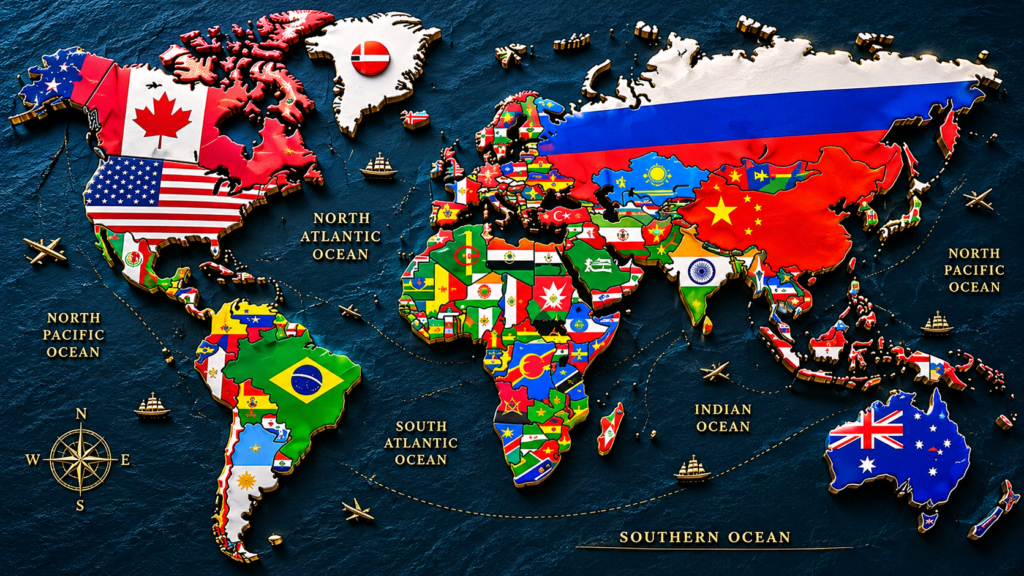
International law is often described as the legal framework governing relations between countries. Yet its influence reaches far beyond diplomatic agreements. It shapes international trade, maritime boundaries, human rights, environmental responsibilities, armed conflict and the treatment of individuals across borders.
Unlike domestic law, international law does not operate under a single world government. There is no global parliament with unlimited authority, no universal police force and no supreme executive capable of automatically enforcing every ruling.
Instead, the system is built through treaties, international conventions, customary practices, judicial institutions and agreements between sovereign states.
The United Nations Charter provides one of its central foundations. It recognises the sovereign equality of member states, requires peaceful settlement of international disputes and prohibits the threat or use of force against another state’s territorial integrity or political independence, subject to recognised exceptions under international law.
These principles establish an ambitious proposition: national power should operate within an internationally recognised legal framework.
The International Court of Justice: A Court for Nations
The International Court of Justice, based at the Peace Palace in The Hague, is the principal judicial organ of the United Nations.
Its role is to resolve legal disputes submitted by states and provide advisory opinions on legal questions referred to it by authorised United Nations bodies and agencies.
The distinction between international and domestic courts is important. The ICJ does not prosecute individual political leaders or military commanders. Its contentious cases concern disputes between states.
It may consider matters involving territorial sovereignty, maritime boundaries, diplomatic relations and the interpretation of international treaties.
However, the Court cannot simply summon any country before it. Its jurisdiction in contentious cases depends on the consent of the states concerned, expressed through recognised legal arrangements such as treaty provisions, declarations accepting jurisdiction or special agreements.
This creates an important limitation. A country cannot automatically be taken before the Court merely because another government believes it has violated international law.
Nevertheless, ICJ judgments carry legal authority and are binding on the parties in the particular case. They can influence diplomatic relations, international negotiations and the development of legal principles.
The International Criminal Court: Individual Accountability
While the ICJ deals with disputes between countries, the International Criminal Court focuses on individuals.
Established through the Rome Statute, which entered into force in 2002, the ICC was created to investigate and prosecute individuals accused of some of the most serious international crimes.
Its jurisdiction covers genocide, crimes against humanity, war crimes and the crime of aggression, subject to the specific jurisdictional conditions of the Statute.
The principle behind the Court is significant: individuals should not automatically escape criminal responsibility because they hold political or military authority.
However, the ICC is not a universal criminal court with authority over every person in every country. Its jurisdiction depends on factors including territorial or nationality connections to states parties, acceptance of jurisdiction by a non-party state, or a United Nations Security Council referral.
It also follows the principle of complementarity. National courts retain primary responsibility for prosecuting these crimes, while the ICC may intervene when the relevant national authorities are genuinely unwilling or unable to carry out proceedings.
The Court therefore represents an important development in international justice, but its effectiveness depends heavily on legal jurisdiction and cooperation from governments.
The United Nations Security Council: Where Law Meets Power
The United Nations Security Council occupies a particularly influential position in international peace and security.
It has 15 members, including five permanent members: China, France, Russia, the United Kingdom and the United States.
The permanent members possess veto power over substantive resolutions. This arrangement was established as part of the post-Second World War international order, reflecting the political realities of the period.
The Council can impose sanctions, establish peacekeeping operations and authorise certain enforcement measures under the UN Charter.
However, the veto creates a fundamental tension. A permanent member can prevent substantive Council action even when other members support intervention.
This means the enforcement of international decisions can be influenced by geopolitical alliances and national interests.
The arrangement illustrates one of the central contradictions of international governance: the institution entrusted with maintaining international peace is also shaped by the political power of its strongest members.
When Countries Disagree: The Importance of Treaties
International law does not depend exclusively on courts and the United Nations.
Treaties are among its most important instruments. Countries negotiate and sign agreements that establish obligations on subjects ranging from trade and diplomatic relations to environmental protection and human rights.
The Geneva Conventions, for example, establish important protections for people affected by armed conflict. The Paris Agreement provides a framework for international cooperation on climate change. The United Nations Convention on the Law of the Sea establishes a broad legal framework governing maritime activities and ocean rights.
Treaties are particularly important because they transform political commitments into legal obligations for the states that become parties to them.
Their effectiveness, however, depends on implementation, monitoring, transparency and the willingness of governments to fulfil their commitments.
A country may formally accept an international agreement while facing domestic political, economic or administrative difficulties in implementing it.
The distance between signing an agreement and delivering its promised results remains one of the most important challenges in international law.
The Problem of Enforcing Justice
One of the most frequently asked questions about international law is simple: what happens when a country refuses to obey?
The answer is complicated.
Unlike domestic legal systems, international institutions generally lack independent enforcement agencies capable of compelling every government to comply with every decision.
The ICJ does not maintain its own police force. The ICC also depends on national authorities to execute arrest warrants and facilitate the surrender of suspects.
Under Article 94 of the UN Charter, a party to a case before the ICJ undertakes to comply with the Court’s judgment. If it fails to do so, the other party may approach the Security Council, which can make recommendations or decide upon measures.
But political considerations can influence what happens next.
Governments may respond to violations through diplomatic pressure, economic sanctions, reciprocal measures, international investigations or coordinated action through multilateral institutions.
These responses can create significant consequences, but they are not always immediate or consistent.
Consequently, international law often operates through a combination of legal authority, political pressure, cooperation and international reputation rather than automatic enforcement.
Can Powerful Nations Be Held Accountable?
The question of accountability becomes especially difficult when the state involved possesses considerable military, economic or diplomatic influence.
International law is founded on the principle of sovereign equality, meaning that states have equal legal standing within the United Nations system. Yet their practical influence is far from equal.
A smaller country may depend heavily on international institutions and diplomatic partnerships, while a powerful nation may possess greater resources to resist external pressure.
This imbalance does not mean international law has no value. Legal proceedings can establish facts, clarify obligations, preserve evidence and create formal records of alleged violations.
International judgments and investigations can also influence domestic court proceedings, diplomatic decisions and future treaty negotiations.
However, accountability is not guaranteed simply because a legal violation has been alleged or a court has issued a decision.
The credibility of the system ultimately depends on whether its rules are applied consistently, including when politically influential countries are involved.
The Future of International Justice
The international legal system is entering an increasingly complex period.
Cyberattacks, artificial intelligence, autonomous weapons, climate-related disputes, cross-border data regulation and emerging technologies are creating questions that existing legal frameworks were not always designed to address.
Governments must determine how traditional principles of sovereignty, responsibility and jurisdiction apply to activities that can cross national borders within seconds.
International cooperation will become increasingly important as these challenges develop.
Reforming international institutions, improving access to justice, strengthening investigative capacity and encouraging consistent treaty implementation will all contribute to the future credibility of the system.
There is also a growing need to ensure that smaller countries have meaningful opportunities to participate in shaping international rules rather than merely responding to decisions made by more powerful governments.
The Rule of Law in a World of Power
International law cannot eliminate political rivalry, prevent every conflict or guarantee that every government will obey international decisions.
Its importance lies elsewhere.
It provides a common language through which countries can challenge one another’s actions, negotiate solutions, establish obligations and seek legal remedies without relying exclusively on military or economic power.
The institutions supporting this framework remain imperfect, and their limitations deserve serious scrutiny. Yet abandoning international legal principles would leave global relations even more dependent on the unequal distribution of power.
The ultimate test of international justice is not whether it can hold weaker nations accountable. It is whether its principles retain credibility when the most influential countries are placed under scrutiny.
In a world without a single authority above all nations, the rule of law remains one of humanity’s most important attempts to ensure that power is accompanied by responsibility.