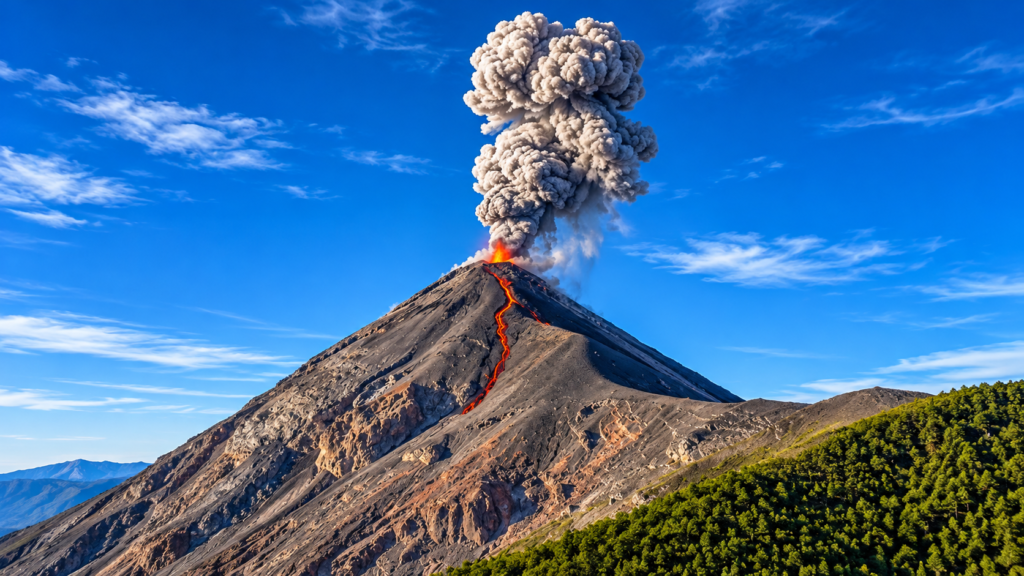
Beneath mountains, islands and apparently peaceful landscapes, the Earth holds an extraordinary source of energy. Volcanoes reveal this hidden world, releasing molten rock, gases and ash while continually reminding humanity that the planet beneath our feet is alive with geological activity.
Few natural phenomena combine beauty and destruction quite like a volcanic eruption. A mountain that appears dormant can suddenly release enormous clouds of ash, glowing lava and powerful explosions. Entire landscapes can change, coastlines can expand and communities can be forced to leave their homes.
Yet volcanoes are not simply instruments of destruction. They have helped create islands, enriched agricultural land, shaped atmospheric conditions and offered scientists an extraordinary window into the planet’s interior.
Understanding them means exploring some of the most powerful processes taking place on Earth.
The Planet’s Hidden Heat
The Earth is not a solid, motionless sphere. Beneath its crust lies an interior characterised by extreme temperatures, pressure and slowly moving geological materials.
The outermost layer, known as the crust, is divided into enormous sections called tectonic plates. These plates move gradually over geological time. Their interactions are responsible for many of the planet’s most significant geological features, including mountain ranges, ocean trenches, earthquakes and volcanoes.
Magma is molten or partially molten rock beneath the Earth’s surface. When it reaches the surface, it is called lava. As magma rises, pressure changes can allow dissolved gases to expand, contributing to volcanic activity.
Volcanoes commonly develop where tectonic plates separate, where one plate moves beneath another, or where magma rises through areas of concentrated geological activity.
However, not every volcano forms at a plate boundary. Some develop above mantle plumes, regions where unusually hot material rises from deeper within the Earth.
The Different Personalities of Volcanoes
Not all volcanoes erupt in the same way. Their behaviour depends on magma composition, temperature, viscosity and the amount of gas trapped within it.
Some produce relatively gentle lava flows. Others generate explosive eruptions capable of sending ash and volcanic material high into the atmosphere.
Shield volcanoes, such as those found in Hawaii, are generally broad with gently sloping sides. Their fluid lava can travel considerable distances.
Stratovolcanoes, including Mount Fuji in Japan and Mount Vesuvius in Italy, typically have steeper profiles and can produce both lava flows and explosive eruptions.
Calderas represent another dramatic volcanic feature. They form when a volcanic system loses significant material during an eruption or through underground magma movement, causing the ground above to collapse. Some calderas become enormous geological depressions.
Each volcanic structure tells a different story about the geological processes operating beneath it.
The World’s Most Extraordinary Volcanic Landscapes
Volcanoes have created some of the most remarkable landscapes on Earth.
Mount Etna in Sicily is among Europe’s most active volcanoes. Its repeated eruptions have reshaped the surrounding terrain and influenced the agricultural life of the region. Its presence is inseparable from the identity of eastern Sicily.
In Japan, Mount Fuji stands as a powerful symbol of national culture and natural heritage. Its almost symmetrical form has inspired artists, writers and travellers for generations. Although its last major eruption occurred in 1707, it remains an active volcano monitored by scientists.
Iceland offers a different experience. Situated along the Mid-Atlantic Ridge, the country has an extraordinary concentration of volcanic and geothermal features. Its landscape includes lava fields, volcanic craters, hot springs and areas where the movement of tectonic plates can be observed.
In Indonesia, Mount Merapi is one of the country’s most closely monitored volcanoes. Its history of eruptions illustrates the challenges faced by communities living near active volcanic systems.
These locations demonstrate that volcanoes are not isolated geological curiosities. They are part of the natural and cultural identity of entire regions.
When the Earth Changes Its Shape
The most dramatic eruptions can transform landscapes on an extraordinary scale.
The 1980 eruption of Mount St. Helens in the United States caused a major collapse of the volcano’s northern flank, followed by a powerful lateral explosion. Forests were destroyed across a wide area, and the surrounding landscape underwent a profound transformation.
The 1991 eruption of Mount Pinatubo in the Philippines was among the most significant volcanic events of the twentieth century. It released enormous quantities of sulphur dioxide into the atmosphere. The resulting sulphate aerosols contributed to a temporary reduction in global average temperatures.
These events reveal an important distinction: volcanic activity is not confined to the immediate area around an eruption. Major eruptions can influence atmospheric conditions and have consequences extending across national borders.
The Hidden Dangers of Volcanic Activity
Lava is often the most visually recognisable feature of an eruption, but it is not necessarily the greatest threat to nearby populations.
Volcanic ash can damage buildings, disrupt electricity supplies, contaminate water systems and create serious problems for aviation. Fine particles can travel long distances depending on atmospheric conditions.
Pyroclastic density currents are among the most dangerous volcanic hazards. These rapidly moving mixtures of hot gases, ash and volcanic fragments can travel down volcanic slopes at extremely high speeds.
Another major danger is the lahar: a destructive flow of water, volcanic ash and debris. Lahars can occur during eruptions or long after them, particularly when heavy rainfall mobilises accumulated volcanic material.
The historical eruption of Mount Vesuvius in AD 79 remains one of the most recognised examples of volcanic destruction. The ancient Roman settlements of Pompeii and Herculaneum were buried beneath volcanic material, preserving an extraordinary archaeological record of everyday life.
How Scientists Read the Signs
Modern volcanology combines geology, physics, chemistry and advanced monitoring technologies.
Scientists use seismometers to detect earthquakes and underground movements associated with volcanic systems. Changes in the shape of a volcano can be measured using satellite observations, GPS instruments and ground-based equipment.
Gas monitoring provides another important source of information. Changes in emissions, including sulphur dioxide and carbon dioxide, may reveal changes in the movement of magma.
Thermal cameras and satellite instruments can also identify variations in surface temperature.
No single measurement can reliably predict every eruption. Instead, scientists combine multiple observations to assess changing conditions and estimate potential hazards.
This information supports early-warning systems, evacuation planning and decisions made by local authorities.
The Paradox of Fertile Destruction
Volcanoes have a complicated relationship with human settlement.
Their eruptions can devastate communities, but volcanic landscapes can also support agriculture and economic activity. Over time, volcanic materials weather and contribute minerals to soils, creating conditions that can be favourable for certain crops.
Many communities have developed around volcanic regions because of fertile land, geothermal energy, tourism and cultural heritage.
Geothermal systems can provide renewable heat and electricity where geological conditions are suitable. Iceland is a particularly notable example of a country that has developed extensive geothermal infrastructure.
The challenge is balancing the opportunities offered by volcanic environments with the risks of living near active geological systems.
The Future of Volcanic Discovery
Scientific understanding of volcanoes continues to advance. Satellite observation, improved seismic networks, gas analysis and computer modelling are helping researchers examine volcanic systems in greater detail.
One important area of research is understanding why some volcanoes remain quiet for long periods before erupting, while others display frequent activity. Scientists are also studying how magma reservoirs develop, how underground fluids move and how different volcanic hazards interact.
Artificial intelligence and advanced data analysis may help researchers identify patterns across large volumes of monitoring information. These tools can support scientific assessment, although expert interpretation and reliable ground observations remain essential.
Volcanoes also offer opportunities to understand geological processes beyond Earth. By studying volcanic rocks and landscapes, scientists gain insights into planetary evolution and the history of other worlds.
A Planet That Never Stands Still
Volcanoes remind humanity that the landscape is never entirely permanent. Mountains rise, islands emerge, valleys change and geological forces continue their work over timescales far longer than human history.
Their power is both unsettling and extraordinary. The same processes capable of destroying settlements have helped create some of the planet’s most beautiful environments and influenced the development of life and civilisation.
Beneath the Earth’s surface, the story continues. Every eruption reveals another part of a geological system that remains only partly understood.
To study volcanoes is to understand a planet still in motion.