

From ancient Indian philosophy to the changing landscape of global society, Shakti represents the transformative force of feminine power — a force expressed through creation, wisdom, courage, leadership and the ability to reshape the world.
Shakti is more than a word. It is an idea that has travelled through centuries, philosophies and cultures, representing the power that gives life, sustains existence and makes transformation possible. Rooted deeply in Indian philosophical traditions, Shakti describes the dynamic feminine principle — an energy that is creative, protective, intellectual and transformative.
Yet its significance extends far beyond religious symbolism. Across the world, women have shaped kingdoms, influenced political thought, built institutions, preserved cultures, advanced science and redefined leadership. Their influence has rarely been confined to positions of authority. Often, it has operated through knowledge, conviction, vision and the ability to create change where none previously existed.
To understand Shakti is to recognise that feminine power is not a modern invention. It is an idea with an ancient intellectual and cultural foundation.
The Origins of an Eternal Force
In Hindu philosophical traditions, Shakti represents divine energy and the dynamic principle of existence. It is frequently associated with the feminine aspect of the divine, understood not simply as a symbol of womanhood but as the creative energy through which the universe operates.
In traditions that honour the relationship between Shiva and Shakti, Shiva represents consciousness, while Shakti represents the dynamic energy through which consciousness becomes active. Their relationship expresses a philosophical understanding of existence in which stillness and movement, awareness and energy, are interconnected.
This symbolism gives Shakti a significance that extends beyond conventional definitions of strength. It represents the ability to create, sustain, challenge and transform.
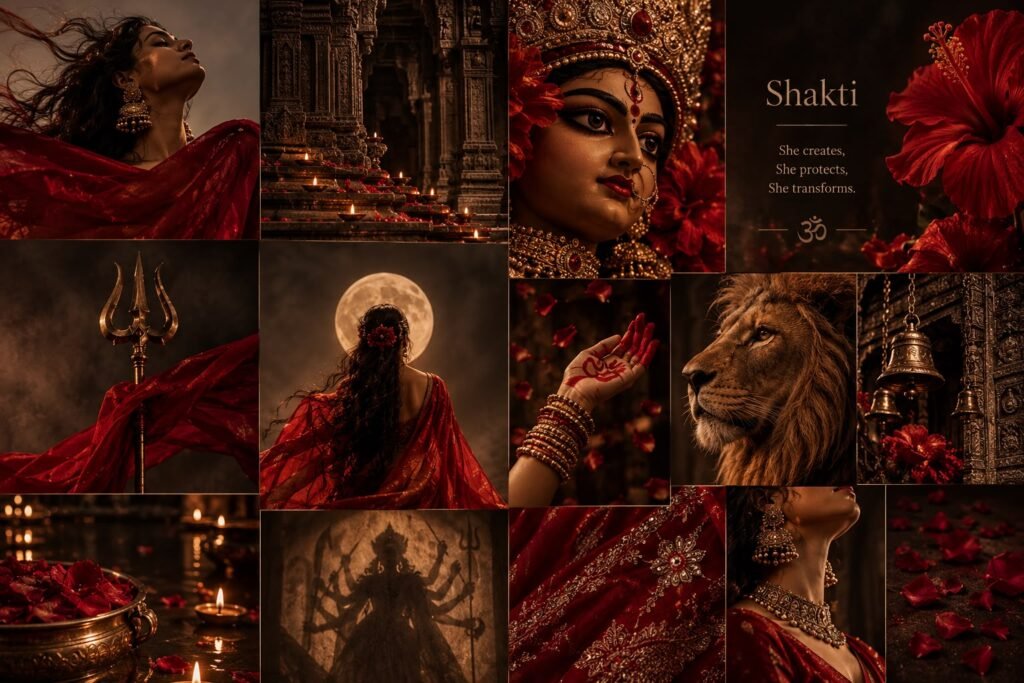
The concept has found expression through several powerful divine forms. Durga embodies protection and courage, Kali represents the destruction of destructive forces and the passage of transformation, Lakshmi is associated with prosperity and abundance, while Saraswati represents knowledge, learning and the arts.
Together, these forms express different dimensions of power: the ability to protect, the courage to confront, the capacity to create prosperity and the wisdom to guide.
The Many Expressions of Feminine Power
Feminine power has never belonged to a single profession, institution or social position. It has emerged through different expressions across history.
A woman may exercise power through intellectual achievement, another through political leadership, another through artistic creation, and another through the preservation of knowledge and cultural traditions.
In ancient India, figures such as Gargi Vachaknavi and Maitreyi became associated with philosophical inquiry and intellectual debate. Their presence in early philosophical literature demonstrates that women have occupied important spaces within the history of ideas.
Elsewhere, women have shaped the political and cultural direction of societies. Cleopatra VII influenced the politics of the ancient Mediterranean world. Hatshepsut governed Egypt as pharaoh, while Empress Wu Zetian became the only woman to rule China as emperor in her own name.
These histories reveal that feminine influence has taken many forms, sometimes through formal authority and sometimes through intellectual, cultural or institutional leadership.
The meaning of Shakti, therefore, can be understood through the diversity of ways in which women have shaped the world.
Beyond Borders: A Global Language of Strength
Although Shakti has distinct roots in Indian philosophy, the recognition of feminine power is not limited to India.
Across different civilisations, women have represented courage, knowledge, justice, creativity and social transformation.
In Africa, Queen Nzinga of Ndongo and Matamba became known for her political leadership and resistance to Portuguese expansion. In Europe, Marie Curie transformed scientific understanding through her pioneering research into radioactivity. In the United States, Katherine Johnson’s mathematical contributions helped advance American space exploration.
In the world of literature, Virginia Woolf challenged established ideas about women’s intellectual and creative independence. In contemporary global leadership, women continue to influence economics, science, diplomacy, education and public institutions.
These women emerged from different historical circumstances and cultural traditions. They did not necessarily share the same philosophies or experiences. Yet their lives demonstrate a common truth: the ability to shape history is not restricted by gender.
Shakti can therefore serve as a cultural lens through which to appreciate the many expressions of feminine influence across the world, without assuming that every civilisation understands womanhood in the same way.
The Power to Create, Protect and Transform
One of the most meaningful aspects of Shakti is its association with creation.
Creation is not limited to childbirth or motherhood. It includes the creation of ideas, institutions, businesses, artistic movements, communities and opportunities. Women have participated in each of these dimensions, often changing the direction of entire industries and societies.
Protection is another expression of this force. It can be seen in women who defend communities, preserve endangered traditions, advocate for justice or safeguard knowledge for future generations.
Transformation, perhaps, is its most visible modern expression. Women entering fields that historically excluded them are changing the structure of professional life. Their presence in science, finance, technology, governance, architecture and the arts is expanding the possibilities available to future generations.
However, recognising women’s contributions should not require portraying women as extraordinary simply for succeeding in environments where they have historically faced barriers. Their achievements deserve recognition on the basis of their knowledge, ability and contribution.
Shakti in the Modern World
Today, the idea of Shakti has acquired renewed relevance as societies reconsider leadership, equality and the meaning of influence.
The modern woman occupies multiple spaces. She may lead an international organisation, establish a family business, conduct scientific research, create cultural movements or preserve an artistic tradition. Her identity is not defined by a single role.
Yet the discussion of feminine power must move beyond symbolism. Celebrating women through cultural language has limited meaning if institutions continue to restrict their access to education, economic opportunity, safety, representation and decision-making.
True recognition requires more than admiration. It requires systems that allow women to exercise their abilities and make independent choices.
Shakti, interpreted in a contemporary context, can become a reminder that power should be accompanied by responsibility, opportunity and the freedom to determine one’s own direction.
It also challenges the assumption that strength must always resemble dominance. Leadership can be decisive without being aggressive, influence can be meaningful without being visible, and resilience can exist without the expectation that women must endure every difficulty silently.
The Legacy of Feminine Influence
The legacy of Shakti is not simply the story of powerful women. It is the story of how societies understand the relationship between energy, creation, knowledge and transformation.
From ancient philosophical traditions to contemporary institutions, the presence of women has influenced the development of civilisation in ways that cannot be reduced to a single narrative.
Their contributions are visible in the sciences that advance human understanding, the institutions that shape public life, the businesses that influence economies, the artistic traditions that preserve cultural memory and the ideas that challenge established thinking.
Perhaps the greatest significance of Shakti lies in its ability to connect these different expressions of influence without reducing them to one definition.
A force does not always announce itself. Sometimes it creates quietly, sometimes it protects courageously, and sometimes it transforms everything around it.
Shakti is a reminder that feminine power is neither confined to history nor dependent on recognition. It is expressed wherever women have the freedom, knowledge and opportunity to shape the world.
She is Shakti — not merely a symbol of strength, but a force of creation, consciousness and change.