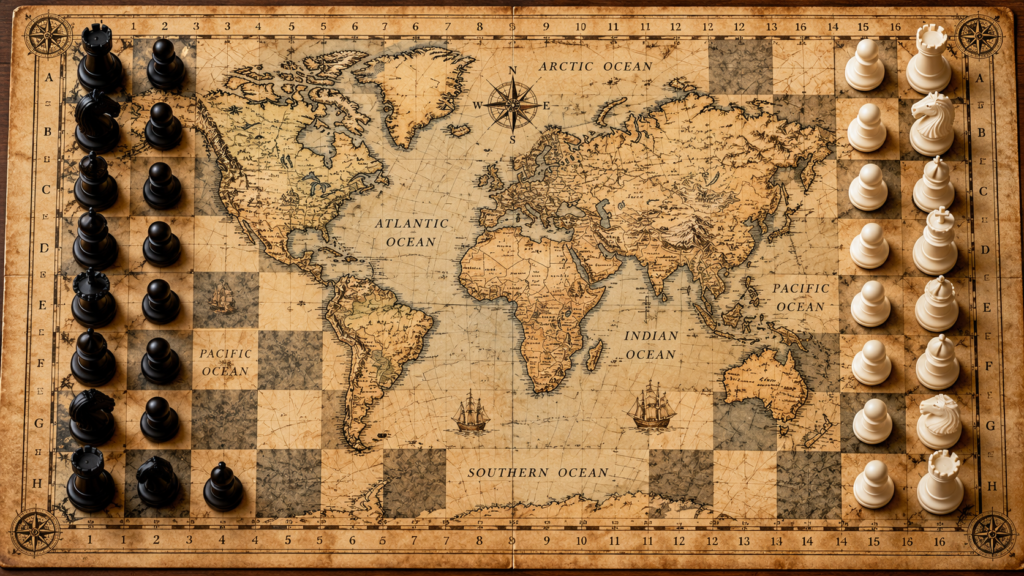
Across centuries and continents, chess has challenged rulers, inspired intellectuals and produced sporting legends. Today, its influence stretches from historic championship halls to digital platforms, making it one of the world’s most enduring contests of intelligence and ambition.
Chess is unusual among international sports. It requires no stadium, expensive equipment or physical arena. A board, 32 pieces and two competing minds are enough to create a contest that can last for hours and be remembered for generations. Yet behind its apparent simplicity lies a world of extraordinary complexity: preparation, psychology, patience, calculation and the ability to recognise possibilities before an opponent does.
From royal courts to global tournaments, chess has evolved into far more than a recreational pastime. It is a competitive discipline, a cultural tradition and, increasingly, a meeting point between human intelligence and technology.
A Journey Across Civilisations
The story of chess is closely connected to the movement of ideas between civilisations. Its earliest recognised predecessor, chaturanga, emerged in India around the sixth century. The game reflected the structure of an army, with pieces representing different military divisions. It later travelled to Persia, where it developed into shatranj, before spreading through the Arab world and reaching Europe.
As the game crossed borders, its rules and pieces gradually changed. By the late fifteenth century, several important developments had helped establish the foundations of modern chess. Its journey demonstrates how a cultural invention can travel across languages and societies while retaining its central identity.
The game also entered royal and intellectual life. It became associated with education, strategy and refinement, attracting rulers, scholars and aristocratic circles. Its appeal was not simply the prospect of winning. Chess offered a controlled environment in which foresight, discipline and judgement could be tested.
The Rise of the Grandmasters
Modern competitive chess developed rapidly during the nineteenth century. International tournaments and organised matches created opportunities for leading players to establish reputations beyond their own countries. The first recognised modern World Chess Championship match took place in 1886, when Wilhelm Steinitz defeated Johannes Zukertort.
The establishment of the International Chess Federation, known as FIDE, in 1924 gave the sport a stronger international structure. Standardised regulations, recognised titles and international competitions helped transform chess into an organised global discipline.
The title of grandmaster became one of the most respected distinctions in intellectual sport. It represents years of study, tournament performance and exceptional competitive ability. Behind every title lies an immense commitment to preparation: analysing openings, studying previous games, understanding endgames and learning to make accurate decisions under pressure.
Champions Who Defined Generations
Chess history is shaped by individuals whose playing styles changed how the game was understood.
Garry Kasparov became one of the defining figures of modern chess through his extraordinary preparation, aggressive approach and long rivalry with Anatoly Karpov. Their championship encounters became major international sporting events, attracting attention far beyond the traditional chess community.
Viswanathan Anand brought another dimension to the game’s global story. His achievements helped establish India as a major force in elite chess and inspired generations of young players. His success demonstrated that the highest levels of the sport were no longer confined to a small group of established chess nations.
Magnus Carlsen later became a defining champion of the digital era, recognised for his exceptional versatility and ability to maintain pressure in positions that might appear equal. His career reflects a modern generation of players who combine traditional understanding with sophisticated computer-assisted preparation.
The women’s game has also produced extraordinary champions. Vera Menchik, the first Women’s World Champion, helped establish a lasting competitive tradition. Later champions such as Judit Polgár, Hou Yifan and Ju Wenjun expanded the visibility and achievements of women in international chess.
These players represent different periods and styles, but their influence shares a common quality: they have expanded public understanding of what is possible on the chessboard.
The Chess Olympiad: Nations in Competition
While world championship matches focus attention on individual brilliance, the Chess Olympiad celebrates national representation and collective achievement.
Teams from different countries compete in an international environment where preparation, coordination and consistency matter. The event creates a rare sporting atmosphere: competitors may sit silently across a board, yet their games contribute to a larger national contest.
The Olympiad also illustrates how widely chess has spread. Established chess nations compete alongside emerging programmes, and young players gain opportunities to test themselves against experienced international opponents.
For countries investing in chess education and competitive development, these events provide more than medals. They create role models, strengthen national federations and encourage participation at grassroots level.
India’s Growing Chess Influence
India’s relationship with chess has come full circle. A game with deep roots in the subcontinent has become a major part of its modern sporting identity.
Viswanathan Anand’s world championship success was a turning point, but the country’s influence now extends well beyond one generation. A growing number of young Indian players have reached elite international levels, while schools, academies, clubs and online communities have widened access to competitive chess.
Players such as D. Gukesh, R. Praggnanandhaa and Arjun Erigaisi represent a generation that has grown up with international tournaments, digital analysis and global competition. Their achievements have brought renewed attention to India’s talent pipeline and the possibilities created by early training.
The significance is not limited to professional results. Chess has become a visible part of conversations about education, discipline and sporting ambition. India’s expanding presence also reminds the international chess world that its historical origins and modern competitive future remain closely connected.
The Digital Transformation of the Game
Technology has changed how chess is learned, played and followed. Online platforms allow players to compete across continents without travelling to a tournament venue. Games can be reviewed instantly, lessons are widely accessible, and international events reach audiences through live broadcasts and commentary.
Computer engines have transformed preparation. They can examine positions with extraordinary precision, identify tactical opportunities and challenge assumptions that even experienced grandmasters might overlook. Players now use these tools to test ideas and understand complex positions in greater depth.
Artificial intelligence has also influenced the way people appreciate chess. Spectators can follow evaluations, explore alternative moves and understand why a seemingly natural decision may be inaccurate.
Yet technology has not removed the human element. A computer may calculate a position, but competitive chess still involves nerves, time pressure, stamina and judgement. The challenge is no longer simply finding the strongest move in isolation; it is finding it when the clock is running and the consequences are immediate.
More Than a Test of Intelligence
Chess is often described as a game of logic, but its greatest contests reveal the importance of psychology. A player must manage confidence, recognise danger, resist impulsive decisions and remain composed after a mistake.
The game rewards patience, but it also demands courage. A cautious move can preserve a position, while a bold sacrifice can create opportunities that would otherwise remain hidden. Knowing when to defend and when to take a risk is central to the art of competition.
This balance helps explain why chess attracts people from so many backgrounds. It offers different challenges to beginners, club players, students and world champions. Each game creates a new problem, and even familiar positions can produce unexpected outcomes.
The Future of a Timeless Sport
Chess is entering a period in which its traditional institutions and digital communities increasingly influence one another. Online competition has widened participation, while major tournaments continue to preserve the prestige of face-to-face play. New audiences are discovering the game through streaming, short-form analysis and the stories of its leading personalities.
The next chapter will depend on how effectively the sport balances accessibility with integrity, innovation with tradition, and technology with human competition. Fair play, transparent regulation and opportunities for young talent will remain essential.
Chess has survived changes in political systems, cultural fashions and technology because its central challenge remains compelling. Every game begins with equal pieces and a shared set of rules, but the decisions that follow can reveal striking differences in imagination, discipline and nerve.
On a board of just 64 squares, the world finds an endless contest of possibilities. That is the enduring power of chess: a game born in one civilisation, shaped by many others and still capable of bringing the world together through the quiet intensity of a single move.