
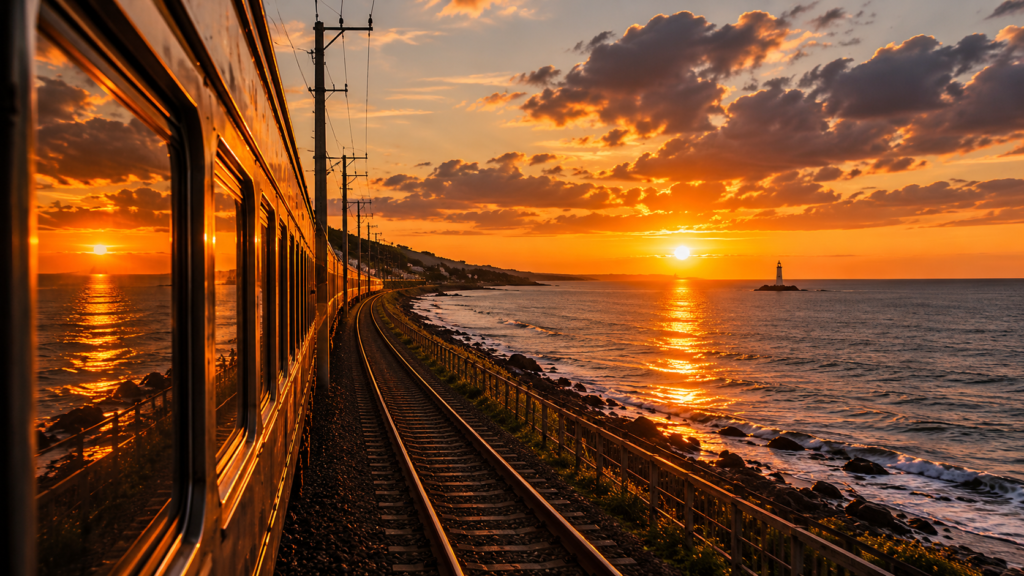
In a world accustomed to faster journeys and increasingly compressed travel schedules, the overnight train is offering something different: the opportunity to travel through the night, enjoy the journey itself and arrive in a new destination with a story already unfolding.
For decades, aviation and high-speed rail transformed the way people moved between cities and countries. Speed became the principal measure of convenience, while overnight trains gradually disappeared from several international routes. Today, however, night train travel is attracting renewed attention. A new generation of travellers is rediscovering the appeal of private cabins, scenic routes, carefully designed interiors and journeys that make the passage between destinations part of the experience.
The revival is not simply about nostalgia. It reflects changing ideas about comfort, sustainability, personal time and the value of travel itself. For luxury travellers, the overnight railway is becoming an alternative to the conventional airport experience: less hurried, more immersive and, on selected routes, remarkably refined.
The European Sleeper Revival
Europe is at the centre of the renewed interest in overnight rail. Established operators and newer private companies are rebuilding connections between major cities, allowing passengers to cross national borders while they sleep.
Austria’s ÖBB Nightjet network remains one of the most recognisable names in this movement. Its routes connect destinations including Vienna, Hamburg, Zurich, Amsterdam and Rome. Private operator European Sleeper has also expanded its network, introducing the Paris–Berlin service in March 2026 and the Brussels–Milan connection in September 2026.
These developments demonstrate that overnight rail is not merely a romantic idea from an earlier era. It is being reconsidered as part of modern international mobility.
The experience varies considerably by route and operator. Some services offer shared couchettes, while others provide private sleeping compartments and more spacious accommodation. Travellers can choose according to their priorities, whether that means affordability, privacy or a more comfortable overnight journey.
Yet the network is not expanding uniformly. Europe’s 2026 night-train map recorded five new connections alongside the disappearance of ten services. This contrast reveals the central challenge of the revival: passenger interest must be matched by investment in trains, infrastructure and commercially sustainable operations.
The New Meaning of Luxury on Rails
Luxury in rail travel has never been defined by speed alone. Its strongest appeal lies in the details: a private compartment, a comfortable bed, thoughtful service, carefully prepared food and the pleasure of watching unfamiliar landscapes pass beyond the window.
Modern sleeper accommodation is evolving to meet expectations shaped by premium hotels and contemporary hospitality. Private cabins, improved bedding, individual storage, showers on selected services and more considered interior design are helping redefine the overnight experience.
However, there is an important distinction between a standard sleeper service and a luxury rail journey. Not every night train offers restaurant-style dining, private bathrooms or hotel-level service. These features depend on the train, operator and accommodation category.
The opportunity lies in creating a journey where comfort and movement work together. Instead of losing an evening to airport transfers, security queues and hotel check-ins, passengers can settle into their compartment and let the destination come to them.
Japan: Where Precision Meets the Romance of Rail
Japan offers a distinctive perspective on overnight railway travel.
The Sunrise Seto and Sunrise Izumo connect Tokyo with Takamatsu and Izumoshi respectively. The two services travel together before separating at Okayama, continuing towards their individual destinations.
Their accommodation includes private cabins as well as the distinctive Nobinobi sleeping spaces. The experience is different from the expansive luxury of a hotel train, but its appeal lies in thoughtful design, efficient use of space and the opportunity to travel overnight through Japan.
The country also has a history of exceptional luxury rail experiences. Trains such as Seven Stars in Kyushu and Train Suite Shiki-shima demonstrate how rail journeys can become carefully curated hospitality experiences, combining accommodation, regional cuisine and destination-led itineraries.
Japan’s approach shows that the future of luxury rail does not have to follow a single formula. It can be intimate, technologically refined, culturally rooted or deliberately extravagant.
India’s Palace on Wheels Tradition
India has a different relationship with overnight rail travel. Long-distance sleeper services are an established part of everyday mobility, connecting cities, regions and communities across a vast country.
Alongside this extensive network, India has developed a separate world of luxury tourist trains. The Maharajas’ Express, Palace on Wheels, Deccan Odyssey and Golden Chariot present rail travel as an immersive journey through architecture, heritage, cuisine and landscape.
The Maharajas’ Express, for example, offers accommodation ranging from Deluxe Cabins to a Presidential Suite, alongside dedicated restaurants and lounge spaces. Its itineraries connect destinations such as Agra, Jaipur, Udaipur, Jodhpur and Varanasi.
These trains are not simply overnight transport services. They are destination-led experiences in which the train itself becomes part of the holiday.
India’s contribution to luxury rail is therefore especially distinctive: it draws on royal history and regional identity while offering a contemporary hospitality experience to international travellers.
Why Travellers Are Rediscovering the Journey
The renewed interest in night trains is connected to a broader change in travel preferences. Many people are becoming more selective about how they spend their time. They want journeys that offer more than the shortest possible transfer between two points.
An overnight train can combine transport and accommodation, potentially reducing the need for a separate hotel night. It can also bring passengers directly into city centres, depending on the route and station.
There is an environmental dimension as well. Rail can offer a lower-emission alternative to flying on certain journeys, although the actual benefit depends on the route, energy source, occupancy and comparison being made. A 2025 study published in Case Studies on Transport Policy examined the potential of overnight trains to replace a share of long-distance European air travel, while emphasising that substantial investment would be needed to expand services meaningfully.
For travellers, the attraction is not exclusively environmental. It is also about recovering a sense of time. A journey through mountains, forests, coastlines and unfamiliar towns can become an experience in its own right.
The Challenges Behind the Romance
The return of sleeper trains faces practical obstacles.
Modern overnight services require expensive rolling stock, maintenance, trained staff and access to railway infrastructure across different countries. International routes also depend on coordination between operators, national railway systems and infrastructure managers.
Cabin quality and service standards vary, and tickets can become expensive when private compartments are in high demand. Delays, limited dining options and disruptions caused by engineering work can affect the experience.
The business model is particularly challenging because sleeper trains require substantial space for accommodation while carrying fewer passengers than conventional seating services. Investment and effective route planning are essential if operators want to provide both comfort and financial sustainability.
The future of the sector will depend on whether governments and private operators can make these journeys dependable, accessible and attractive beyond a small market of enthusiasts.
A Different Way to Arrive
The return of the night train reflects a larger shift in the meaning of luxury. Travellers are increasingly discovering that the most memorable experience is not always the fastest one.
A private cabin moving through the European night, a Japanese sleeper crossing the country or an Indian palace-inspired train travelling between historic cities each offers a different interpretation of the same idea: the journey deserves attention.
Night trains are unlikely to replace aviation or daytime high-speed rail. Their value lies in offering another choice, particularly where routes, schedules and onboard comfort make overnight travel practical.
The future of luxury mobility may therefore be defined not only by how quickly people reach a destination, but also by what they experience along the way.
Sometimes, the most extraordinary part of a journey begins after the lights dim and the train leaves the station.