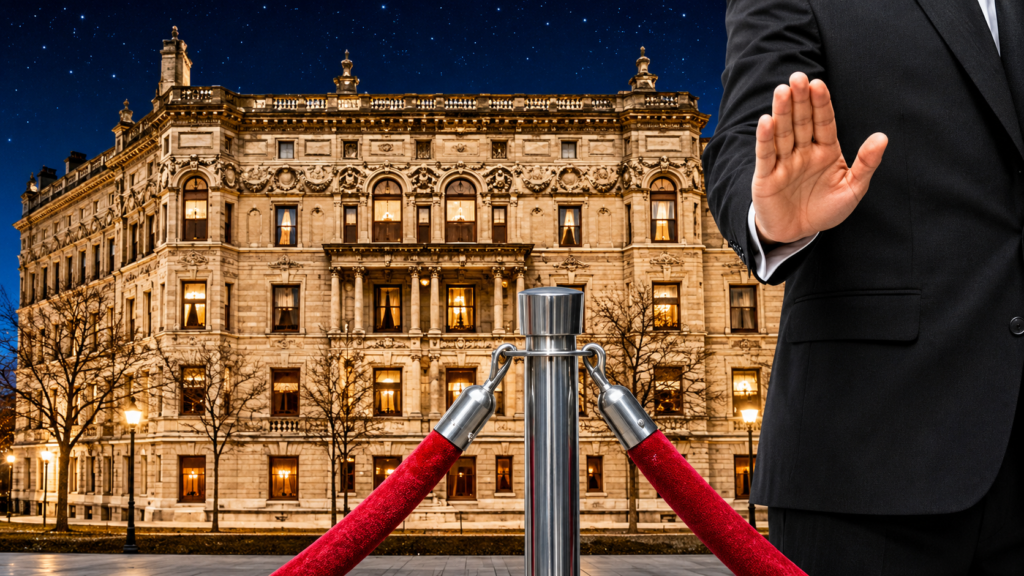
Some of the world’s most interesting conversations take place far from public spaces. Behind discreet entrances, historic façades and carefully designed interiors, private members’ clubs have created environments where culture, business, friendship and influence intersect. Their traditions are changing, but their appeal remains remarkably persistent.
Private Members’ Clubs occupy a distinctive place in the international world of luxury. They are not simply restaurants, hotels or social venues. At their best, they offer a sense of belonging: a familiar environment, a shared set of interests and the opportunity to encounter people beyond the boundaries of everyday professional and social life.
For centuries, these institutions have reflected the ambitions and values of the societies around them. Some were built around politics and public affairs; others around literature, art, travel, sport or professional identity. Today, a new generation of clubs is redefining the experience, bringing together entrepreneurs, artists, investors, designers and internationally mobile members.
The Origins of Club Culture
The modern private members’ club has deep roots in the coffee houses and meeting places of seventeenth-century Britain. London’s coffee houses became centres of conversation, debate, news and commercial exchange. Over time, groups began organising around shared interests and identities, establishing more permanent private institutions.
By the eighteenth and nineteenth centuries, London’s St James’s district had become synonymous with club culture. Establishments such as White’s, Boodle’s and Brooks’s developed distinct identities and traditions. Their grand interiors, formal dining rooms, libraries and carefully observed rules reflected a world in which membership carried considerable social significance.
These clubs were historically exclusive, often admitting only men and relying on established networks and personal recommendations. Their influence was not always exercised through formal business meetings. Friendships, introductions and repeated conversations could create relationships that extended into politics, finance and public life.
The club became an institution in which social connection itself held value.
A World Built Around Belonging
The appeal of a private club is often difficult to measure through its facilities alone. A restaurant can provide excellent food, a hotel can offer exceptional accommodation and a lounge can create a comfortable environment. A successful club combines these experiences with something less tangible: continuity.
Members return to familiar surroundings, recognise faces and develop relationships over time. The atmosphere is shaped not only by architecture and service, but also by the people who use the space.
This is why many clubs invest heavily in their identity. Some are associated with a particular profession or intellectual tradition. Others cultivate an artistic, sporting or international outlook. Their membership becomes part of the institution’s character.
The most distinctive clubs understand that exclusivity is not simply about restricting entry. It is about creating a coherent environment in which members feel that they share something meaningful.
From Traditional Clubland to a Global Network
The traditional British model was never the only expression of private club culture. Similar institutions developed in different cities, shaped by local histories and social expectations.
In New York, historic clubs became part of the city’s civic and professional landscape. In other international centres, private clubs developed around commerce, cultural exchange and expatriate communities. Singapore and Hong Kong, for example, have long histories of institutions serving international business and social networks.
The contemporary model has expanded further. Soho House, founded in London’s Soho district in 1995, introduced a club environment aimed at people working in creative industries. Its subsequent international growth brought the concept to cities including New York, Berlin, Mumbai, Hong Kong and Bangkok.
Its approach illustrates how the idea of a members’ club has evolved. Rather than relying entirely on the formality of historic clubland, contemporary houses combine dining, workspaces, cultural programming, accommodation and wellness facilities.
The result is a global club culture in which local identity and international familiarity can exist together.
Architecture as Part of the Experience
The physical environment remains central to the identity of a private club. Some occupy historic townhouses, former banks or heritage buildings, preserving architectural details that communicate a sense of permanence. Others are designed around contemporary ideas of hospitality, combining art, natural materials, private dining rooms and carefully planned social spaces.
Interiors influence how members use a club. A library encourages quiet conversation and reading; a drawing room creates a more intimate atmosphere; a terrace encourages informal gatherings. Dining rooms and private meeting spaces serve different purposes, while bedrooms allow members to extend their stay.
Good club design rarely depends on spectacle alone. It is concerned with atmosphere, proportion, comfort and the relationship between public and private areas. The most memorable interiors often feel distinctive without demanding constant attention.
In this sense, architecture becomes part of the club’s unwritten language.
The Changing Meaning of Exclusivity
Private clubs have also had to reconsider what membership means in a changing world. Historically, many institutions reflected narrow social structures and restricted opportunities for women and people outside established circles.
Over time, women’s clubs emerged, and many traditional institutions began changing their membership policies. Contemporary clubs increasingly define their communities around professional interests, creative pursuits, shared values or lifestyle rather than inherited social status alone.
Yet the question of access remains important. Membership fees, selection procedures, location and social networks can all influence who is able to participate. The challenge is to maintain a recognisable identity without allowing exclusivity to become disconnected from the wider society.
For modern clubs, relevance depends on more than reputation. Members increasingly expect quality, thoughtful programming, meaningful connections and an experience that justifies their commitment.
Networking Without the Conference Room
One reason private clubs remain attractive is that they create opportunities for relationships to develop naturally. Unlike a formal networking event, where introductions are often brief and transactional, a club offers repeated encounters.
A conversation over dinner may lead to a professional introduction months later. A cultural event can bring together people from different industries. A shared interest in art, architecture, literature or sport can create connections that would be unlikely in a conventional business environment.
This does not mean every club is a centre of commercial influence, nor that membership guarantees professional opportunity. Its value lies in the environment it creates for people to meet and become familiar with one another.
In an increasingly digital professional world, the appeal of genuine in-person interaction has become particularly significant.
The New Generation of Private Clubs
The next phase of club culture is likely to be shaped by flexibility. Members may expect access across cities, spaces designed for both work and leisure, and programmes that reflect contemporary interests. Wellness facilities, cultural events, private dining and accommodation are increasingly part of the wider proposition.
Technology can make reservations and member services more convenient, but it cannot replace the human character of a club. The atmosphere still depends on service, discretion, shared interests and the quality of the community.
The strongest institutions will be those that understand their own identity while adapting to new expectations. Some will preserve centuries-old traditions; others will experiment with more informal formats and international membership models.
The Influence of a Private World
Private members’ clubs have endured because they answer a need that extends beyond luxury consumption. They offer continuity in a changing world, private space in crowded cities and opportunities for conversation in an age of constant digital communication.
Their influence is not always visible, and it should not be confused with automatic access to power. Yet the relationships formed within these institutions can become part of wider cultural, professional and social networks.
Ultimately, a great private club is defined neither by its entrance nor by the exclusivity of its address. It is defined by the quality of the community it creates and the experience it sustains.
Behind closed doors, the most valuable currency may still be conversation.