From the geometric grandeur of European royal estates to the contemplative beauty of Japanese gardens and the symmetry of Mughal landscapes, the world’s great gardens reveal how nature can become an extraordinary expression of architecture, culture and power.
A garden can be far more than an arrangement of trees, flowers and pathways. Throughout history, some of the world’s most remarkable landscapes have been designed as statements of authority, artistic ambition, spiritual philosophy and refined living. They have reflected the values of royal families, the imagination of architects and the relationship between human civilisation and the natural world.
From vast formal gardens surrounding European palaces to carefully composed Japanese landscapes, these environments demonstrate that the art of designing outdoor spaces is as culturally significant as the architecture of the buildings they surround.
Today, landscape design continues to evolve, combining historical influences with environmental awareness, contemporary architecture and new ideas about private living.
Versailles: The Language of Royal Grandeur
Few landscapes represent the relationship between gardens and political power as dramatically as the gardens of the Palace of Versailles in France.
Designed principally under the direction of André Le Nôtre during the reign of Louis XIV, the gardens became an extension of the palace’s architectural and ceremonial identity. Their carefully arranged pathways, fountains, sculptures and geometric planting created an extraordinary visual composition.
The design reflected the formal French garden tradition, in which nature was organised through symmetry, proportion and controlled perspective.
Versailles was not simply intended to provide a beautiful setting. It communicated the authority and ambition of the French monarchy. The landscape became a theatrical environment in which architecture, art, water and nature worked together.
Its influence extended throughout Europe, inspiring generations of royal estates and landscape designers.
Japan: The Beauty of Restraint
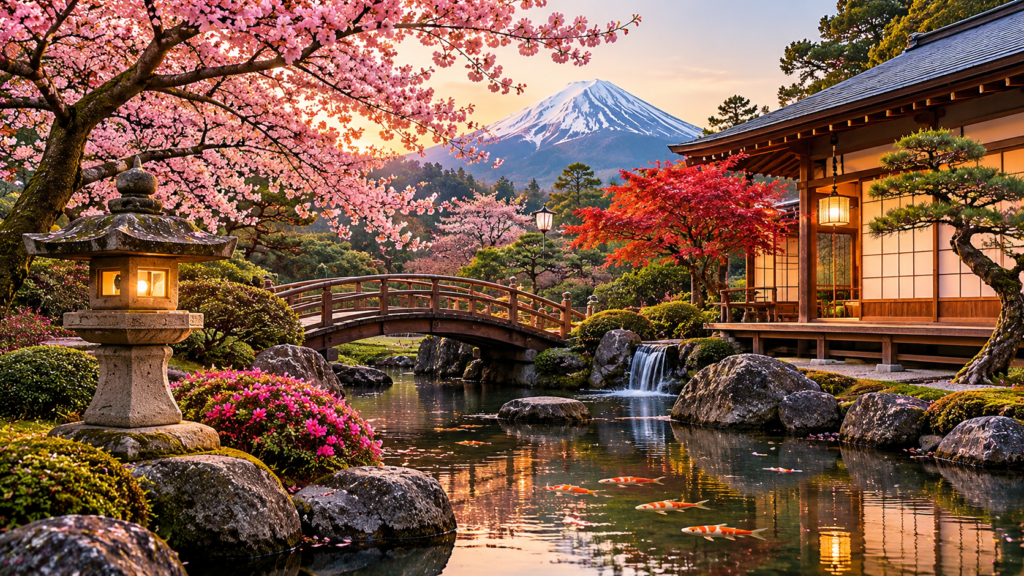
Japanese gardens offer a contrasting philosophy. Rather than demonstrating control over nature through grand symmetry, many traditional Japanese landscapes seek to create harmony through carefully considered simplicity.
Stone arrangements, water, moss, bridges, trees and carefully framed views are used to create environments that encourage contemplation.
The dry landscape gardens associated with Zen Buddhist temples, often known as karesansui, use gravel, rocks and limited vegetation to suggest natural landscapes in an abstract form.
Kyoto remains one of the most important centres of Japanese garden heritage. Its historic temple gardens demonstrate how seemingly modest elements can create remarkable spatial experiences.
The Japanese approach also highlights the significance of seasonality. Cherry blossoms, autumn foliage, winter landscapes and the changing appearance of moss and vegetation give gardens an identity that evolves throughout the year.
India: The Geometry of Mughal Gardens
India’s garden heritage offers another extraordinary interpretation of landscape architecture.
Mughal gardens developed through a combination of Persian influences, regional traditions and the architectural ambitions of imperial courts. Their designs frequently incorporated geometric divisions, flowing water, fountains, terraces and carefully arranged planting.
The concept of the charbagh, or four-part garden, became particularly influential. It organised the landscape into four principal sections, often divided by water channels or pathways.
The gardens associated with Kashmir’s Shalimar Bagh and Nishat Bagh demonstrate this tradition through terraced layouts, mountain settings, fountains and carefully composed views.
The garden surrounding the Taj Mahal in Agra is another internationally recognised example. Its formal organisation and relationship with the monument create a carefully balanced architectural and landscape composition.
These spaces reveal how gardens in the Indian subcontinent became expressions of imperial vision, cultural exchange and an appreciation of water and nature.
Italy: Gardens as Architectural Masterpieces
The Italian Renaissance transformed the relationship between architecture and landscape.
Gardens became carefully planned extensions of villas and palaces, incorporating terraces, sculptures, fountains, staircases and dramatic views.
Villa d’Este in Tivoli is among the most celebrated examples. Its elaborate water features, monumental fountains and layered terraces demonstrate how engineering and artistic imagination can transform a landscape.
The gardens of Villa Lante and Boboli Gardens in Florence offer further examples of the Italian tradition, where landscape design became closely connected with architecture, sculpture and the visual arts.
These historic estates established an enduring design language that continues to influence contemporary landscape architecture.
The English Landscape: Nature in a Different Form
The English landscape garden developed partly as a response to the highly formal geometric gardens of continental Europe.
Designers such as Capability Brown promoted landscapes that appeared more natural, with rolling lawns, carefully positioned trees, lakes and winding paths.
Rather than relying on rigid symmetry, the English landscape tradition sought to create picturesque compositions that appeared to emerge naturally from the surrounding countryside.
This approach changed the way private estates were designed. Gardens and parks became expansive environments in which nature, architecture and the wider landscape could be experienced as one composition.
The tradition remains influential in the design of country estates and contemporary private properties.
The Modern Garden: Where Architecture Meets Ecology
Contemporary landscape architecture is increasingly concerned with the relationship between design, environmental responsibility and everyday living.
Private estates, cultural institutions, hotels and public buildings are incorporating landscapes that serve both aesthetic and ecological purposes.
Native planting, water conservation, biodiversity and climate-sensitive design are becoming important considerations. Architects and landscape designers are also exploring how gardens can improve the experience of buildings through natural shading, outdoor rooms and carefully planned transitions between interior and exterior spaces.
Urban landscapes are evolving as well. Rooftop gardens, vertical planting, botanical spaces and green courtyards are changing how nature is incorporated into dense cities.
This evolution suggests that the future of landscape design will depend not only on visual beauty, but also on its ability to respond to environmental challenges.
Preserving the World’s Living Heritage
Historic gardens require continuous care. Trees mature, water systems deteriorate, plants respond to changing climates and original design intentions can become difficult to maintain.
Preservation therefore involves more than protecting individual features. It requires understanding the historical design, botanical choices, engineering systems and cultural significance of the entire landscape.
Institutions, conservation specialists, horticulturalists and landscape architects play important roles in maintaining these environments for future generations.
Historic gardens are living cultural assets. Unlike paintings or sculptures, they continue to grow and change, making their preservation a continuous responsibility.
The Enduring Art of Living Landscapes
The world’s great gardens demonstrate that landscape design can communicate ideas as powerfully as architecture.
Versailles expresses royal ambition through symmetry and scale. Japanese gardens reveal the beauty of restraint and contemplation. Mughal landscapes demonstrate the relationship between geometry, water and imperial imagination. Italian Renaissance gardens unite engineering, sculpture and artistic composition.
Each tradition reflects a different understanding of nature and the role of human creativity.
In contemporary design, these influences continue to evolve, creating landscapes that balance heritage, innovation and environmental responsibility.
Ultimately, a remarkable garden is not simply a beautiful setting. It is a living work of art, shaped by time, culture and imagination.