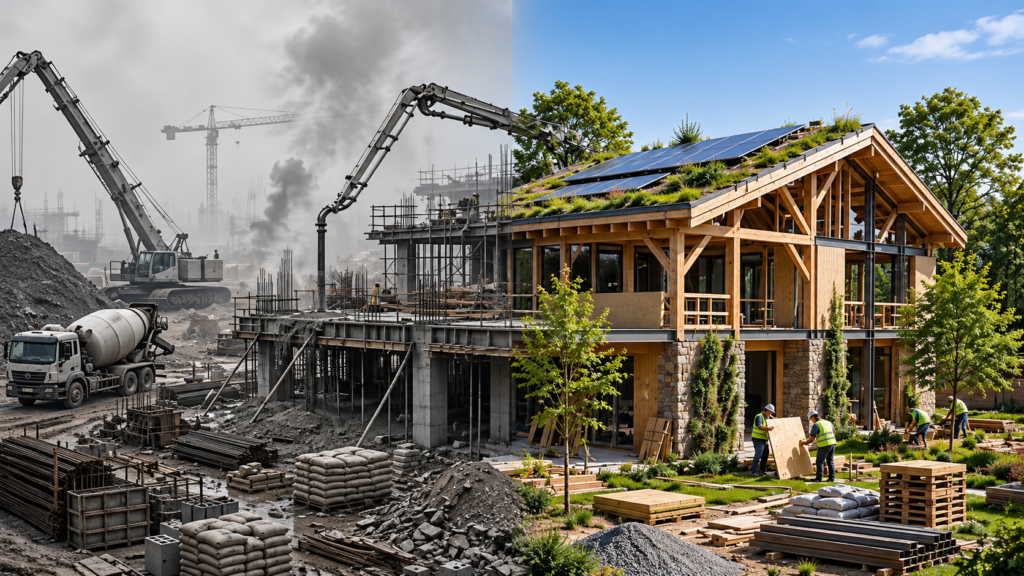
The future of sustainable construction will not be decided by architecture alone. It will depend on transforming the materials that build the modern world.
Low-carbon materials are moving from specialist innovation into the centre of global industrial strategy. Steel and cement are essential to everything from skyscrapers and bridges to transport networks, factories and renewable-energy infrastructure. Yet their conventional production methods carry a substantial environmental cost. Now, manufacturers, investors and governments are confronting a difficult question: can the world continue building at scale while fundamentally changing how its most important materials are made?
The Hidden Environmental Cost of Modern Construction
Steel and cement rarely receive the public attention given to electric vehicles, renewable energy or sustainable fashion. Nevertheless, they sit at the foundation of the global economy.
Steel supports transport, manufacturing, energy systems and urban development. Cement is the essential binding ingredient in concrete, the material used extensively in housing, roads, airports and commercial buildings.
Their environmental challenge is different. Steel production has traditionally relied heavily on coal-based processes, while conventional cement manufacturing releases emissions both from the energy required to heat materials and from the chemical reactions involved in producing clinker.
The scale of the challenge makes these industries particularly important to the global transition. Reducing emissions from transport or electricity generation will not be enough if the materials required to build the future remain dependent on highly emissions-intensive production.
Green Steel: Changing the Foundations of Manufacturing
Green steel is emerging as one of the most closely watched industrial developments. Rather than relying exclusively on conventional coal-based production, alternative approaches include hydrogen-based direct reduction, greater use of recycled steel and electric-arc furnaces powered by lower-emissions electricity.
The ambition is to reduce the environmental footprint of steel without compromising the strength, reliability and performance required by modern industry.
However, the transition is not straightforward. Hydrogen production requires substantial supplies of affordable clean electricity. New industrial facilities demand significant investment, while existing plants face difficult decisions about retrofitting equipment or replacing entire production systems.
The global project pipeline also reveals a gap between ambition and delivery. The September 2026 Green Steel Tracker recorded 61 projects and approximately $56.4 billion in tracked investment. Yet the sector remains far from having enough operational capacity to transform global production.
The next phase will therefore be measured less by announcements and more by whether projects reach commercial operation, secure customers and produce competitively priced steel.
Low-Carbon Cement: Rethinking an Essential Material
Cement presents a different technological challenge. Even if a factory switches to cleaner energy, the chemical process involved in conventional clinker production continues to generate emissions.
One promising response is blended cement. By reducing the proportion of traditional clinker and incorporating suitable alternative materials, manufacturers can lower the emissions associated with production while retaining the performance required for construction.
Other approaches include calcined clay, alternative cement chemistries, recycled concrete materials and carbon capture. Some technologies aim to reduce emissions during manufacturing; others seek to capture or permanently store carbon generated during production.
The commercial challenge is to make these alternatives reliable, affordable and widely available. Construction standards, testing requirements, material supply chains and established industry practices all influence how quickly new formulations can be adopted.
A development reported in November 2026 illustrates the growing momentum. An international initiative is encouraging governments to promote blended cement through public procurement and updated building standards. Its supporters argue that changing the composition of commonly used cement could deliver meaningful emissions reductions without requiring every construction project to adopt an entirely new building system.
The Investment Race Is Becoming Global
The transformation of industrial materials is creating a new investment landscape.
Europe has been an important centre for green steel development, supported by industrial policy and climate regulation. Sweden’s major projects have attracted international attention, while Germany and other European economies continue to explore alternative production pathways.
The Middle East is also positioning itself within the emerging market, particularly through its potential to combine industrial infrastructure with renewable-energy resources. Australia and other resource-rich economies are exploring opportunities linked to iron ore, direct-reduced iron and future low-emissions supply chains.
In Asia, the challenge is especially significant because of the scale of steel and cement manufacturing. China remains central to global industrial production, while India faces the dual responsibility of expanding infrastructure and improving the environmental performance of its manufacturing base.
India’s transition is particularly important because its steel industry includes numerous smaller producers that may not have the financial resources or technical capabilities available to the largest international companies. Industrial clusters, shared infrastructure, financing and access to suitable technology will therefore influence how widely cleaner production methods can spread.
The opportunity is not limited to manufacturers. It extends to engineering firms, technology developers, renewable-energy providers, infrastructure investors, certification bodies and financial institutions.
Regulation Is Changing the Meaning of Competitiveness
Industrial sustainability is increasingly connected to trade policy.
The European Union’s Carbon Border Adjustment Mechanism entered its definitive phase in January 2026. It introduces a framework requiring importers of covered goods, including steel and cement, to account for embedded emissions under the mechanism’s rules.
This development matters because manufacturers are no longer competing only on production cost, quality and delivery. The environmental characteristics of their products are becoming increasingly relevant to access in certain international markets.
At COP31 in Antalya, the push for lower-carbon blended cement has added another dimension to the discussion. Governments are considering how procurement rules, standards and industrial policies can encourage the adoption of materials with lower emissions.
The implications extend beyond Europe. Exporting economies may need to improve emissions measurement, production processes and certification if they want to remain competitive in markets where environmental performance is becoming a commercial consideration.
The Challenges Behind the Promise
Despite the progress, green steel and low-carbon cement are not yet universal solutions.
New production facilities require substantial capital. Clean electricity and hydrogen are not equally available across countries. Carbon capture requires suitable infrastructure, storage arrangements and long-term investment. Alternative cement ingredients may also be difficult to source consistently in every region.
There is another important consideration: a product cannot become sustainable simply because it carries a green label. Buyers need credible emissions data, transparent standards and independent verification.
The industry must also avoid creating a transition that benefits only wealthy economies. Developing markets need access to technology, affordable financing and the skills required to modernise industrial facilities. Otherwise, cleaner production could become a competitive advantage available only to a limited group of manufacturers.
The real test will be whether these technologies can move beyond demonstration projects and become dependable parts of everyday industrial production.
Building the Future Before It Is Built
The materials revolution is ultimately about redefining progress. For generations, industrial success was measured primarily through production capacity, cost, speed and scale. Those measures remain important, but the environmental performance of materials is becoming an additional factor in economic competitiveness.
The buildings, transport systems and energy infrastructure of the coming decades will require enormous quantities of steel and cement. Their production will influence not only the appearance of future cities but also the environmental cost of creating them.
The companies that succeed will be those capable of combining technological innovation with commercial discipline. Governments will need to establish credible standards and create demand. Investors will have to support projects that can move from ambitious plans to reliable production.
The next industrial revolution may not be immediately visible to the public. It will happen inside furnaces, processing plants, laboratories, supply chains and procurement departments.
But its consequences will be visible everywhere.
The future of construction will not be defined only by what the world chooses to build. It will also be defined by what the world chooses to build with.