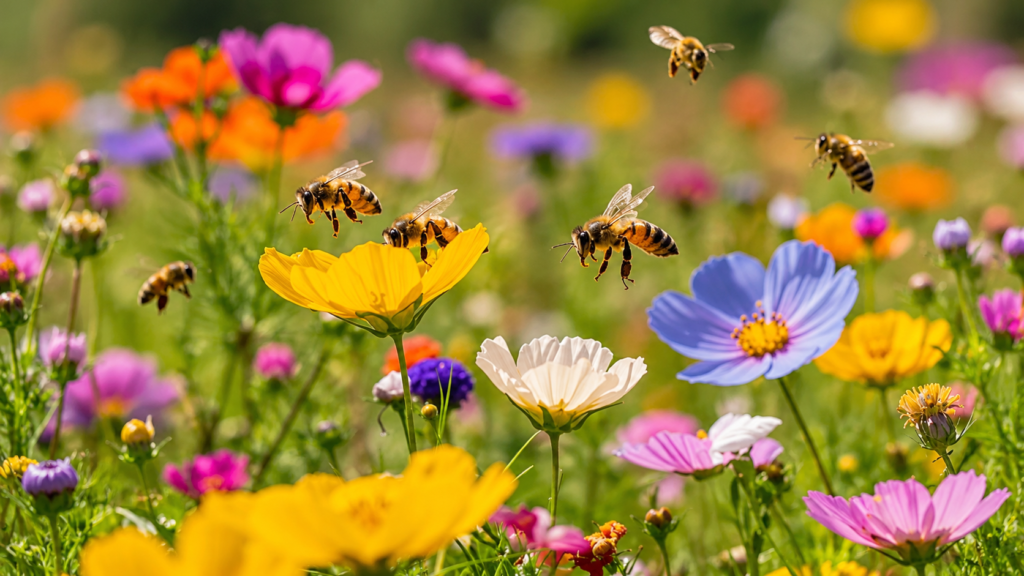
Behind the world’s agricultural abundance is an extraordinary natural workforce. Bees, butterflies, birds and other pollinators are quietly sustaining food production, rural livelihoods and the ecological systems upon which modern economies depend. As their populations face growing pressure, protecting them is becoming an economic priority.
The Pollinator Economy is emerging as an important subject in conversations about global food security, biodiversity and sustainable development. Although pollinators rarely feature in discussions about international commerce or economic power, their contribution reaches almost every part of the agricultural supply chain. From coffee plantations and almond orchards to fruit farms and vegetable fields, these small species perform a function that technology and industrial infrastructure cannot easily replace.
Their importance is now receiving greater international recognition. In November 2026, the Food and Agriculture Organization of the United Nations hosted its first Global Pollinator Conference in Rome, bringing attention to the need for stronger international cooperation and practical conservation measures.
The discussion signals a growing understanding that protecting nature is not simply an environmental responsibility. It is also a question of economic resilience.
The Natural Workforce Behind Global Agriculture
Pollination is one of the fundamental processes supporting the production of food. Bees are perhaps the most recognised pollinators, but the wider community includes butterflies, moths, beetles, birds, bats and other animals.
Their contribution is especially important for crops that depend on animal pollination to improve the quantity, quality or diversity of their harvests. Coffee, almonds, apples, tomatoes and several other commercially important crops benefit from this natural activity.
According to the FAO, approximately 75 per cent of the world’s most important food crops rely at least partly on pollination. This does not mean that three-quarters of global food production would disappear without pollinators. Rather, it demonstrates how deeply agricultural productivity and food diversity are connected to these species.
For farmers, the presence of healthy pollinator populations can influence crop quality, consistency and commercial value. For consumers, their contribution is reflected in the variety of food available in markets. For entire agricultural regions, pollination supports livelihoods and strengthens the foundations of rural economies.
Why Pollinator Populations Are Under Pressure
Despite their importance, pollinators are confronting a combination of environmental challenges. Habitat destruction, intensive agricultural practices, pesticide exposure, pollution, invasive species and climate change are affecting populations across different regions.
The transformation of natural landscapes into expanding urban and agricultural areas can remove the flowering plants, nesting locations and sheltered habitats that pollinators require. Large agricultural monocultures may provide extensive farmland while offering limited food sources outside particular flowering periods.
Climate change introduces another layer of uncertainty. Changes in temperature, rainfall and seasonal patterns can disturb the relationship between flowering plants and the species that pollinate them. When these natural cycles become disconnected, ecosystems and agricultural production can both experience consequences.
The challenge is not restricted to honeybees. Wild bees and other less familiar pollinators are equally important, yet they often receive less public attention. Their conservation requires an understanding of local ecosystems rather than an approach focused on a single species.
The Economic Value of Biodiversity
For a long time, biodiversity was treated primarily as a conservation subject, separated from mainstream economic decision-making. That distinction is becoming increasingly difficult to maintain.
Agriculture, food processing, retail, hospitality and several other industries depend directly or indirectly on functioning ecosystems. When pollinator populations decline, the consequences can travel through supply chains, affecting crop availability, production costs and the stability of agricultural businesses.
This has encouraged investors, policymakers and companies to pay closer attention to nature-related risks.
The Nature Conservancy and Forest Trends reported in their 2026 analysis that private investment in nature had increased fivefold over the previous decade, reaching more than US$14 billion in annual investment during 2025. Although this investment covers a wider range of nature-related activities rather than pollinator conservation alone, it demonstrates the growing financial interest in protecting natural systems.
The emerging opportunity lies in connecting environmental protection with measurable economic outcomes. Supporting pollinator habitats, improving agricultural practices and investing in ecological restoration can contribute to more resilient landscapes and supply chains.
However, financial commitments must translate into credible conservation results. Simply attaching an environmental label to an investment does not guarantee that ecosystems are improving.
A New Responsibility for Businesses and Investors
Businesses that depend on agricultural commodities have an important reason to understand pollinator health. Food producers, retailers, hospitality groups and manufacturers are exposed to environmental conditions throughout their supply chains, even when their operations are located far from farms.
This creates opportunities for companies to work more closely with agricultural communities, support habitat restoration and encourage farming practices that protect biodiversity.
Financial institutions also have a role to play. Investment decisions can influence how land is managed, which agricultural practices receive support and whether conservation becomes part of long-term business planning.
The challenge is accountability. Nature-related investments require reliable monitoring, transparent reporting and evidence that conservation measures are producing meaningful improvements. Without these safeguards, biodiversity initiatives risk becoming public relations exercises rather than lasting environmental contributions.
The International Push for Pollinator Protection
The growing international attention surrounding pollinators reflects the need for cooperation across borders and institutions.
The FAO’s first Global Pollinator Conference, held in Rome on 5 and 6 November 2026, brought governments, researchers and other stakeholders together to discuss coordinated action. Discussions included the possibility of a Global Pollinator Platform that could strengthen knowledge-sharing, research cooperation and practical support for conservation.
Such cooperation matters because pollinators and the agricultural systems they support are not confined by national boundaries. Scientific knowledge, conservation experience and agricultural practices can benefit from international exchange.
The European Union has also been developing more systematic approaches to pollinator monitoring, including a framework for collecting data on species abundance and diversity. Better information can help policymakers understand where populations are declining and whether restoration efforts are working.
The wider objective is to move beyond isolated conservation projects towards coordinated, evidence-based protection.
Agriculture Must Become More Nature-Conscious
Farmers remain among the most important participants in this transition. Their decisions about land management, crop diversity, pesticide use and habitat preservation can influence the conditions in which pollinators survive.
Flowering field margins, hedgerows, native vegetation and protected nesting areas can provide valuable habitats within agricultural landscapes. Diversified farming practices can also offer more consistent food sources for pollinators throughout the year.
These measures do not require agriculture to abandon productivity. Instead, they encourage a more balanced relationship between food production and ecological health.
Governments can support this transition through research, farmer education, conservation incentives and policies that reward responsible land management. Businesses can contribute by recognising the environmental conditions that sustain their agricultural suppliers.
The objective should be to make biodiversity protection a practical part of agricultural development rather than an additional responsibility placed on farmers without adequate support.
Protecting What Economies Cannot Easily Replace
Modern economies often measure progress through infrastructure, technology, production and investment. Yet some of their most essential foundations remain natural processes that cannot be manufactured on demand.
Pollinators represent one of those foundations. Their work is largely invisible, their contribution is distributed across countless ecosystems, and their importance becomes most apparent when those ecosystems begin to deteriorate.
The future of the Pollinator Economy will depend on whether governments, businesses, investors and agricultural communities can turn growing awareness into meaningful action. Protecting these species is not simply about preserving the beauty of nature. It is about safeguarding the systems that support food diversity, economic activity and the livelihoods of millions of people.
The smallest contributors to the global economy may ultimately prove among its most indispensable. Recognising their value today could help determine how securely the world produces food tomorrow.