In a world where almost everything can be seen, shared and documented, the ability to remain unseen has acquired a new significance. Private islands, secluded estates and discreet retreats are becoming symbols of a deeper form of luxury: the freedom to withdraw, control access and reclaim personal space. Beyond their beauty, these destinations reveal how privacy is reshaping the meaning of wealth, influence and modern living.
When Visibility Becomes a Burden
Luxury has long been associated with visibility. Grand residences, rare possessions, prestigious destinations and exclusive experiences have traditionally communicated status. The ability to display wealth has often been considered one of its defining privileges.
Yet the relationship between wealth and visibility is changing.
For individuals whose lives involve business leadership, public influence or substantial social responsibilities, constant visibility can become an unwanted consequence of success. Professional commitments extend into personal time, digital communication follows individuals across locations, and even leisure can become an occasion for public attention.
The desire for privacy emerges from this contradiction.
Modern luxury is increasingly concerned with what can be kept separate from the outside world. It is the ability to choose when to engage, when to retreat and which parts of life remain beyond public access.
Privacy is no longer simply a feature of a luxurious environment. It is becoming a measure of personal freedom.
The Private Island as a Symbol of Escape
The private island occupies a distinctive position in the imagination of luxury.
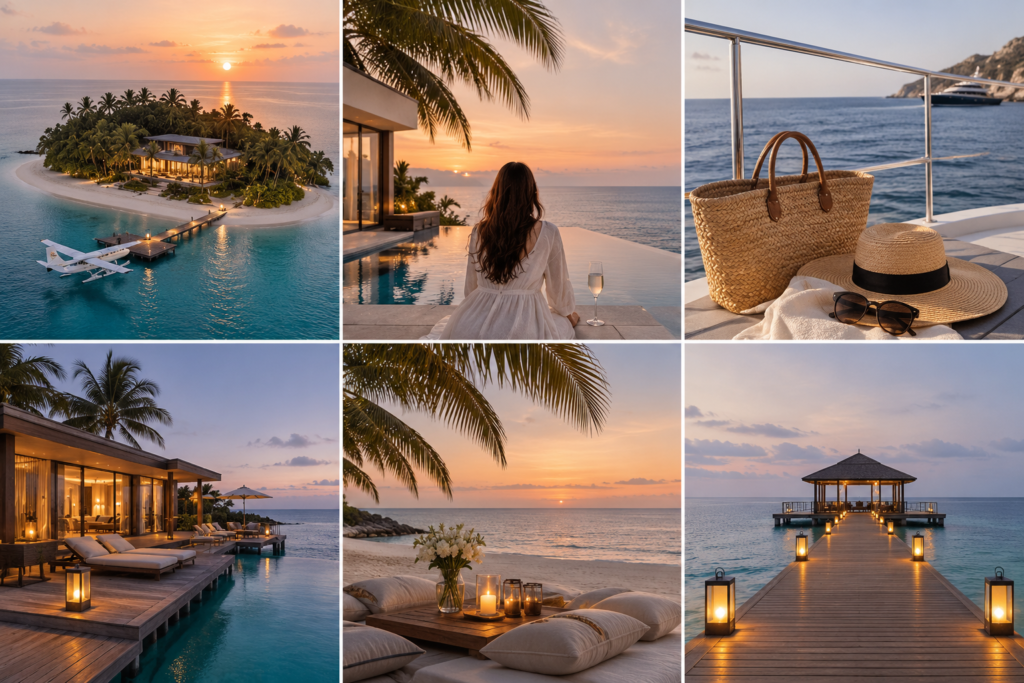
Surrounded by water and removed from the familiar geography of cities, it represents a physical boundary between public life and personal experience. The journey itself becomes part of the appeal: arriving by boat or aircraft, leaving behind crowded spaces and entering an environment shaped by a different rhythm.
But the appeal of a private island extends beyond its landscape.
It offers the possibility of controlling the conditions of one’s surroundings. The absence of immediate urban demands, the relationship between architecture and nature, and the sense of separation can create an experience that is difficult to reproduce elsewhere.
Contemporary luxury travel increasingly reflects this desire for seclusion. Private villas, remote island resorts and low-density destinations are marketed around space, discretion and the ability to disconnect from everyday life. Recent travel coverage</a> has described privacy and exclusive access as increasingly important priorities among affluent travellers.
The island, therefore, becomes more than a destination. It becomes an idea: a place where access is selective and the outside world feels less immediate.
The Architecture of Discretion
The architecture of escape is not necessarily monumental.
Its defining characteristic is often restraint. A residence positioned within a natural landscape, a secluded courtyard or a building designed around private gardens can create a sense of separation without relying on excessive scale.
Privacy can be shaped through the arrangement of spaces.
The orientation of a building determines what is visible from within and beyond. Landscaping can soften the relationship between the residence and its surroundings. Separate living areas allow individuals to move between shared experiences and solitude without interruption.
In this sense, architecture becomes an instrument of personal choice.
A well-designed private environment does not simply offer shelter or comfort. It establishes boundaries between public and private life, allowing individuals to decide how much of themselves they wish to share.
The most sophisticated spaces often communicate their value quietly. Their distinction lies not in what they reveal, but in what they allow to remain unseen.
The New Geography of Luxury
The geography of luxury is changing alongside its priorities.
Traditional luxury destinations have often relied on recognition. Their appeal comes partly from their established reputation, social visibility and association with prestigious experiences.
Privacy-oriented destinations offer a different proposition.
Remote islands, secluded coastal residences, mountain retreats and private estates provide an alternative to crowded environments and highly visible social settings. Their appeal is not necessarily the absence of other people, but the ability to determine the nature of one’s surroundings.
The modern traveller may seek a destination that allows a slower pace, fewer interruptions and greater control over personal time.
The attraction is not limited to tropical islands.
For some, it may be a countryside estate. For others, a private residence in a historic city or a remote architectural retreat.
The geography matters less than the experience it makes possible.
Privacy Is More Than Seclusion
A secluded destination does not automatically guarantee privacy.
Physical separation is only one part of a much broader idea. Social privacy concerns the people who have access to personal life. Digital privacy concerns the information generated through communication, travel and everyday activity.
These dimensions can overlap, but they are not identical.
A remote residence may provide physical solitude while remaining connected to the digital systems through which modern life operates. A discreet urban home may offer a high degree of privacy despite being surrounded by a busy city.
The distinction is important because privacy is ultimately about control.
It is the ability to decide who has access, what information is shared and when personal boundaries are respected.
Wealth can create more opportunities to establish these conditions. Yet the experience of privacy depends on more than financial resources. It also requires choices about how people organise their lives and relationships.
The Economics of Being Unreachable
Privacy has become an economic consideration within the luxury landscape.
The resources required to maintain a secluded lifestyle can include property, transportation, architecture, staffing and ongoing management. These arrangements can make privacy an expensive privilege.
Wealth can also make withdrawal more practical.
Professional responsibilities may be delegated, logistics managed by others and personal time protected from competing demands. The individual gains greater control over the circumstances in which they are available.
This does not mean that money automatically creates freedom.
A person may possess substantial resources while remaining tied to professional obligations, public expectations or personal responsibilities. The ability to purchase a secluded destination does not necessarily translate into the ability to disengage.
The distinction between possessing privacy and experiencing it remains significant.
The deeper value lies in having the freedom to use time and space according to personal priorities.
The Limits of Escape
The desire to withdraw also raises a question about influence.
For individuals whose decisions affect businesses, institutions or communities, privacy can provide valuable space for reflection. It can protect personal life and support more considered judgment.
But the same privilege can become problematic when withdrawal is used to avoid legitimate scrutiny.
Privacy and accountability are not opposing principles. An individual can protect personal boundaries while remaining responsible for public decisions and professional conduct.
The challenge is to understand where the boundary belongs.
The ability to retreat should not become an excuse to avoid responsibility. Nor should public visibility automatically eliminate the right to a private life.
The distinction matters particularly in a world where wealth and influence often attract attention beyond the individual.
A Different Definition of Luxury
The evolution of luxury suggests a shift away from the simple accumulation of possessions towards the conditions that make life more intentional.
A rare object can express taste. A grand residence can demonstrate resources. A secluded destination can offer an experience of separation.
But the deeper attraction is the freedom to decide how one’s life is organised.
It is the ability to protect personal time, choose relationships carefully and establish boundaries between public responsibility and private existence.
This is why the idea of disappearance has become so compelling.
The private island is not simply a place to escape. It represents a possibility: a life in which access is selective, attention is protected and personal freedom is treated as something worth preserving.
The last luxury is not necessarily a place where the world cannot reach you.
It is the ability to decide when the world may.